- Plants
- ›Vascular Plants
- ›flowering plants
- ›monocots
- ›Aroids, Water Plantains, Seagrass, and allies
- ›Water-Plantain family
- ›Echinodorus
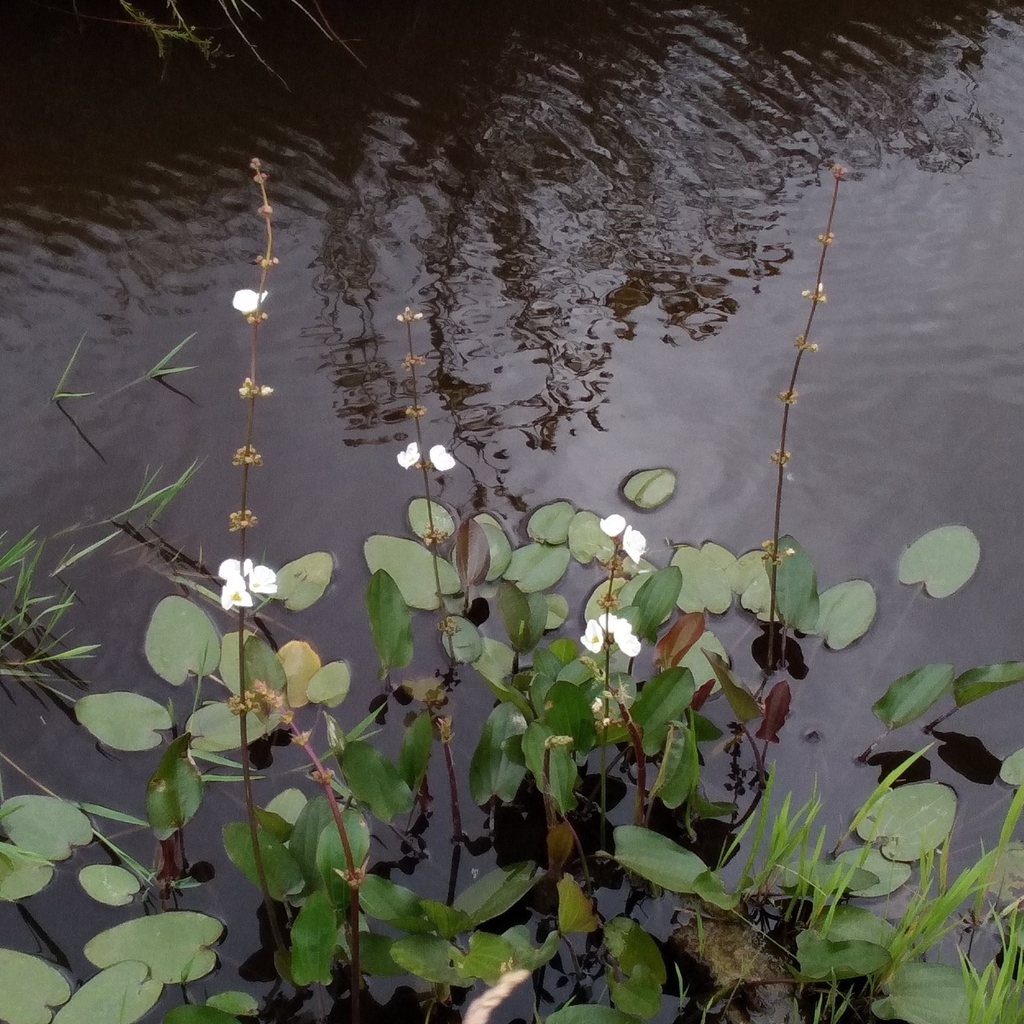
Echinodorus longiscapus
Echinodorus longiscapus is a perennial, aquatic plant of the Alismataceae, native to South America (Brazil, Paraguay, Uruguay and Argentina). It is cultivated as a pond or aquarium plant.
From the article Echinodorus longiscapus on Wikipedia (CC BY-SA), quoted section by section
Description
Leaves long-petioled, petioles 1.5 - 3 x longer than the blades. Blades oval, ovate or cordate, at the tip obtuse or shortly acuminate, at the base lobate or abrupt, 9 – 11 cm long x 7 – 8 cm wide, in the terrestrial forms often only 3 cm long x 2 cm wide. Submersed blades oval or ovate, often nearly rounded. Blades trimmed with pellucid lines to 2 mm long. Stem erect, longer than the leaves, glabrous or rarely scabrous, 30 – 80 cm long. Inflorescence racemose having 3 - 9 whorls containing 6 - 12 flowers each, proliferous. Bracts as long as the pedicels, or hardly longer, to 1.5 cm long, having 9 - 11 ribs and membraneous margins. Pedicels usually 1 - (2.5) cm long, sepals 5 – 6 mm long having 16 - 20 undistinct ribs, petals white, 1.7 – 2 cm long, corolla 2.5 – 4 cm in diameter. Stamens 20 - 25, anthers as long as the filaments, pistils numerous. Aggregate fruit globular or ovate, 5 – 7 mm in diameter. Achenes 2 - 2.3 mm long x 0.9 – 1 mm wide having usually 4 lateral ribs and (1) - 3 glands placed in a row in the upper half of the body. Beak erect or bent, 0.5 mm long.
How it is grown
Propagated by division or adventitious plantlets. Seeds germinate freely. Easy to cultivate and seems to withstand a wide range of water conditions and temperatures.
Wikipedia: “Cultivation”
Where it lives
Recorded sightings
—
geo-referenced records in GBIF, from museums, herbaria and field observers.
Drag the globe to turn it. Dots are where records exist, not a range map; darker means more records.
In the stacks
Searching the stacks…
Every page naming Echinodorus longiscapus in the Biodiversity Heritage Library →
This page is assembled live from iNaturalist, GBIF, Wikipedia, the Source Library and the Internet Archive. It is not yet part of the hand-edited codex. iNaturalist taxon 356227.