- Animals
- ›Arthropods
- ›Hexapods
- ›Insects
- ›Winged and Once-winged Insects
- ›Flies
- ›Brachyceran Flies
- ›Cyclorrhaphan Flies
- ›Schizophoran Flies
- ›Acalyptrate Flies
- ›Fruit, Signal, and Picture-winged Flies
- ›Fruit Flies
- ›Cucurbit Fruit Flies
- ›Dacini
- ›Bactrocera
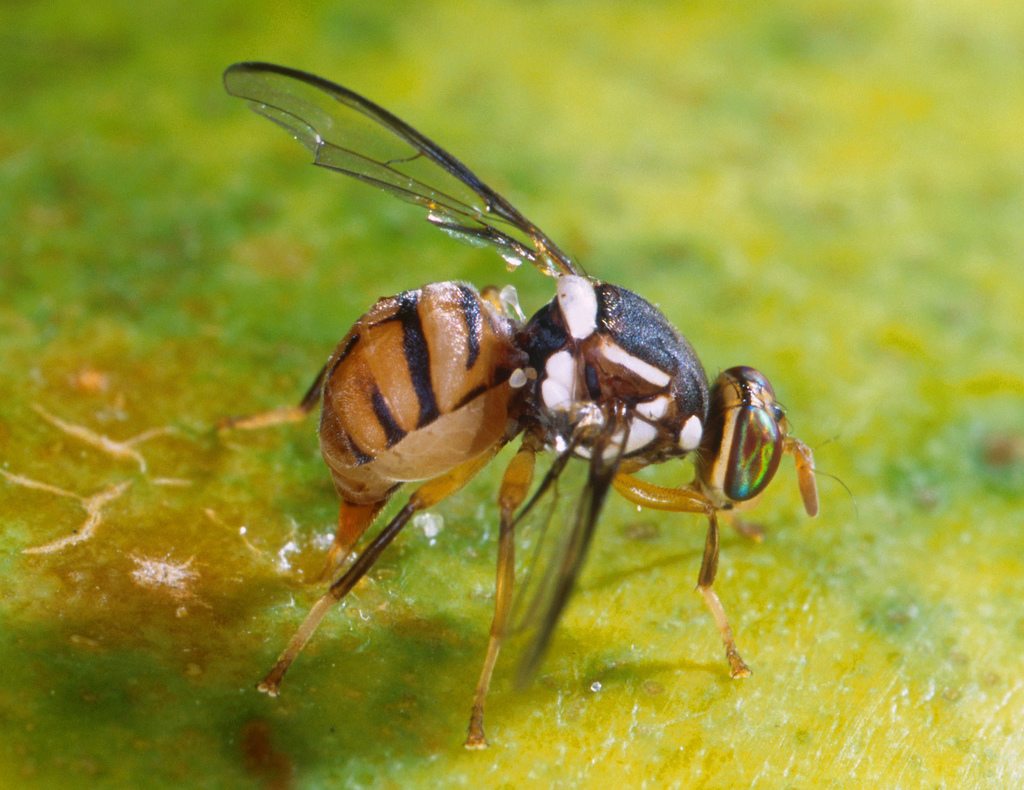
Oriental Fruit Fly
Bactrocera dorsalis
Bactrocera dorsalis, previously known as Dacus dorsalis and commonly referred to as the oriental fruit fly, is a species of tephritid fruit fly that is originally from to Southeast Asia. It is one of the major pest species in the genus Bactrocera with a broad host range of cultivated and wild fruits. Male B. dorsalis respond strongly to methyl eugenol, which is used to monitor and estimate populations, as well as to annihilate males as a form of pest control. They are also important pollinators and visitors of wild orchids, Bulbophyllum cheiri and Bulbophyllum vinaceum in Southeast Asia, which lure the flies using methyl eugenol.
The fly is similar to the closely related species B. carambolae and B. occipitalis. The species name B. dorsalis is identical to other synonyms B. papayae, B. invadens and B. philippinensis.
From the article Bactrocera dorsalis on Wikipedia (CC BY-SA), quoted section by section
Description
B. dorsalis is a species of tephritid fruit fly. Flies that belong to this family are usually small to medium-sized with colorful markings. In particular, B. dorsalis belongs to a complex of physically similar flies called the Bactrocera dorsalis complex, whose defining characteristics include a mostly black thorax and dark T-shaped marking on the fly's abdominal segment. The T-shape marking consists of a dark medial and transverse band along the fly's abdomen. The B. dorsalis species has distinctive yellow and black markings on its thorax and abdomen, which may vary between flies. Two vertical yellow markings on the thorax and the dark T-shaped marking on the abdomen differentiate this species of fly from its close relatives. The wings are clear with a continuous costal band. The adult body is around 8.0 mm in length, with wings approximately 7.3 mm in length. The female adult has a tapered ovipositor for depositing eggs in host fruits, while in male adults this ovipositor is notably absent.
Range & habitat
B. dorsalis is found in tropical and subtropical areas and is endemic to Southeast Asia. It is a highly invasive pest species. From 1910 to 1990, the fly species was only observed in 5 countries; however, in the last three decades, the rate of spread by B. dorsalis has sharply increased, with the species invading an additional 70 countries. It now has a presence in at least 65 countries. They can be found in the USA, China, the UAE, the rest of Southeast Asia, India, Brunei, Malaysia, the Philippines, The Mariana Islands, Timor Leste, Pakistan, Taiwan and the rest of South Asia. It has also been introduced to Hawaii, the Mariana Islands, and Tahiti. The fly is also found in most countries of sub-Saharan Africa. Individuals have been found and eradicated in New Zealand. B. dorsalis has been spotted in California and Florida. These appearances then trigger a cascade of eradication efforts. Four major oriental fruit fly eradication efforts occurred in response to infestations in California between 1960 and 1997. Two additional infestations were eradicated in 2006 and 2007, occurring within 3–4 years of reports of these infestations. In July 2010, flies were discovered in traps in the Sacramento and Placer counties of California. A quarantine was established, and eradication efforts followed. …
Wikipedia: “Distribution”
What it does
B. dorsalis has symbiotic relationships with many bacteria. Different bacteria dominate at different developmental stages of the fruit fly. Pseudomonadota are most often present in immature stages, whereas Bacillota are most often present in the adult stages. Overall, the most abundant families are Enterococcaceae and Comamondaceae. Meanwhile, Comamonas are extremely abundant in pupae, but disappear entirely by adulthood. Researchers have also tested the relationship between certain gut symbiotic bacteria and fly foraging behavior and nutrient ingestion. Suppression of the fly's microbiome resulted in changes in the foraging behavior in both male and female flies. Aposymbiotic flies responded faster to diets in experimental conditions and fed more, for longer periods of time.
Wikipedia: “Symbiotic relationships”
At the table
B. dorsalis has been seen in more than 200 kinds of fruit and nut plants, but the species lay eggs in mango, papaya, and avocado fruits most often. Adult flies feed on decaying fruit, plant nectar, and other substances during their lifetime and prefer to feed in the morning.
Wikipedia: “Food resources”
How it is grown
B. dorsalis is not only a highly invasive species, accidentally introduced to Hawaii from Taiwan during the 1940s in World War II, but also very destructive to crop yield for farmers of various fruits, vegetables, and nuts across the world. The larval stage of the life cycle is the most damaging to fruits because of larval feeding on the soft flesh of fruits. After ovipositing occurs by a female fly, the larvae develop under the skin of the fruit or soft tissues of the plant and begin to feed on the fruit or plant's flesh. Once feeding occurs, other microorganisms can invade the site of larval feeding and cause the fruit to decay faster. Although ripe fruits are believed to be preferred for ovipositing, unripe fruits have served as hosts for eggs as well.
Conventional pest treatment. B. dorsalis has created many agricultural issues for humans, especially in the areas where it is endemic. In the Pacific Islands, the fly has restricted the development of a diverse tropical fruit and vegetable industry, necessitated that commercial fruits go through quarantine treatment before shipment, and provided an avenue for their introduction to countries not previously exposed to the fly species. …
Wikipedia: “Agricultural pest”
In human culture
Under summer conditions, development from egg to adult requires 16 days. Several stages can be delayed in cooler conditions. B. dorsalis eggs may take up to 20 days to hatch under cool conditions, extended from the usual single day. Pupariation occurs in the soil under the host plant and is normally completed within 10–12 days, but can be delayed up to 90 days under cool conditions. Flies typically live from 1–3 months, but this can be extended to up to 12 months under cool conditions. Mated female B. dorsalis puncture the skin of mature fruit and deposit eggs in a few batches of 3–30 eggs underneath a fruit's skin via ovipositor, depending on the quality and ripeness of the fruit. Eggs usually hatch within a day, although the hatching process can be delayed in cool conditions. Females are capable of laying over 3,000 eggs during their lifetime under optimal conditions, but in field conditions, reports a typical range from about 1,200 to 1,500 eggs laid per female. Eggs hatch to larvae and moult twice (there are three larval instars) while feeding on the flesh of the fruit for about 6–35 days. Larvae are creamy white in color with a maggot-like appearance and are about 10 mm in length.
The third instar larvae exit the fruit and burrow into the soil under the host plant to pupate. Larvae generally pupate in the upper 4 cm of the soil. …
Wikipedia: “Life history”
Listen
Looking for field recordings…
Where it lives
Recorded sightings
—
geo-referenced records in GBIF, from museums, herbaria and field observers.
Drag the globe to turn it. Dots are where records exist, not a range map; darker means more records.
In the stacks
Searching the stacks…
Every page naming Bactrocera dorsalis in the Biodiversity Heritage Library →
This page is assembled live from iNaturalist, GBIF, Wikipedia, the Source Library and the Internet Archive. It is not yet part of the hand-edited codex. iNaturalist taxon 358125.