- Animals
- ›Arthropods
- ›Hexapods
- ›Insects
- ›Winged and Once-winged Insects
- ›Ants, Bees, Wasps, and Sawflies
- ›Narrow-waisted Wasps, Ants, and Bees
- ›Ants, Bees, and Stinging Wasps
- ›Vespoid Wasps
- ›Hornets, Paper Wasps, Potter Wasps, and Allies
- ›Paper Wasps
- ›Polistini
- ›Polistes
- ›Polistella
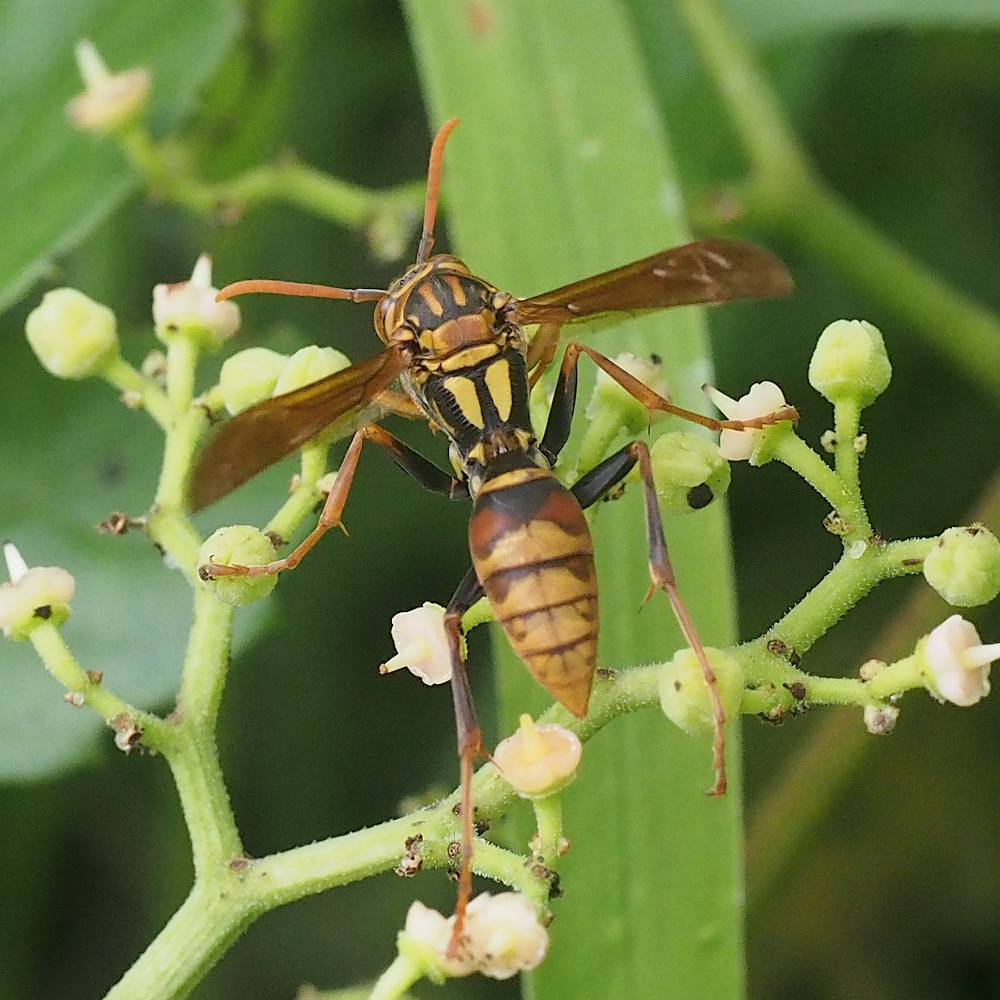
Polistes japonicus
Polistes japonicus is a eusocial paper wasp found in Japan. It was first described by Henri Louis Frédéric de Saussure in 1858. It is closely related to Polistes formosanus. This species lives in small colonies with few workers and a foundress queen. Nests of these wasps are sometimes used as a traditional medicine in Korea, China, and Japan.
From the article Polistes japonicus on Wikipedia (CC BY-SA), quoted section by section
Description
P. japonicus has a pronotum with sparse, minor punctures. In males, the anterior margin of the clypeus is rounded. The scutellum disc is slightly convex. The abdomen is yellow with brown and/or black bands. The wings are darkened with a brownish tint. There are no morphological differences between workers and new reproductive females in this species. There is a sexual dimorphism in P. japonicus, with males being larger than females. This is suggested to be a result of local mate competition between the males.
Nests. The nests are paper nests, which are generally small, open faced, 1-tiered nests. These nests can be found in lowland areas, and they usually have 40–80 cells.
Wikipedia: “Description and identification”
Range & habitat
Although the first described population of P. japonicus was found in Japan (japonicus, "of Japan") subsequently these wasps have been found to be rare in Japan, where researchers have been able to study them in central Japan. They have also been found in Vietnam, India, China, Mongolia, and Korea.
Wikipedia: “Distribution and habitat”
What it does
The dominance hierarchy is maintained by aggressive encounters in which individuals exhibit dominant behaviors such as mounting, biting or rushing. Rushing is when an individual rushes at another and pushes against it with its mandibles. A wasp will approach another more quickly when rushing than when biting. Biting is when an individual bites a part of the other wasp with its mandible. Rushing is less common than biting. Other dominance behaviors that are commonly found in other species that are not observed in this species include dominant worker buzzing its wings, stinging the subordinate and rising above the subordinate on its legs. These aggressive behaviors maintain the social dominance hierarchy and determine the reproduction sequence among workers.
Wikipedia: “Aggressive behaviors”
Listen
Looking for field recordings…
Where it lives
Recorded sightings
—
geo-referenced records in GBIF, from museums, herbaria and field observers.
Drag the globe to turn it. Dots are where records exist, not a range map; darker means more records.
In the stacks
Searching the stacks…
Every page naming Polistes japonicus in the Biodiversity Heritage Library →
This page is assembled live from iNaturalist, GBIF, Wikipedia, the Source Library and the Internet Archive. It is not yet part of the hand-edited codex. iNaturalist taxon 358406.