- Animals
- ›Arthropods
- ›Hexapods
- ›Insects
- ›Winged and Once-winged Insects
- ›Ants, Bees, Wasps, and Sawflies
- ›Sawflies, Horntails, and Wood Wasps
- ›Typical Sawflies
- ›Common Sawflies
- ›Allantinae
- ›Empriini
- ›Monostegia
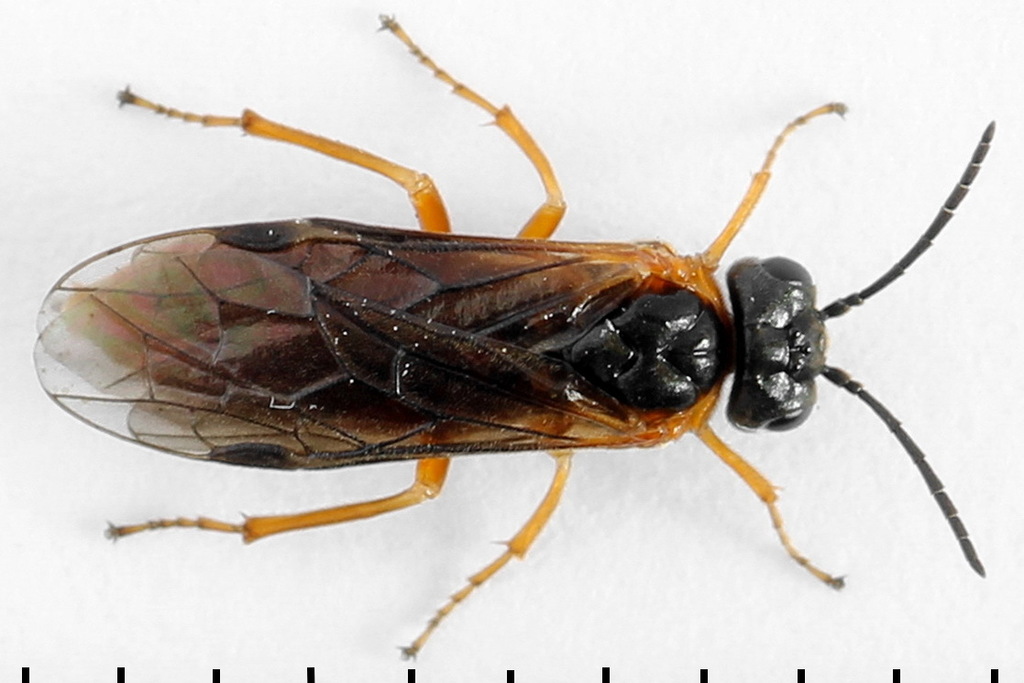
Loosestrife Sawfly
Monostegia abdominalis
Monostegia is a genus of sawfly. The authority is based on the description by Achille Costa and Oronzio Costa, although earlier work grants this to Fabricius 1798., though the most common species, M. abdominalis, bears the authority of Fabricius.
From the article Monostegia on Wikipedia (CC BY-SA), quoted section by section
Description
Adults: Head and thorax are black, with some yellow parts including mouthparts. Legs and abdomen mainly yellow, wings suffused with brown. Eggs: Smooth, white and oblong measuring 1 mm by 4 mm. Larvae: Caterpillar-like, growing from 2–4 mm to 16–21 mm. Pupae: Shorter and fatter measuring 8 mm in length, and become increasingly melanized.
Range & habitat
Distribution is holarctic, from Europe to Asia Minor and the Caucasus in the south, through to Siberia. Though it was only introduced to North America from Europe in the 1950s, where it naturalised, its range continues to expand. In 1979 its distribution in North America was from Quebec to New Jersey, and west to Ontario and Ohio, but in 2016 it was also detected as far west as Washington in the United States and from Alberta to the Maritimes in Canada.
Wikipedia: “Distribution”
What it does
Two (bivoltine) to three (multivoltine) generations per year occur, depending on the length of the summer season, with some larvae over wintering, otherwise the larvae mature in July, emerging from the soil as adults in August. Larvae that winter in the soil pupate in the spring to emerge in June. Adults are thelyotokous, females being produced from unfertilised eggs, and males are rare. The emerging female alights the underside of leaves at the top of the host plant, and contain 30–70 eggs, which they deposit over the space of about a week, and live for about a further week. the female penetrates the leaf with her ovipositor, depositing the eggs into the cavity, usually two at a time, moving from the distal leaf towards the stem, forming an egg cluster of between 6 and 16 eggs. The eggs are laid on the leaves of the host plant, and the immature larvae ( first instar) remain with the clusters of eggs for a day before dispersing and feeding on the underside of the leaves. One larva can consume a whole plant, migrating to a new plant after total defoliation. The mature larva (sixth instar) stops feeding and drops to the soil where it burrows and pupates.
Wikipedia: “Life cycle”
Listen
Looking for field recordings…
Where it lives
Recorded sightings
—
geo-referenced records in GBIF, from museums, herbaria and field observers.
Drag the globe to turn it. Dots are where records exist, not a range map; darker means more records.
In the stacks
Searching the stacks…
Every page naming Monostegia abdominalis in the Biodiversity Heritage Library →
This page is assembled live from iNaturalist, GBIF, Wikipedia, the Source Library and the Internet Archive. It is not yet part of the hand-edited codex. iNaturalist taxon 358530.