- Plants
- ›Vascular Plants
- ›flowering plants
- ›Dicots
- ›Sunflowers, Bellflowers, Fanflowers, and Allies
- ›Sunflowers, Daisies, Asters, and Allies
- ›chicories, dandelions, and allies
- ›Lettuce, Chicory, Dandelion and Salsify Tribe
- ›dandelions, hawksbeards, and rattlesnake roots
- ›Nabalus
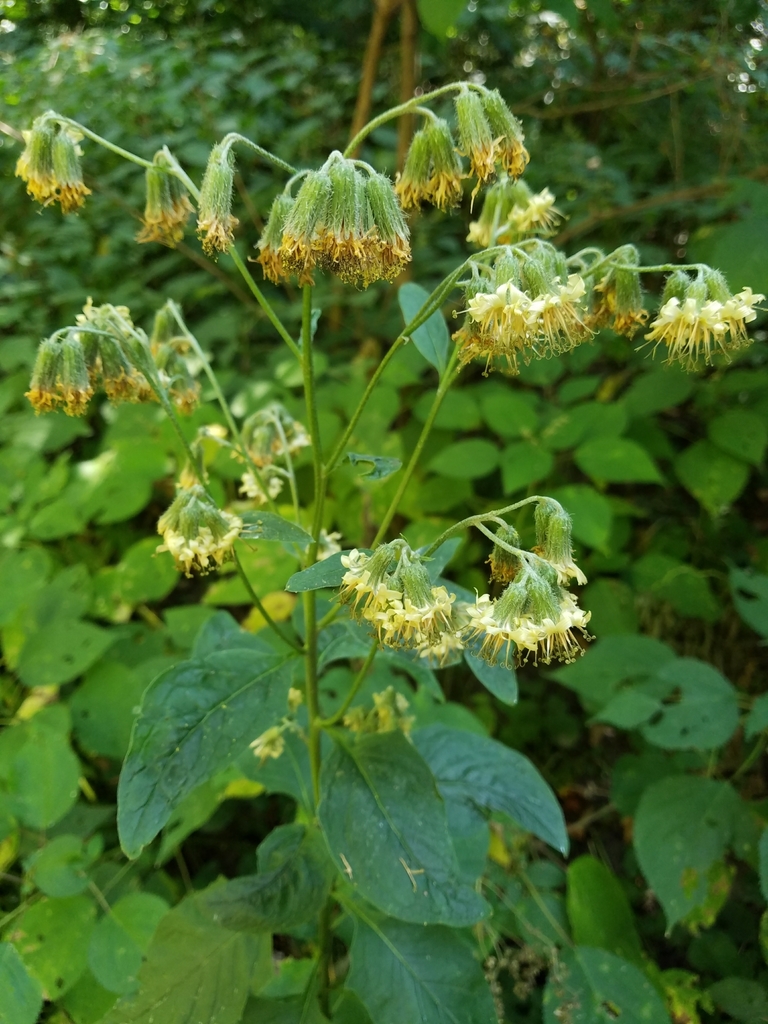
nodding rattlesnake root
Nabalus crepidineus
Nabalus crepidineus, commonly called the nodding rattlesnakeroot, is a species of flowering plant in the family Asteraceae. It is native to the United States, where it is found in the Midwest and Upland South regions. Its natural habitat is in bottomland and mesic forests, and along streambanks.
From the article Nabalus crepidineus on Wikipedia (CC BY-SA), quoted section by section
Description
It is a perennial flowering plant growing up to 3 m (9.8 ft) tall. It produces white (sometimes yellow) flowers in late summer and autumn. It is most easily seen in the spring, where it can forms large colonies of sterile basal rosettes. These rosettes are typically epehemeral, with proportionally very few persisting beyond mid-summer into the flowering period. Molecular and morphological evidence indicates that Nabalus crepidineus and its North American relatives are best treated in a separate genus from Prenanthes. This treatment became widely adopted in the 2010s.
Range & habitat
This plant occurs from western New York west to southeastern tip of Minnesota, south to Arkansas and Tennessee. Although widespread, it is considered infrequent throughout its range. In Arkansas, this species occurs in 12 counties, mostly in the Arkansas Ozarks.
== References ==
Wikipedia: “Range”
Where it lives
Recorded sightings
—
geo-referenced records in GBIF, from museums, herbaria and field observers.
Drag the globe to turn it. Dots are where records exist, not a range map; darker means more records.
In the stacks
Searching the stacks…
Every page naming Nabalus crepidineus in the Biodiversity Heritage Library →
This page is assembled live from iNaturalist, GBIF, Wikipedia, the Source Library and the Internet Archive. It is not yet part of the hand-edited codex. iNaturalist taxon 359172.