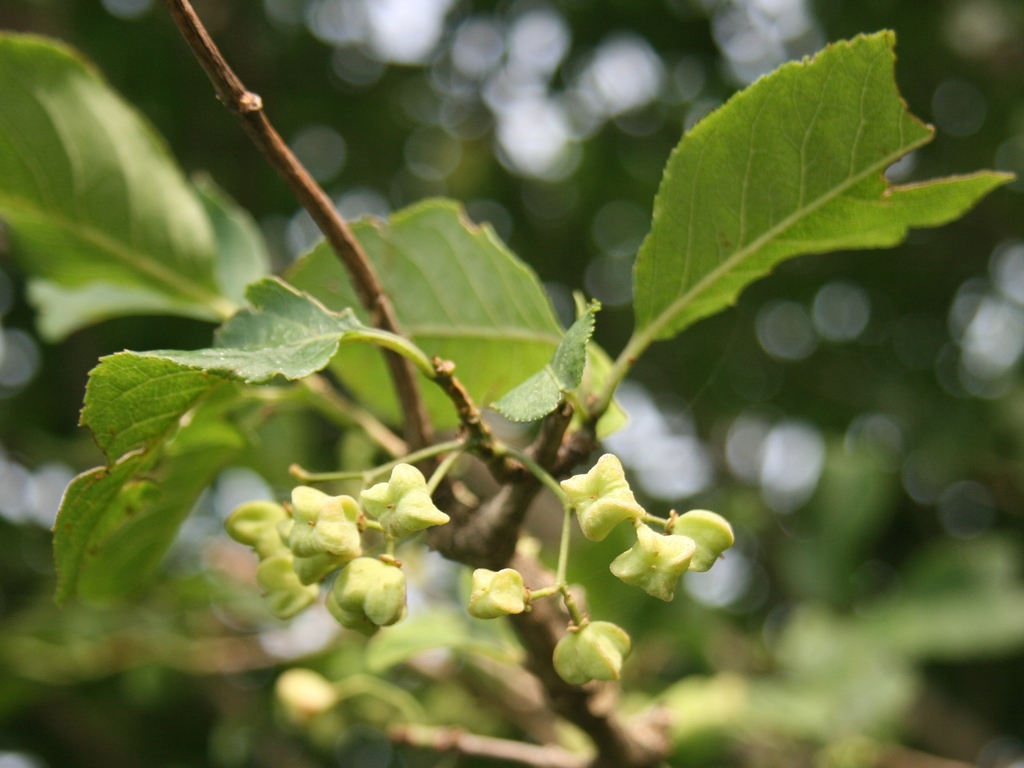
Hamilton's spindle
Euonymus hamiltonianus
Euonymus hamiltonianus, known by the common names Hamilton's spindletree, Himalayan spindle, and Siebold's spindle is a species of flowering plant in the family Celastraceae. It is native to Asia, where it is distributed in Afghanistan, Russia, China, Japan, Korea, India, Nepal, Pakistan, Bhutan, Thailand, and Myanmar. This is one of the most common Euonymus species. It is cultivated in gardens and landscapes in other parts of the world.
From the article Euonymus hamiltonianus on Wikipedia (CC BY-SA), quoted section by section
Description
In the wild, this species may grow to be a shrub of 3 meters or a tree up to 20 meters tall. The leaf blades are somewhat oval with pointed tips and measure up to 15 centimeters long. They are leathery to papery in texture with rough surfaces and slightly wavy edges. The inflorescence is a cymose cluster of several white flowers, each nearly a centimeter wide. The brown, yellowish, or reddish fruit capsule splits into four sections holding brown seeds with orange arils.
At the table
A number of novel chemical compounds have been isolated from this plant, including the coumarins euonidiol and euoniside and several triterpenes.
== References ==
Wikipedia: “Uses”
How it is grown
Like some other spindles, this plant is cultivated as an ornamental for its fall foliage, which can be many bright shades of red, pink, and yellow. The fruits and large seeds are also considered attractive. Cultivars include 'Coral Charm', which has light pink fruit capsules containing seeds with red arils, and 'Red Elf', a shrubbier breed with dark pink fruits and seeds with orange-red arils.
Wikipedia: “Cultivation”
Where it lives
Recorded sightings
—
geo-referenced records in GBIF, from museums, herbaria and field observers.
Drag the globe to turn it. Dots are where records exist, not a range map; darker means more records.
In the stacks
Searching the stacks…
Every page naming Euonymus hamiltonianus in the Biodiversity Heritage Library →
This page is assembled live from iNaturalist, GBIF, Wikipedia, the Source Library and the Internet Archive. It is not yet part of the hand-edited codex. iNaturalist taxon 359219.