- Animals
- ›Arthropods
- ›Hexapods
- ›Insects
- ›Winged and Once-winged Insects
- ›True Bugs, Hoppers, Aphids, and allies
- ›True Hoppers
- ›Spittlebugs, Cicadas, Leafhoppers and Treehoppers
- ›Cicadas
- ›Typical Cicadas
- ›Cicadinae
- ›Cicadini
- ›Hyalessa
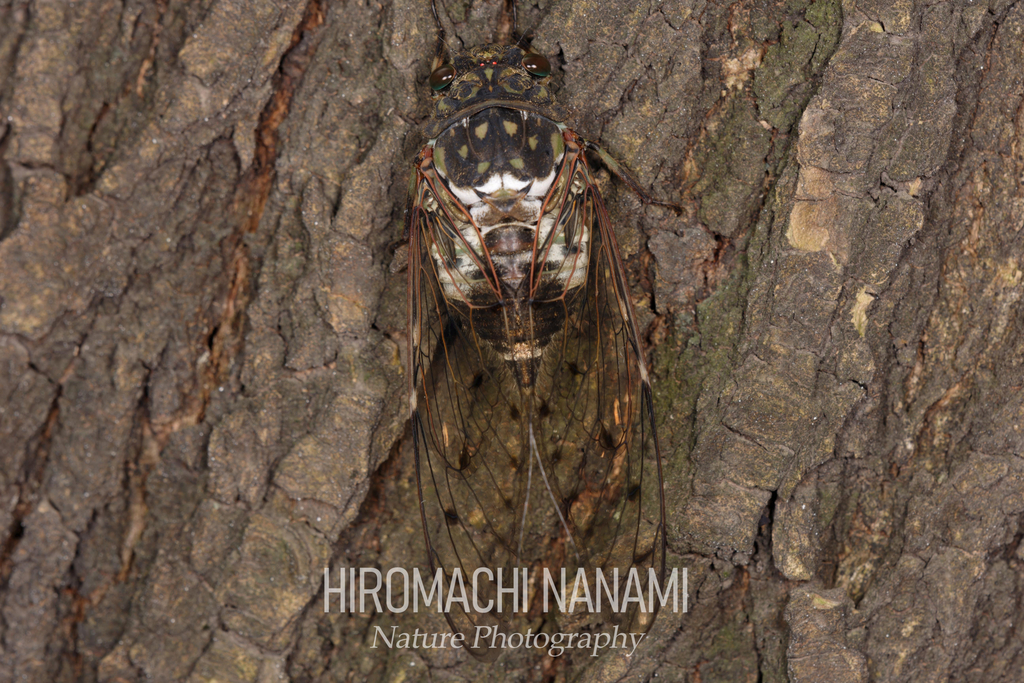
Robust Cicada
Hyalessa maculaticollis
Hyalessa maculaticollis is a species of cicada found in Northeast Asia in the order Hemiptera.
Regarding the classification, the genus of the species was changed from Hyalessa to Oncotympana because of its difference from the species found in the Philippines.
From the article Hyalessa maculaticollis on Wikipedia (CC BY-SA), quoted section by section
Description
The colour of Hyalessa maculaticollis varies between green and black depending on the location. Only the males make a calling sound, and this changes depending on the location. Japanese cicadas have a call that sounds like 'min—minminminminmi...' (Japanese: ミーンミンミンミンミンミー...). Meanwhile, the sound of Korean cicadas is like 'maemmaemmaemmaem...mi...' (Korean: 맴맴맴맴...미) and a longer note duration (maeee—mm....) is found in the latter half of the sound. The sound of this species affected the Korean word '매미' ('cicada'). Chinese cicadas sound similar to Korean cicadas. Typical adults grow up to about 33–36 mm in length. It has a narrow head and a thick and short abdomen, with an overall egg-shaped body. However, the wings are large relative to the body, and are almost the same size as the brown cicada when the wings are included. The body color is white near the boundary between the chest and abdomen, but the others have light blue or green spots on a black background, and the body color is relatively bright for a Japanese cicada. There are also individuals with almost no black spots and mainly bluish green, and these are called mikadominmin (ミカドミンミン). …
Range & habitat
Hyalessa maculaticollis is found in China, Japan, the Korean Peninsula and maritime areas of Russia. Individuals in Korea, Eastern China and Far East Russia were considered to be Hyalessa fuscata (Distant, 1905) but recent taxonomic data shows H. fuscata is a synonym of H. maculaticollis. In Japan, they are distributed from the Oshima Peninsula in southern Hokkaido to Honshu, Kyushu, and their surrounding islands (Tsushima, Koshiki Islands). Their distribution is limited by the cold northern climates and have forced them to migrate to middle and southern areas of Japan. However there are some isolated habitats that can presumably survive in Hokkaido's cold climates due to the region's prevalence of high geothermal heat such as hot springs and volcanic activity. These areas include Jozankei Onsen (Sapporo City) and the Wakoto Peninsula in Eastern Hokkaido. According to local researchers, nymphs of Hyalessa maculaticollis found in northern regions do not climb trees and instead emerge on a type of bamboo species, Kuma Bamboo Grass. In eastern Japan, it inhabits flat forests and is often found in urban green areas, whereas in western Japan they prefer mountainous areas with slightly higher altitudes. On the Asian continent, it inhabits northern China and Korea, and is found mostly in urban areas. …
Wikipedia: “Distribution”
Listen
Looking for field recordings…
Where it lives
Recorded sightings
—
geo-referenced records in GBIF, from museums, herbaria and field observers.
Drag the globe to turn it. Dots are where records exist, not a range map; darker means more records.
In the stacks
Searching the stacks…
Every page naming Hyalessa maculaticollis in the Biodiversity Heritage Library →
This page is assembled live from iNaturalist, GBIF, Wikipedia, the Source Library and the Internet Archive. It is not yet part of the hand-edited codex. iNaturalist taxon 359390.