- Animals
- ›Arthropods
- ›Hexapods
- ›Insects
- ›Winged and Once-winged Insects
- ›True Bugs, Hoppers, Aphids, and allies
- ›True Bugs
- ›Cimicomorph Bugs
- ›Miroidea
- ›Plant Bugs
- ›Bryocorinae
- ›Eccritotarsini
- ›Campyloneura
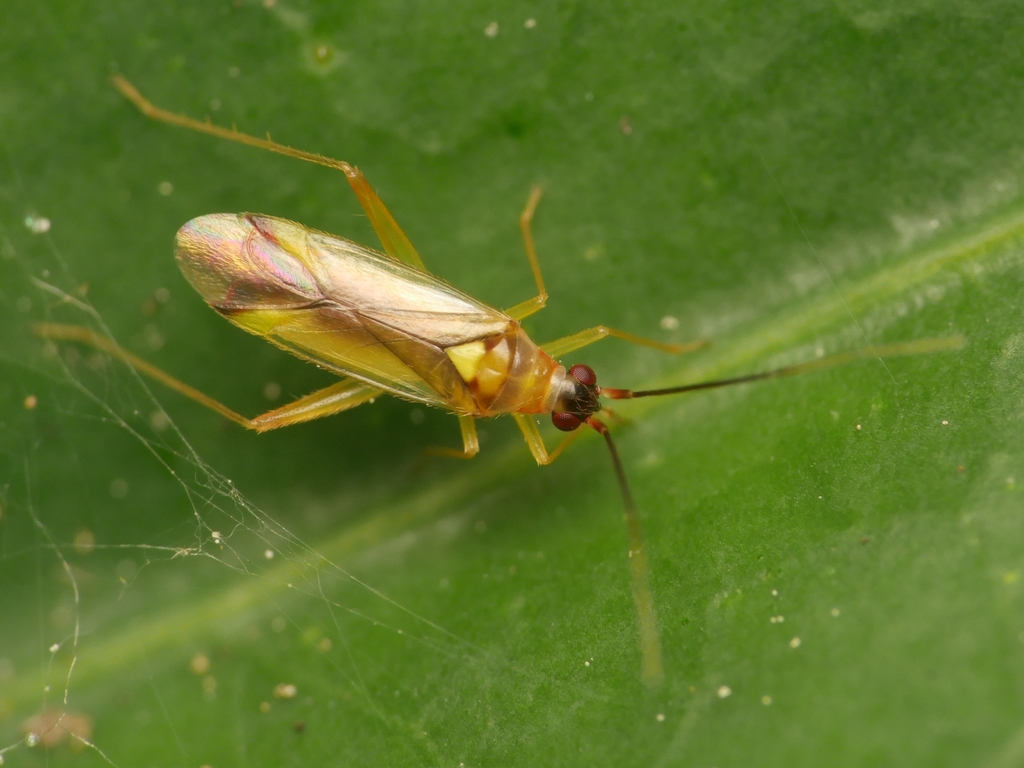
Campyloneura virgula
Campyloneura virgula is a species of bugs in Miridae family. It is the only species in the genus Campyloneura Fieber, 1861.
From the article Campyloneura on Wikipedia (CC BY-SA), quoted section by section
Description
Campyloneura virgula can reach a length of 4–5 millimetres (0.16–0.20 in). Adults have pale translucent hemelytra, a red stripe on the edge of a pale green pronotum, a yellow scutellum, a black head, long red-banded antennae and bright yellow cuneus that are tipped with dark red. Legs are pale yellow. Nymphs are yellow, with a red stripe on the edge of the pronotum.
Range & habitat
This species is widespread in the Nearctic realm, in Europe and in the Mediterranean area up to Turkestan. It has been introduced in the United States of America.
Wikipedia: “Distribution”
What it does
This common predatory bug hunts for small insects, as aphids and red mites. Adults' flight time is from June to October during which they could be found on numerous deciduous trees, including hazel, hawthorn and oak. The adults overwinter and nymphs appear in May. The peculiarity of this bug is that in almost all of its range males are extremely rare, as C. virgula reproduces without mating (parthenogenesis). This characteristic has an exception in Sicily and in North Africa, where the males are commonly present and the species has a normal sexual reproduction.
Wikipedia: “Biology and ecology”
Listen
Looking for field recordings…
Where it lives
Recorded sightings
—
geo-referenced records in GBIF, from museums, herbaria and field observers.
Drag the globe to turn it. Dots are where records exist, not a range map; darker means more records.
In the stacks
Searching the stacks…
Every page naming Campyloneura virgula in the Biodiversity Heritage Library →
This page is assembled live from iNaturalist, GBIF, Wikipedia, the Source Library and the Internet Archive. It is not yet part of the hand-edited codex. iNaturalist taxon 360042.