- Plants
- ›Vascular Plants
- ›flowering plants
- ›Dicots
- ›Mints, Plantains, Olives, and Allies
- ›Mint Family
- ›Nepetoideae
- ›Ocimeae
- ›Ociminae
- ›Ocimum
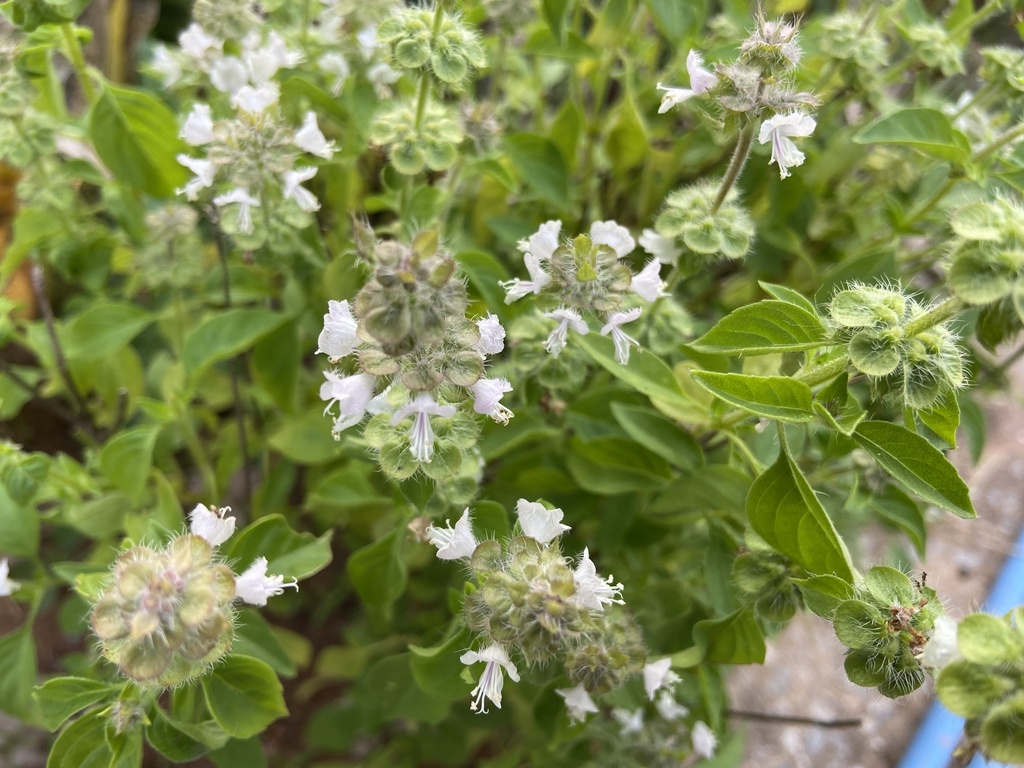
Lemon Basil
Ocimum × africanum
Lemon basil, hoary basil, Thai lemon basil, or Lao basil, (Ocimum × africanum) is a hybrid between basil (Ocimum basilicum) and American basil (Ocimum americanum). The herb is grown primarily in northeastern Africa and southern Asia for its fragrant lemon scent, and is used in cooking.
Lemon basil stems can grow to 20–40 cm (8–20 in) tall. It has white flowers in late summer to early fall. The leaves are similar to basil leaves, but tend to be narrower with slightly serrated edges. Seeds form on the plant after flowering and dry on the plant.
From the article Lemon basil on Wikipedia (CC BY-SA), quoted section by section
At the table
In Lao cuisine, (where it is called pak i tou,) lemon basil is used extensively in soups, stews, curries and stir-fried dishes as it is the most commonly used type of basil in Laos. Many Lao stews require the use of lemon basil as no other basil varieties are acceptable as substitutes. The most popular Lao stew called or lam uses lemon basil as a key ingredient. Lemon basil is used much in Indonesian cuisine, where it is called kemangi. It is often eaten raw with salad or lalap (raw vegetables) and accompanied by sambal. Lemon basil is often used to season certain Indonesian dishes, such as curries, soup, stew and steamed or grilled dishes. In Thailand, Lemon basil, called maenglak (Thai: แมงลัก), is one of several types of basil used in Thai cuisine. The leaves are used in certain Thai curries and it is also indispensable for the noodle dish khanom chin nam ya. In the Philippines, where it is called sangig, particularly in Cebu and parts of Mindanao, Lemon basil is used to add flavor to law-uy, which is an assortment of local greens in a vegetable-based soup. The seeds resemble chia seeds after they have been soaked in water and are used in sweet desserts. It is also used in North East part of India state Manipur. In Manipur, it is used in curry like pumpkin, used in singju (a form of salad), and in red or green chilli pickles. …
Wikipedia: “Culinary”
How it is grown
Lemon basil requires the same care as other basil varieties. It is a tropical plant, that should be in a spot receiving at least six hours of direct sunlight a day. It is actually quite hardy and can sometimes grow continuously given only water, but the flavor will be at risk if not given any fertilizer, chemical or organic. It can really grow in a matter of weeks. It should be watered whenever the topmost part of the soil is dry. At this time, the plant will wilt, but will be back to normal once watered. Basil should never reach flowering during the harvesting periods. If given a chance to flower, its flavor will be sacrificed and the leaves become smaller, dry and leathery. Once the flower clusters form, they should be removed so the plant will continue its vegetative growth. It is, however, a good idea for it to be left to flower and set seeds that will be collected during fall, because the cold winter frosts will kill the basil plant anyway. Harvesting the seeds two weeks before the last frost, and sowing them indoors in the spring will provide next year's harvest. Harvesting once a week for each plant will make it bushy due to the side shoots that will develop. The plant should never be completely defoliated. Propagation is achieved by sowing seeds and from stem cuttings. …
Wikipedia: “Cultivation”
Where it lives
Recorded sightings
—
geo-referenced records in GBIF, from museums, herbaria and field observers.
Drag the globe to turn it. Dots are where records exist, not a range map; darker means more records.
In the stacks
Searching the stacks…
Every page naming Ocimum × africanum in the Biodiversity Heritage Library →
This page is assembled live from iNaturalist, GBIF, Wikipedia, the Source Library and the Internet Archive. It is not yet part of the hand-edited codex. iNaturalist taxon 360190.