- Plants
- ›Vascular Plants
- ›flowering plants
- ›monocots
- ›Agaves, Orchids, Irises, and Allies
- ›iris family
- ›Crocoideae
- ›Ixieae
- ›Freesiinae
- ›Crocosmia
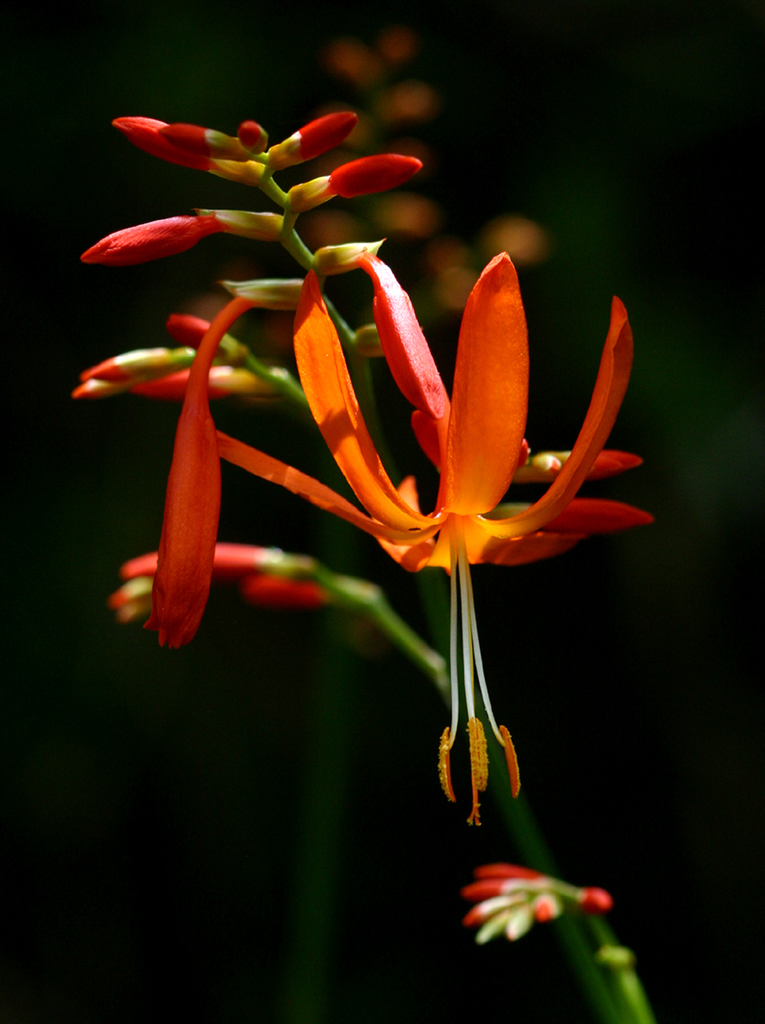
Falling Stars
Crocosmia aurea
Crocosmia aurea, common names falling stars, Valentine flower, or montbretia, is a perennial flowering plant belonging to the family Iridaceae.
From the article Crocosmia aurea on Wikipedia (CC BY-SA), quoted section by section
Description
Crocosmia aurea reaches on average 120 centimetres (47 in) in height. It grows from basal underground corms with long stolons. The basal, alternate leaves are cauline, linear, with a distinct midvein and entire margins, about 20–30 millimetres (0.79–1.18 in) wide. At the end of the flower stalk they have colourful branched inflorescences of bright orange to red flowers, reaching on average 40 millimetres (1.6 in) in diameter. The flowering period extends from June through August. The fruit is a capsule, with small blackish and round seeds. The plant can also be propagated by dividing the clumps of corms, fleshy underground stems similar to bulbs.
Range & habitat
Crocosmia aurea is widely distributed in southern and eastern Africa, from South Africa to Sudan. In South Africa it is common in the grasslands of the Cape Floristic Region.
Wikipedia: “Distribution”
In human culture
The genus name is derived from the Greek words krokos, meaning "saffron", and osme, meaning "odor", as dried leaves of these plants, when immersed in hot water, emit a strong smell similar to saffron. The species Latin name aurea, meaning “golden”, refers to the bright colour of the flowers.
Wikipedia: “Etymology”
Where it lives
Recorded sightings
—
geo-referenced records in GBIF, from museums, herbaria and field observers.
Drag the globe to turn it. Dots are where records exist, not a range map; darker means more records.
In the stacks
Searching the stacks…
Every page naming Crocosmia aurea in the Biodiversity Heritage Library →
This page is assembled live from iNaturalist, GBIF, Wikipedia, the Source Library and the Internet Archive. It is not yet part of the hand-edited codex. iNaturalist taxon 361354.