- Animals
- ›Arthropods
- ›Hexapods
- ›Insects
- ›Winged and Once-winged Insects
- ›Beetles
- ›Water, Rove, Scarab, Long-horned, Leaf, and Snout Beetles
- ›Scarabaeiform Beetles
- ›Scarabs, Stag Beetles, and Allies
- ›Stag Beetles
- ›Lucaninae
- ›Lucanini
- ›Dorcus
- ›Dynodorcus
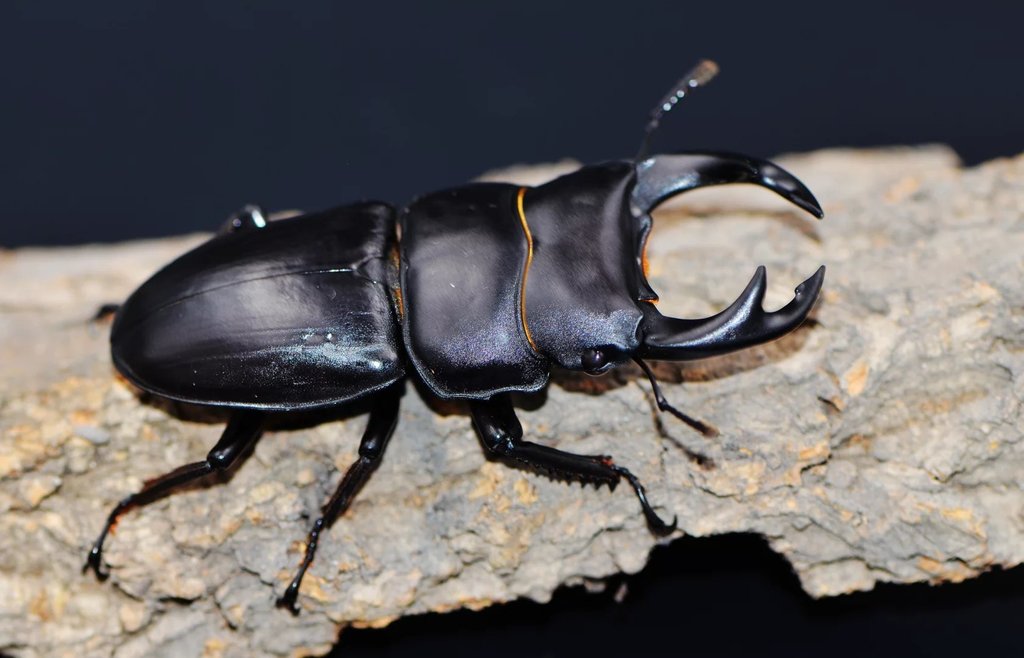
Hope's Stag Beetle
Dorcus hopei
Dorcus hopei is a beetle in the family Lucanidae.
From the article Dorcus hopei on Wikipedia (CC BY-SA), quoted section by section
What it does
The life history of Dorcus hopei is fairly similar to that of all beetles in the Lucanidae family. D. hopei are often in their larval state for around one to two years. D. hopei eggs are laid in decaying wood logs in forests of China, Korea, and Japan. The larvae feed on the decaying wood by utilizing a species of yeast, Pichia, that breaks down the xylose of the rotting wood. The larval stage is unique for its ability to survive the harsh winters of its native range, capable of surviving in temperatures as low as -15°C for 24 hours. This is due to their unique antifreeze proteins, a protein not found in any of their relative Lucanidae and very few insects in general. Because of their native range, the D. hopei has developed to overwinter the icy seasons in Japan, Korea, and China. The adults live for around three to five years, often on the grounds of forests. Studies have shown that the males and females often act differently from one another, often as a result of their sexual dimorphism. The males have different mandible sizes, a common trait amongst stag beetles and often use them depending on the size of them, with larger mandibled males using them for control over reproduction territories and food. D. hopei have become a popular insect in Japan and Korea. They are commonly kept as pets due to their distinct mandibles and their ease of cultivation. …
Wikipedia: “Ecology”
Listen
Looking for field recordings…
Where it lives
Recorded sightings
—
geo-referenced records in GBIF, from museums, herbaria and field observers.
Drag the globe to turn it. Dots are where records exist, not a range map; darker means more records.
In the stacks
Searching the stacks…
Every page naming Dorcus hopei in the Biodiversity Heritage Library →
This page is assembled live from iNaturalist, GBIF, Wikipedia, the Source Library and the Internet Archive. It is not yet part of the hand-edited codex. iNaturalist taxon 361707.