- Plants
- ›Vascular Plants
- ›flowering plants
- ›Dicots
- ›proteas, lotuses, planes, and allies
- ›Protea family
- ›Paired Proteas
- ›Banksieae
- ›Banksiinae
- ›Banksia
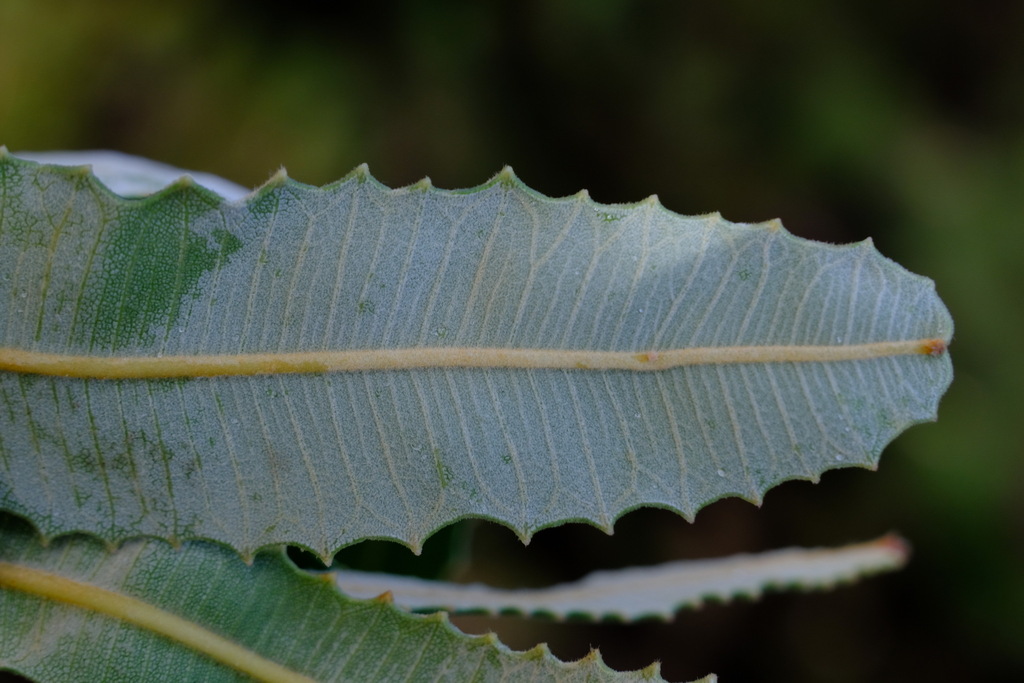
Firewood Banksia
Banksia menziesii
Banksia menziesii, commonly known as firewood banksia, is a species of flowering plant in the family Proteaceae. It is a gnarled tree up to 10 m (33 ft) tall, or a lower spreading 1–3 m (3.3–9.8 ft) shrub in the more northern parts of its range. The serrated leaves are dull green with new growth a paler grey green. The prominent autumn and winter inflorescences are often two-coloured red or pink and yellow, and their colour has given rise to more unusual common names such as port wine banksia and strawberry banksia. Yellow blooms are rarely seen.
First described by the botanist Robert Brown in the early 19th century, no separate varieties of Banksia menziesii are recognised. It is found in Western Australia, from the Perth (32° S) region north to the Murchison River (27° S), and generally grows on sandy soils, in scrubland or low woodland. Banksia menziesii provides food for a wide array of invertebrate and vertebrate animals; birds and in particular honeyeaters are prominent visitors. A relatively hardy plant, Banksia menziesii is commonly seen in gardens, nature strips and parks in Australian urban areas with Mediterranean climates, but its sensitivity to dieback from the soil-borne water mould Phytophthora cinnamomi makes it short-lived in places with humid summers, such as Sydney. Banksia menziesii is widely used in the cut flower industry both in Australia and overseas.
From the article Banksia menziesii on Wikipedia (CC BY-SA), quoted section by section
Description
Banksia menziesii grows either as a gnarled tree to 10 m (33 ft), or a lower spreading 1–3 metres (3.3–9.8 ft) shrub, generally encountered at its northern limits in the vicinity of Eneabba-Mount Adams; thus, it declines steadily in size as the climate becomes warmer and drier further north. In the shrub form, several stems arise from the woody base known as the lignotuber. The trunk is greyish, sometimes with shades of brown or pink, and the 2–3 cm (0.8–1.2 in) thick rough bark breaks away easily. The new growth is covered in fine brownish hair, which wears away after two or three years, leaving smooth stems and leaves. Stems that will bear flower spikes the following year are generally thicker and longer. Oblong in shape and somewhat truncate at the tips, the leaves are grey-green in colour, 8–25 cm (3.1–9.8 in) long and up to 4 cm (1.6 in) wide. The new leaves are paler and finely downy. The leaf margins are serrated with many small 1–2 mm long triangular teeth. The lower surface of the leaf has a midrib covered in fine pale brown hair.
Flowering occurs in autumn and winter, peaking from May to July. Overall the inflorescences, or flower spikes, take around eight months to fully develop from the first microscopic changes in late spring. Ovoid to cylindrical in shape, the flower spikes can be up to 7–8 cm (2.8–3.1 in) wide and 4–12 cm (1.6–4.7 in) high. …
Range & habitat
Banksia menziesii grows primarily in deep sandy soils of the Swan Coastal Plain and Geraldton Sandplains, extending from Waroona in the south to Kalbarri in the north. However, it is uncommon south of Mandurah. It is generally limited to the east by the heavy soils of the Darling Scarp, but does grow on isolated patches of sand in the Jarrah Forest and Avon Wheatbelt regions, such as occur near Beverley, Toodyay and Wongan Hills. The easternmost known occurrence is a specimen collected by Roger Hnatiuk in 1979 from north-east of Brookton, about 125 km (78 mi) from the coast. Much of its range on the Swan Coastal Plain coincides with Perth's expanding metropolitan area, and much habitat has been lost to clearing. Together with B. attenuata (candlestick banksia), B. menziesii is a dominant component in a number of widespread vegetation complexes of the Swan Coastal Plain, including Banksia low woodland and Jarrah-Banksia woodland. These complexes only occur on deep, well-draining sand; in shallower, seasonally wet soils, B. menziesii and B. attenuata give way to other Banksia species, such as B. littoralis (swamp banksia) or B. telmatiaea (swamp fox banksia). On the Geraldton Sandplains to the north, B. menziesii usually occurs as a shrub or small tree emergent above low heath.
Wikipedia: “Distribution and habitat”
What it does
Like many members of the family Proteaceae, Banksia menziesii is largely self-incompatible; that is, inflorescences require pollinators to be fertilised and produce seed. One mechanism by which the species promotes cross-pollination with other plants is protandry, whereby the male parts release pollen that becomes non-viable before the female parts become receptive on the same flower spike. The individual flowers are uniform, and it is unclear why so few go on to develop follicles. Published in 1988, a field study conducted in banksia woodland near Perth noted that anthesis occurred on an inflorescence at an average rate of 40 to 60 florets opening per day, although this varied widely between different flowerheads. Foraging by honeyeaters would cause the florets to open, but bees would not. Banksia menziesii provides an important food source, as flowers and seeds, for the threatened short-billed black cockatoo (Zanda latirostris). Other bird species that have been observed feeding on B. menziesii include the red-capped parrot (Purpureicephalus spurius), western rosella (Platycercus icterotis), red-tailed black cockatoo (Calyptorhynchus banksii), Australian ringneck (Barnardius zonarius), western gerygone (Gerygone fusca) and several honeyeater species, the New Holland honeyeater (Phylidonyris novaehollandiae), white-cheeked honeyeater (P. …
Wikipedia: “Ecology”
How it is grown
Banksia menziesii has several horticultural features including patterned buds and follicles, attractive pinkish new growth, and showy flowerheads. A dwarf form is commonly sold in nurseries. Byron Lamont has observed that dwarf plants may grow into taller single-trunked plants in cultivation. The plant is fairly easy to grow in a Mediterranean climate with good drainage and a light (sandy) soil. However, with medium to high susceptibility to Phytophthora cinnamomi dieback, it is unreliable in conditions that favour the growth of the soil-borne water mould, such as summer humidity or poor drainage. The use of phosphite fungicides does reduce the spread of Phytophthora. It generally does poorly in eastern Australia, although it is grown commercially in southeastern South Australia as a cut flower crop. It is also grown in California and Hawaii. Seeds do not require any treatment prior to planting, and take 26 to 40 days to germinate. Seeds that grow into yellow-flowered plants are pale and unpigmented, while future bronze- and red-flowered plants are dark greyish and black respectively. It generally takes about five to seven years to flower from seed. The plant favours sandy well-drained soils and a sunny position and can be heavily pruned if necessary, as new growth can arise from the lignotuber. …
Wikipedia: “Cultivation”
In human culture
Specimens of B. menziesii were first collected by the botanist Charles Fraser during Captain (later Admiral Sir) James Stirling's March 1827 exploration of the Swan River. The following year, Alexander Macleay sent some of Fraser's specimens to Robert Brown. Brown formally published the species in his 1830 Supplementum Primum Prodromi Florae Novae Hollandiae, giving it the specific epithet in honor of Archibald Menzies, surgeon-naturalist on HMS Discovery under George Vancouver, who discovered King George Sound in 1791. Thus the species' full name is Banksia menziesii R.Br. Neither Brown nor Menzies ever saw the plant growing. Under Brown's taxonomic arrangement, B. menziesii was placed in subgenus Banksia verae, the "True Banksias", because its inflorescence is a typical Banksia flower spike. Banksia verae was renamed Eubanksia by Stephan Endlicher in 1847, and demoted to sectional rank by Carl Meissner in his 1856 classification. Meissner further divided Eubanksia into four series, with B. menziesii placed in series Salicinae. When George Bentham published his 1870 arrangement in Flora Australiensis, he discarded Meissner's series, replacing them with four sections. B. menziesii was placed in Orthostylis, a somewhat heterogeneous section containing 18 species. …
Wikipedia: “History”
Where it lives
Recorded sightings
—
geo-referenced records in GBIF, from museums, herbaria and field observers.
Drag the globe to turn it. Dots are where records exist, not a range map; darker means more records.
In the stacks
Searching the stacks…
Every page naming Banksia menziesii in the Biodiversity Heritage Library →
This page is assembled live from iNaturalist, GBIF, Wikipedia, the Source Library and the Internet Archive. It is not yet part of the hand-edited codex. iNaturalist taxon 361848.