- Animals
- ›Arthropods
- ›Crustaceans
- ›Typical Crustaceans
- ›Malacostracans
- ›Decapods, Isopods, and allies
- ›Decapods and Krill
- ›Decapods
- ›Crabs, Lobsters, Shrimps, and Allies
- ›True Crabs
- ›Eubrachyuran Crabs
- ›Thoracotrematan Crabs
- ›Ghost, Fiddler, Sand Bubbler Crabs and Allies
- ›Ghost and Fiddler Crabs
- ›Ghost Crabs
- ›Ocypode
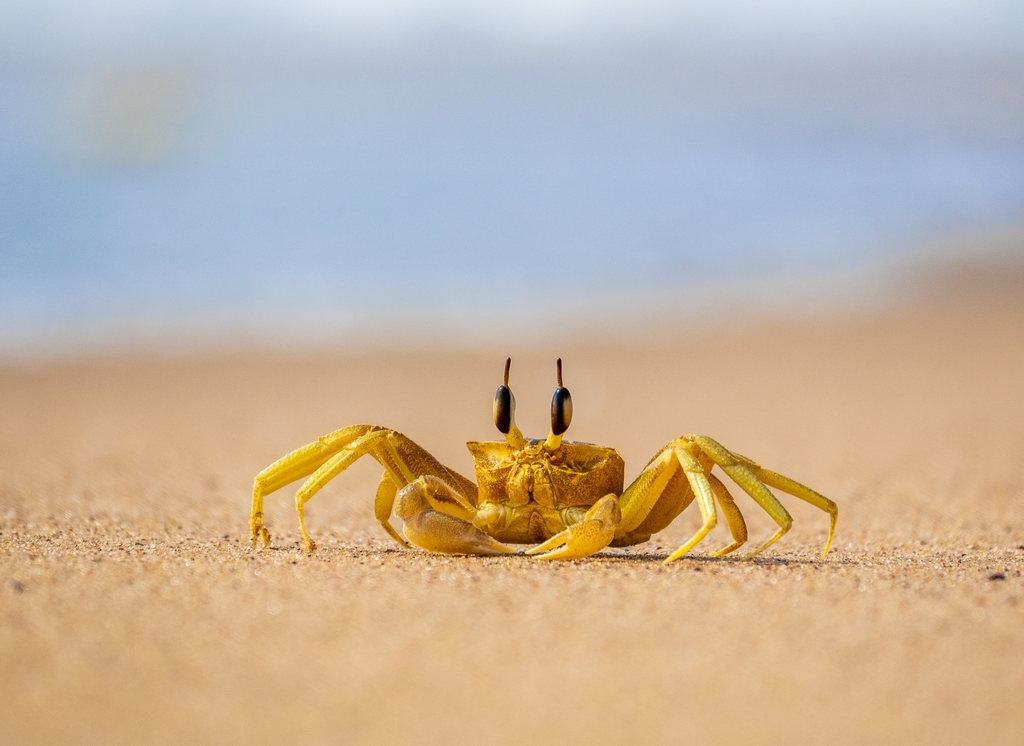
Horn-eyed Ghost Crab
Ocypode brevicornis
Ocypode brevicornis is a species of ghost crab native to the Indian Ocean, from the Gulf of Oman to the Nicobar Islands. They are relatively large ghost crabs with a somewhat trapezoidal body. The carapace reaches a length of 41 mm (1.6 in) and a width of 50 mm (2.0 in). They are a mottled brown to yellow in coloration. Like other ghost crabs, one of their claws is much larger than the other. Their eyestalks are large and elongated, tipped with prolongations at the tip known as styles. They are common inhabitants of open sandy beaches, living in burrows in the intertidal zone.
From the article Ocypode brevicornis on Wikipedia (CC BY-SA), quoted section by section
Description
Ocypode brevicornis are large ghost crabs with deep bodies. The carapace in adults ranges from 24 to 41 mm (0.94 to 1.61 in) in length, and 26 to 50 mm (1.0 to 2.0 in) in width. It is almost trapezoidal in shape, with the rear end distinctly narrower than the front. It is wider than it is long and covered with scattered rough bumps (tubercles). The upper margins of the eye sockets slant forwards on the inner half and backwards for the outer half. The edges of the eye sockets are rectangular.
The eyestalks are large and swollen with the cornea occupying most of the bottom half. The eyestalks exhibit prolongations (styles) on the tips like some other members of the genus. The styles may be absent or much shorter in juvenile specimens, as it only starts growing when the crab is around 12 mm (0.47 in) in length.
Like other ghost crabs, one of the claw appendages (chelipeds, the first pereiopod pair) of Ocypode brevicornis is much bigger than the other. The palm of the larger cheliped is long with a rough bumpy texture on the upper surface. The upper edges of the palm are covered with small bumps while the bottom edge is serrated. The inner surface of the palm of the larger claw in both sexes features stridulating (sound-producing) ridges, which is important for identifying different species within the subfamily Ocypodinae. …
Range & habitat
Ocypode brevicornis are restricted to the Indian Ocean. They can be found from the Gulf of Oman to India, Sri Lanka, and the Nicobar Islands. They are one of six ghost crab species found in the Indian subcontinent, the others being Ocypode ceratophthalma, Ocypode cordimanus, Ocypode macrocera, Ocypode pallidula, and Ocypode rotundata.
Wikipedia: “Distribution”
What it does
Like other ghost crabs, Ocypode brevicornis live in deep burrows near the intertidal zone of open sandy beaches. They are generalists, scavenging carrion and debris as well as preying on small animals. They are primarily nocturnal, though they may emerge during the day. They are swift runners, darting away to their burrows at the slightest sign of danger, even when the intruder sighted is still 30 ft (9.1 m) away. However, they can be approached much more closely at night, though they may still try to escape if illuminated. Males of Ocypode brevicornis exhibit elaborate territorial displays. Like other ghost crabs, they produce sound and vibration by rapping their larger claws against the ground. They may also display "dances" on the approach of another ghost crab. Beginning with a rearing posture, the males conduct increasingly complex sideways movements ending by running around the intruder in circles until it retreats.
Wikipedia: “Ecology”
Where it lives
Recorded sightings
—
geo-referenced records in GBIF, from museums, herbaria and field observers.
Drag the globe to turn it. Dots are where records exist, not a range map; darker means more records.
In the stacks
Searching the stacks…
Every page naming Ocypode brevicornis in the Biodiversity Heritage Library →
This page is assembled live from iNaturalist, GBIF, Wikipedia, the Source Library and the Internet Archive. It is not yet part of the hand-edited codex. iNaturalist taxon 361850.