- Plants
- ›Vascular Plants
- ›flowering plants
- ›Dicots
- ›Heathers, Balsams, Primroses, and Allies
- ›sapodilla family
- ›Sideroxylon
white milkwood
Sideroxylon inerme
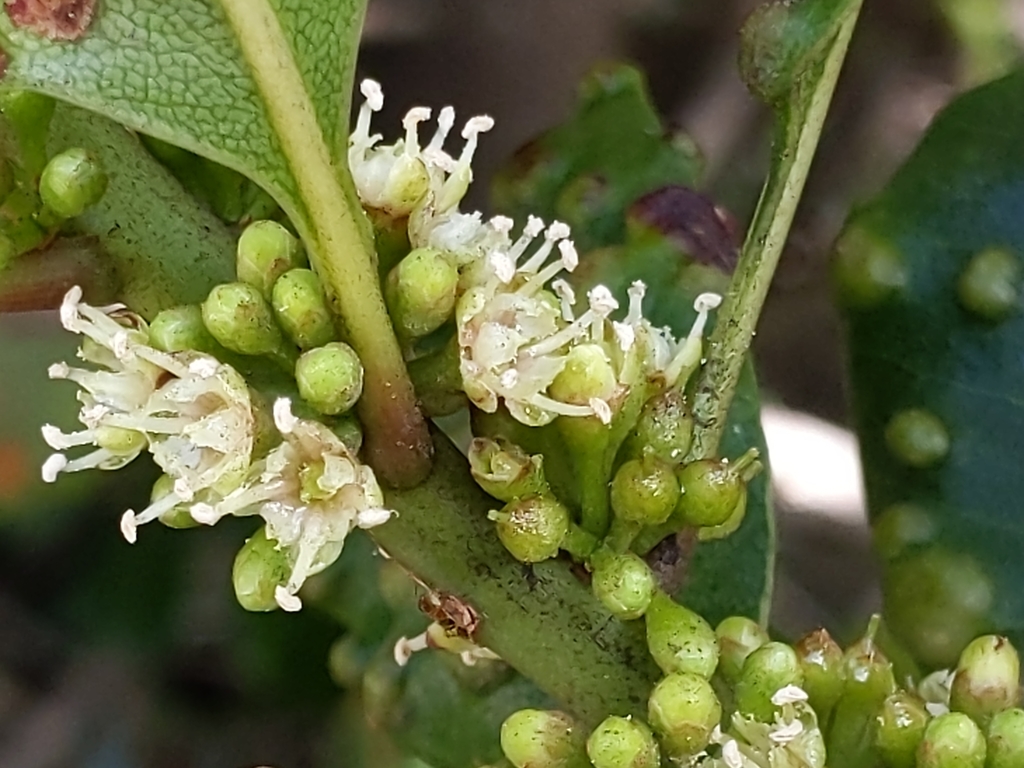
Sideroxylon inerme (aMasethole or white milkwood, Afrikaans: wit-melkhout, Xhosa: Ximafana, Zulu: Umakhwelafingqane) is a southern and eastern African coastal tree, with dense foliage, black berries and small, foetid, greenish flowers. The tree's generic name means "Iron-wood" in Greek, referring to its very hard timber.
It is one of South Africa's "Protected Trees" and several specimens are provincial heritage sites. This is the only member of the genus Sideroxylon in Southern Africa.
From the article Sideroxylon inerme on Wikipedia (CC BY-SA), quoted section by section
Description
Sideroxylon inerme is a semi-coastal sturdy broadleaf evergreen tree with dense foliage, displays of white bisexual flowers and edible purplish-black berries. It boasts leathery, spiral leaves, which, like the berries, contain milky latex. Young branches and new leaves are always covered with fine hairs. The tree can reach 15 m. The milkwood has considerable value in traditional medicine and attracts birds, monkeys and other animals to its flowers and fruits : Speckled mousebirds eat the flowers; birds, bats, monkeys and bush pigs eat the fruit. It is also an effective firebreak and is cultivated for that purpose.
Range & habitat
Sideroxylon inerme trees are scattered through the coastal woodlands and littoral forests of southern and eastern Africa, from the Cape Provinces of South Africa in the south to Somalia in the north, and on Aldabra, the Comoro Islands, and the Mozambique Channel Islands in the western Indian Ocean. Historically, dense forests of large milkwood trees used to exist along the coast and bays of Cape Town, especially at Noordhoek, Macassar and Gordons Bay. The milkwood is not endangered but it is one of South Africa's Protected Trees, which means that it is illegal to damage, move or destroy them.
Wikipedia: “Distribution”
Where it lives
Recorded sightings
—
geo-referenced records in GBIF, from museums, herbaria and field observers.
Drag the globe to turn it. Dots are where records exist, not a range map; darker means more records.
In the stacks
Searching the stacks…
Every page naming Sideroxylon inerme in the Biodiversity Heritage Library →
This page is assembled live from iNaturalist, GBIF, Wikipedia, the Source Library and the Internet Archive. It is not yet part of the hand-edited codex. iNaturalist taxon 362175.