- Animals
- ›Arthropods
- ›Hexapods
- ›Insects
- ›Winged and Once-winged Insects
- ›Grasshoppers, Crickets, and Katydids
- ›Grasshoppers, Locusts, and Allies
- ›Grasshoppers
- ›Pygmy Grasshopper Superfamily
- ›Pygmy Grasshoppers
- ›Tetriginae
- ›Tetrigini
- ›Tetrix
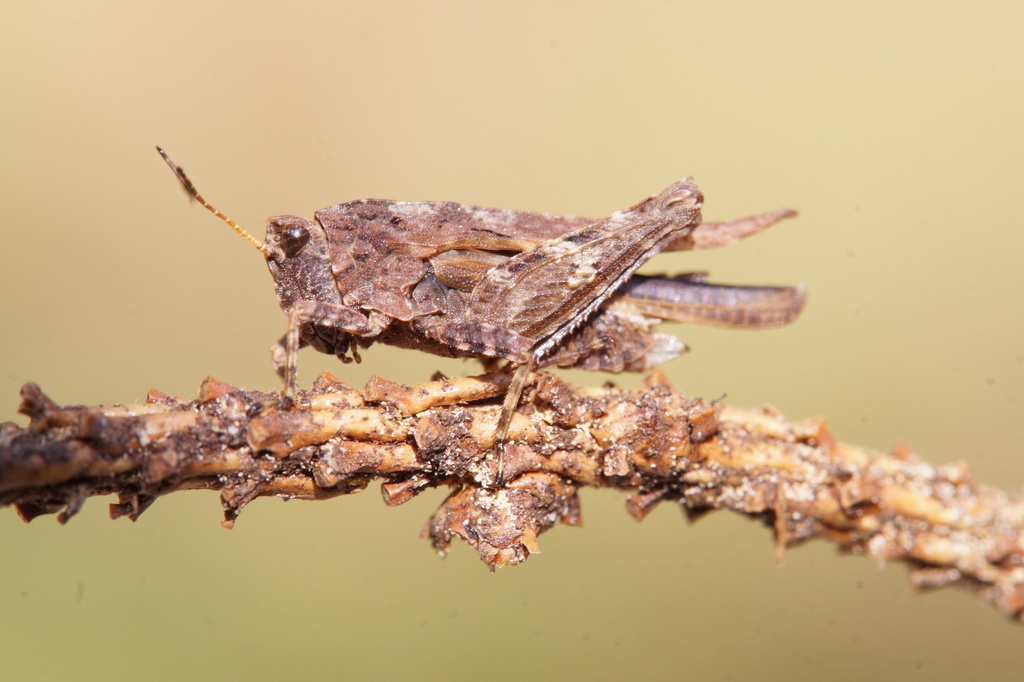
Cepero's Groundhopper
Tetrix ceperoi
Tetrix ceperoi, Cepero's groundhopper, is a member of the family Tetrigidae and is very similar to common grasshoppers. Unlike the common grasshopper, the wings of T. ceperoi extend beyond its pronotum (the upper surface of the first segment of the thorax). The front wings have evolved throughout history to be stumps, and the back wings are very well developed and capable of flying. T. ceperoi sports wide shoulders while covering its narrow abdomen beneath the pronotum. T. ceperoi reach an average length of about 10 millimetres (0.39 in). T. ceperoi is a multi-coloured ground dweller with the ability to blend into its surroundings. The ability of T. ceperoi to be different colours makes it able to evolve colour schemes better adapted to specific habitats which provides protection from predators. T. ceperoi is diurnal but can choose to hibernate during late nymphal instar stages and later on in life as adults.
From the article Tetrix ceperoi on Wikipedia (CC BY-SA), quoted section by section
Range & habitat
T. ceperoi naturally resides in warm places, in damp and bare areas of land. However, due to threatened natural habitats, T. ceperoi also can also be found living in dunes along shore lines, and in low and open vegetations. As T. ceperoi has evolved, it has also become capable of surviving in "floodplains, moist dune slacks, sand pits, drainage ditches or ponds". Adult T. ceperoi are skilled swimmers and therefore are not hindered by the large amounts of water in close proximity in flooded areas.
Subspecies: distribution. The Orthoptera Species File lists:
T. ceperoi ceperoi: from the coasts of the West Mediterranean area, Central Europe, Germany, Southern England and South Wales. T. ceperoi chinensis: records (probably incomplete) from eastern China and Thailand.
Conservation. T. ceperoi is becoming an endangered species in Central Europe due to "coastal protection and floodplain regulation". Therefore, It can only claim its true natural habitat in areas of the Wadden Sea Islands.
Habitat experiments. The question of the little-known habitat of T. ceperoi has come into greater study recently. Hochkirch et al. observed the reproductive interference between T. ceperoi and T. subulata, a neighbor and closely related species. …
Wikipedia: “Habitat”
What it does
The diet of T. ceperoi is composed of moss and various plants. The common mosses eaten by T. ceperoi include Bryum argenteum, B. caespiticum, Ceratodon purpureus and Barbula sp.. Less common diet choices include grasses, algae, and sometimes animal fragments and organic debris.
Wikipedia: “Diet”
Listen
Looking for field recordings…
Where it lives
Recorded sightings
—
geo-referenced records in GBIF, from museums, herbaria and field observers.
Drag the globe to turn it. Dots are where records exist, not a range map; darker means more records.
In the stacks
Searching the stacks…
Every page naming Tetrix ceperoi in the Biodiversity Heritage Library →
This page is assembled live from iNaturalist, GBIF, Wikipedia, the Source Library and the Internet Archive. It is not yet part of the hand-edited codex. iNaturalist taxon 362303.