- Plants
- ›Vascular Plants
- ›flowering plants
- ›Dicots
- ›Heathers, Balsams, Primroses, and Allies
- ›primrose family
- ›primrose subfamily
- ›rock-jasmine tribe
- ›Androsace
- ›Aretia
- ›Aretia
vitaliana
Androsace vitaliana
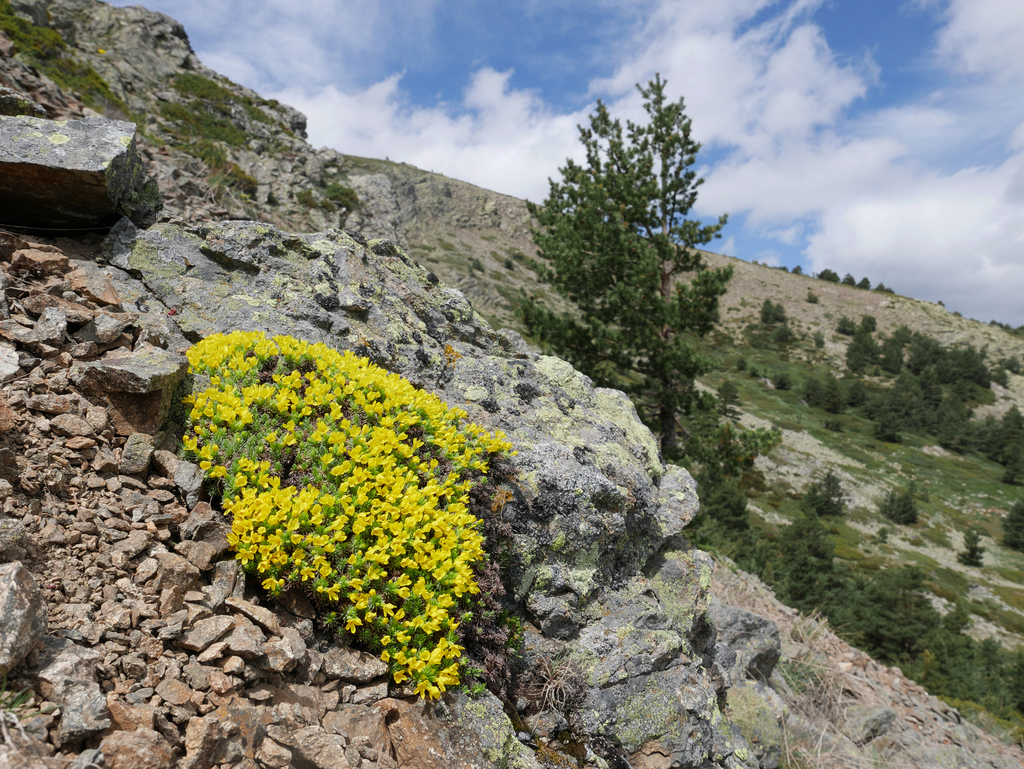
Androsace vitaliana is a species of plant in the primrose family, Primulaceae. It was previously known by the synonym Vitaliana primuliflora. Native to the high mountains of Europe, it is cultivated as an alpine garden plant, being considered easy to grow in well drained soil in a sunny position.
From the article Androsace vitaliana on Wikipedia (CC BY-SA), quoted section by section
Description
Androsace vitaliana is a cushion- or mat-forming plant reaching up to 15 cm (6 in) or more across. Its leaves are arranged in rosettes, each leaf being 5–10 mm (0.2–0.4 in) long and usually greyish green in colour. The flowers are usually unstalked (sessile) and are bright yellow in colour. They consist of a tube about 1–1.5 cm (0.4–0.6 in) or more long with five lobes reaching 1–2 cm (0.4–0.8 in) across when fully open. The flowers are borne singly at the ends of the leaf rosettes. Like the genus Primula, flowers are heterostylous, having pin and thrum forms.
Range & habitat
Androsace vitaliana is native to the high mountains of Europe in Spain, France, Italy, Switzerland and a small part of Austria. It is usually found above 2,000 m (6,600 ft), on screes and rocks and in stony meadows.
Wikipedia: “Distribution and habitat”
How it is grown
Androsace vitaliana is cultivated as an alpine garden plant. It is regarded as easy to grow in well drained but fertile soil in a sunny position. It can be propagated easily by removing rosettes with attached roots from a plant in late summer and growing them on.
Wikipedia: “Cultivation”
Where it lives
Recorded sightings
—
geo-referenced records in GBIF, from museums, herbaria and field observers.
Drag the globe to turn it. Dots are where records exist, not a range map; darker means more records.
In the stacks
Searching the stacks…
Every page naming Androsace vitaliana in the Biodiversity Heritage Library →
This page is assembled live from iNaturalist, GBIF, Wikipedia, the Source Library and the Internet Archive. It is not yet part of the hand-edited codex. iNaturalist taxon 362586.