- Plants
- ›Vascular Plants
- ›flowering plants
- ›monocots
- ›grasses, sedges, cattails, and allies
- ›grasses
- ›Pooideae
- ›Wheats, ryes, barleys and relatives
- ›Wheats, goatgrasses, and relatives
- ›Triticum
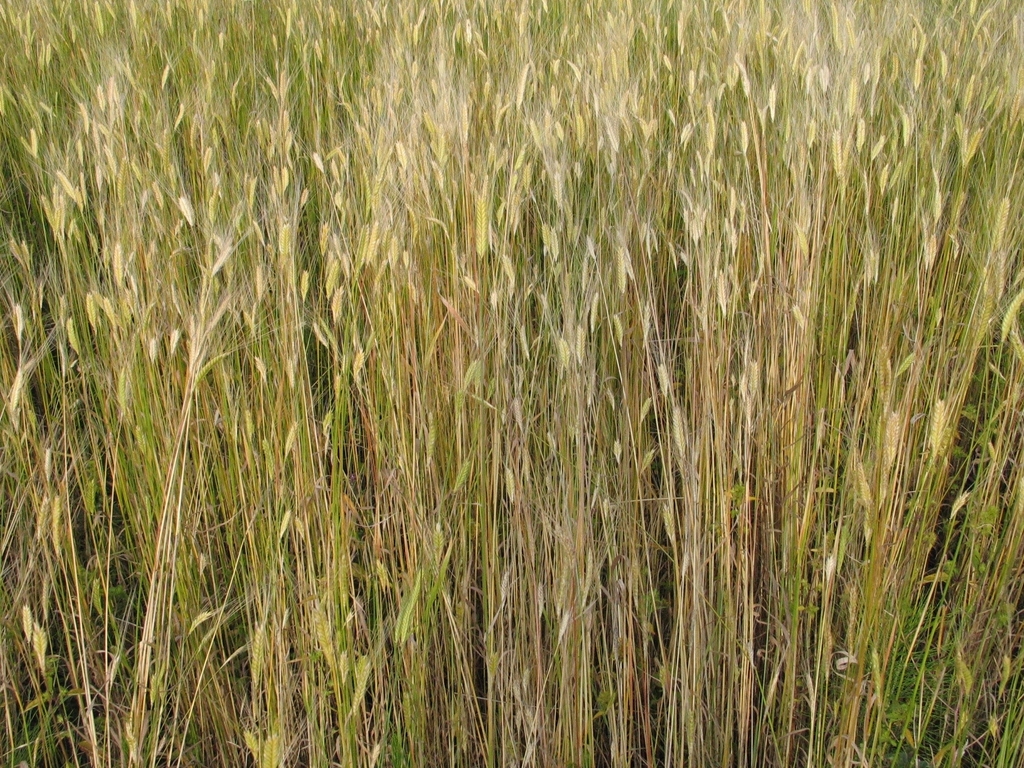
Einkorn Wheat
Triticum monococcum
Einkorn (from German Einkorn, literally "single grain") can refer to either a wild species of wheat (Triticum) or a domesticated form of wheat. The wild form is T. boeoticum (syn. T. m. subsp. boeoticum), and the domesticated form is T. monococcum (syn. T. m. subsp. monococcum). Einkorn is a diploid species (2n = 14 chromosomes) of hulled wheat, with tough glumes (husks) that tightly enclose the grains. The cultivated form is similar to the wild, except that the ear stays intact when ripe and the seeds are larger. The domestic form is known as petit épeautre in French, Einkorn in German, "einkorn" or "littlespelt" in English, piccolo farro in Italian and escanda menor in Spanish. The name refers to the fact that each spikelet contains only one grain. Einkorn was one of the first forms of wheat to be cultivated.
From the article Einkorn on Wikipedia (CC BY-SA), quoted section by section
Description
Einkorn is a short variety of wild wheat, usually less than 70 centimetres (28 in) tall, and is not very productive of edible seeds. The principal difference between wild einkorn and cultivated einkorn is the method of seed dispersal. In the wild variety, the seed head usually shatters and drops the kernels (seeds) of wheat onto the ground. This facilitates a new crop of wheat. In the domestic variety, the seed head remains intact. While such a mutation may occasionally occur in the wild, it is not viable there in the long term: the intact seed head will only drop to the ground when the stalk rots, and the kernels will not scatter but form a tight clump which inhibits germination and makes the mutant seedlings susceptible to disease. Harvesting einkorn with intact seed heads was easier for early human harvesters, who could then manually break apart the seed heads and scatter any kernels not eaten. Over time and through selection, conscious or unconscious, the human preference for intact seed heads created the domestic variety, which has slightly larger kernels than wild einkorn. Domesticated einkorn thus requires human planting and harvesting for its continuing existence. …
Range & habitat
Einkorn wheat commonly grows wild in the hill country in the northern part of the Fertile Crescent and Anatolia, although it has a wider distribution reaching into the Balkans and south to Jordan near the Dead Sea.
Wikipedia: “Ecology and distribution”
At the table
Einkorn is a common food in northern Provence, France. It is used for bulgur or as animal feed in mountainous areas of countries including France, India, Italy, Morocco, the former Yugoslavia, and Turkey. It contains gluten (so is not suitable for people with gluten-related disorders) and has a higher percentage of protein than modern red wheats. It is considered more nutritious because it has higher levels of fat, phosphorus, potassium, pyridoxine, and beta-carotene.
Use in baking. Historically, einkorn was not used in breadmaking, having primarily been eaten boiled in whole grains or in porridge, meaning that cultivars were not selected for their breadmaking potential. Until recently, einkorn was not thought to be suitable for baking, as its dough is sticky, inelastic and difficult to handle. Testing during the 1990s demonstrated that some einkorn varieties could perform favourably in comparison to bread wheats, and, while only some genotypes proved suitable for breadmaking, a wide variety were suitable for use in other baked goods. Einkorn dough has a bright yellow colour due to high levels of carotenoids, and due to low gas retention yields loaves with a dense structure. Einkorn doughs should be kneaded for a shorter time, and require approximately 10-15 minutes longer baking time than comparable bread wheat doughs.
Resource for plant breeding. …
Wikipedia: “Uses”
How it is grown
From the northern part of the Fertile Crescent, the cultivation of einkorn wheat spread to the Caucasus, the Balkans, and central Europe. Einkorn wheat was more commonly grown in cooler climates than emmer wheat, the other domesticated wheat. Cultivation of einkorn in the Middle East began to decline in favor of emmer wheat around 2000 BCE. Cultivation of einkorn was never extensive in Italy, southern France, and Spain. Einkorn continued to be cultivated in some areas of northern Europe throughout the Middle Ages and until the early part of the 20th century.
Wikipedia: “Spread of cultivation”
Where it lives
Recorded sightings
—
geo-referenced records in GBIF, from museums, herbaria and field observers.
Drag the globe to turn it. Dots are where records exist, not a range map; darker means more records.
In the old herbals & bestiaries


In the stacks
Searching the stacks…
Every page naming Triticum monococcum in the Biodiversity Heritage Library →
This page is assembled live from iNaturalist, GBIF, Wikipedia, the Source Library and the Internet Archive. It is not yet part of the hand-edited codex. iNaturalist taxon 363139.