- Plants
- ›Vascular Plants
- ›flowering plants
- ›monocots
- ›palms, bullanocks, and allies
- ›Dasypogonaceae
- ›Calectasia
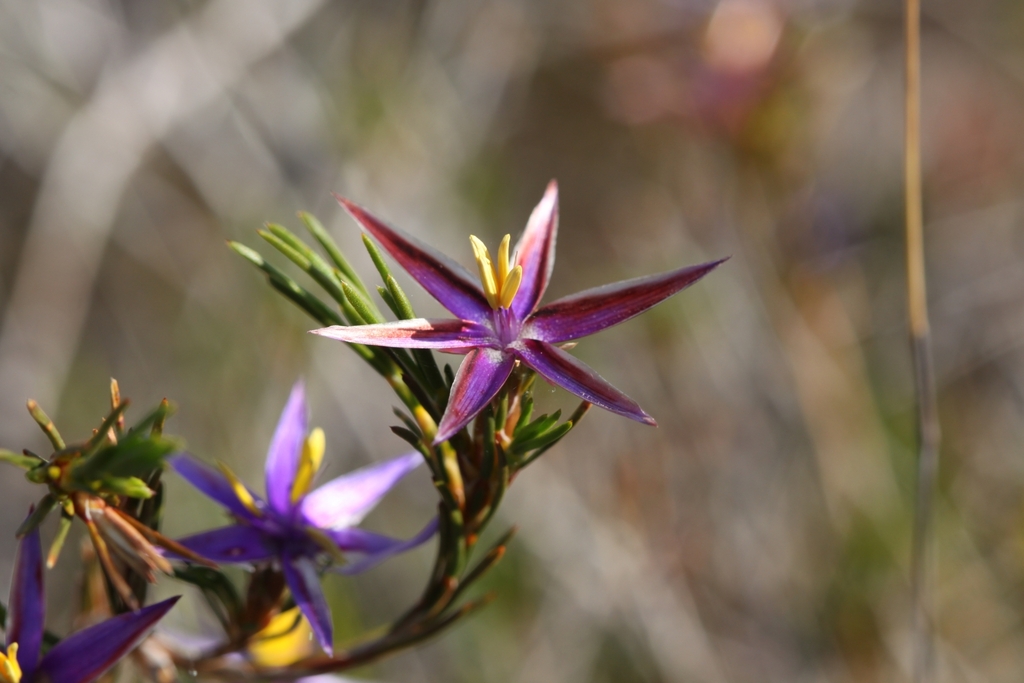
Blue Tinsel Lily
Calectasia grandiflora
Calectasia grandiflora, commonly known as the blue tinsel lily, is a plant in the family Dasypogonaceae growing as a perennial herb endemic to the south-west of Western Australia. It flowers in spring.
From the article Calectasia grandiflora on Wikipedia (CC BY-SA), quoted section by section
Description
Calectasia grandiflora is a rhizomatous perennial herb growing to a height of about 60 cm (24 in). The stems have many side branches and bear leaves 5.2–16.5 x 0.4–1.2 mm. The six petals are blue but turn red as they age; the central anthers are yellow and do not change colour as they age, unlike those of some other Calectasia species. Flowers appear from June to October (Winter and Spring) overall, though earlier in Perth than in the wheatbelt and Stirling Ranges.
Range & habitat
Blue tinsel lily grows on sand, sandy clay, gravel, laterite and granite in swampy areas and on rock outcrops, flats, slopes and ridges. It is endemic to the south-western corner of Western Australia, occurring in the Avon Wheatbelt, Esperance, Geraldton Sandplains, Jarrah Forest, Mallee, Swan Coastal Plain and Warren biogeographic regions.
Wikipedia: “Distribution and habitat”
Where it lives
Recorded sightings
—
geo-referenced records in GBIF, from museums, herbaria and field observers.
Drag the globe to turn it. Dots are where records exist, not a range map; darker means more records.
In the stacks
Searching the stacks…
Every page naming Calectasia grandiflora in the Biodiversity Heritage Library →
This page is assembled live from iNaturalist, GBIF, Wikipedia, the Source Library and the Internet Archive. It is not yet part of the hand-edited codex. iNaturalist taxon 363810.