- Animals
- ›Cnidarians
- ›True Jellies
- ›Discomedusans
- ›Root-mouth Jellies
- ›Dactyliophoran Jellies
- ›Fat-armed Jellies
- ›Catostylus
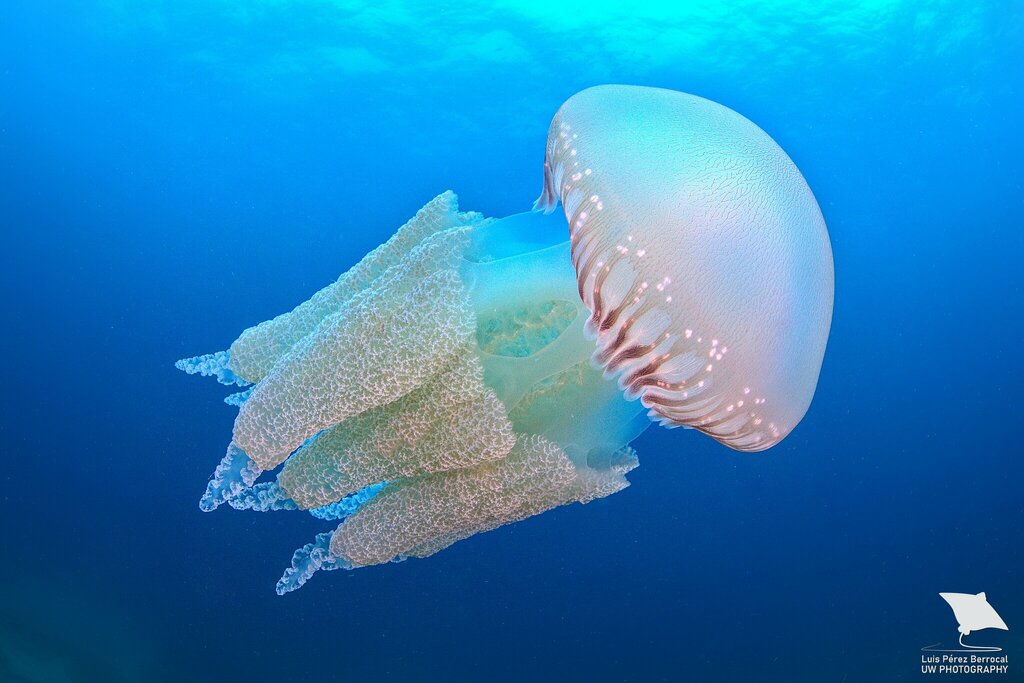
Jelly Blubber
Catostylus tagi
Catostylus tagi is a species of jellyfish from warmer parts of the East Atlantic Ocean and since the 2000s also found in the Mediterranean Sea. It is the only member of the family Catostylidae that is found in Europe, and it is a common species in the Tagus estuary in Portugal. It has collagen in its bell which is currently being researched to see if it has biomedical uses as an intercellular matrix. The species is named after the Tagus river.
From the article Catostylus tagi on Wikipedia (CC BY-SA), quoted section by section
Description
Typical Catostylus with chunky appendages and tentacle to go with each. This jellyfish has a sting that causes light pain and a skin rash, but generally poses no serious threat. It is up to 65 cm (26 in) in bell diameter, but a more typical size is 25 cm (10 in) in diameter and 2.5 kg (5.5 lb) in weight. Its colour is variable and can be blue-white, cream, brown, or off-white. The exumbrellar grooves are reddish or purplish brown. C. tagi has gonads along the edge of its stomach in an X shape. It has the octant formation typical of Catostylus jellies, the height of the octants are also variable.
At the table
Eats both zooplankton and phytoplankton, certain crustaceans, small fish, and marine snow.
Wikipedia: “Food”
In medicine
Its bell collagen is currently being researched for use as an intercellular matrix. The collagen is made up of 1/3 glycine and most of the rest is water and other amino acids, its amino acid content is very small. The collagen is denatured as soon as it reaches 29.9 °C (85.8 °F).
Wikipedia: “Biomedical use”
Where it lives
Recorded sightings
—
geo-referenced records in GBIF, from museums, herbaria and field observers.
Drag the globe to turn it. Dots are where records exist, not a range map; darker means more records.
In the stacks
Searching the stacks…
Every page naming Catostylus tagi in the Biodiversity Heritage Library →
This page is assembled live from iNaturalist, GBIF, Wikipedia, the Source Library and the Internet Archive. It is not yet part of the hand-edited codex. iNaturalist taxon 363872.