- Plants
- ›Vascular Plants
- ›flowering plants
- ›monocots
- ›palms, bullanocks, and allies
- ›palms
- ›Arecoideae
- ›Cocoseae
- ›Bactridinae
- ›Bactris
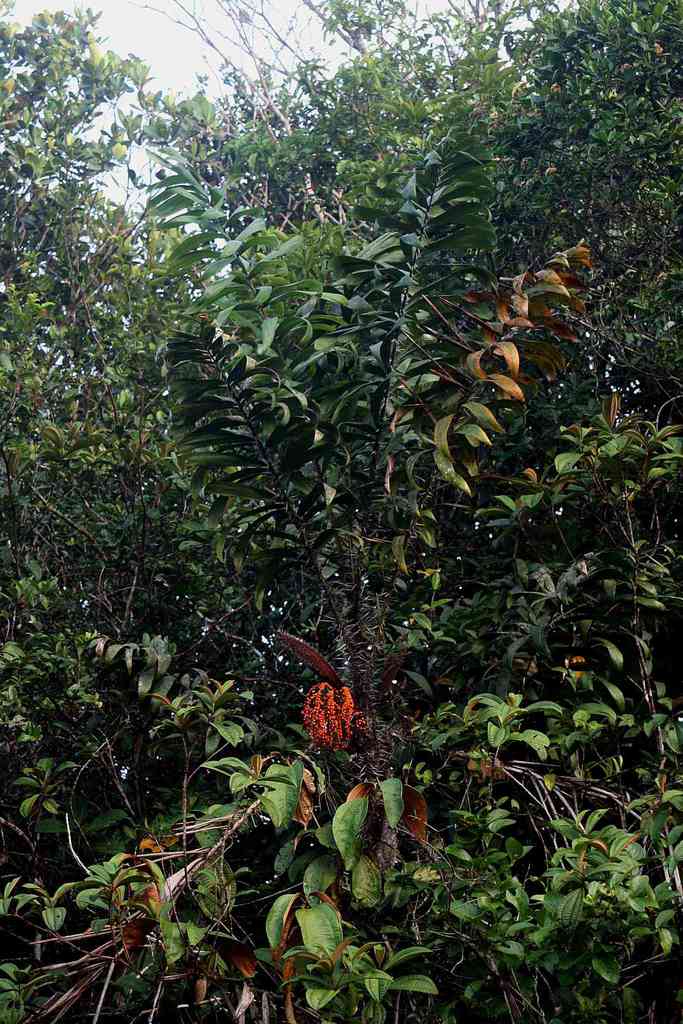
Bactris campestris
Bactris campestris is a small (1–5 m tall) spiny palm which grows in multi-stemmed clumps in savannas and low forests in northern South America from Colombia to the Guianas, Trinidad and Tobago, and northern Brazil.
From the article Bactris campestris on Wikipedia (CC BY-SA), quoted section by section
Description
Bactris campestris grows in small, multi-stemmed clumps. The stems, which are 1–5 metres (3 ft 3 in – 16 ft 5 in) tall and 3–4 centimetres (1.2–1.6 in) in diameter, are often sheathed by the remains of old leaf bases. Stems usually bear between two and five leaves which are covered with flattened greyish-brown spines 2–4 centimetres (0.79–1.57 in) in length. The leaf sheath and petiole are densely covered with spines; those on the rachis are less dense and grow mostly on the lower surface. The leaf sheath is 24–50 centimetres (9.4–19.7 in) long, the petiole 15–90 centimetres (5.9–35.4 in) and the rachis 60–110 centimetres (24–43 in). Each leaf consists of 17 to 32 leaflets which clustered in groups of two to five. The largest of the leaflets are 25–52 centimetres (9.8–20.5 in) long and 1.5–5 centimetres (0.59–1.97 in) broad. The inflorescence consists of a 13–20 centimetres (5.1–7.9 in)-long peduncle and 1–6 centimetres (0.39–2.36 in)-long rachis, off of which branches between eight and 39 rachillae 5–15 centimetres (2.0–5.9 in) long. The rachillae bear male and female flowers. Female flowers grow in triplets, with one female flower flanked by two male flowers. Elsewhere along the rachillae, male flowers grow either singly or in pairs. The male flowers are 3–5 millimetres (0.12–0.20 in) long while the female flowers are 3–3.5 millimetres (0.12–0.14 in) in length. …
Range & habitat
Bactris campestris ranges from eastern Colombia, across Venezuela, north to Trinidad and Tobago, across Guyana, Suriname and French Guiana, and into northern Brazil. It grows in open habitats—generally savannas and low-stature forests—on white sands, at low elevations.
Wikipedia: “Distribution”
At the table
The palm heart of B. campestris is reportedly used to treat snake bites.
== References ==
Wikipedia: “Uses”
Where it lives
Recorded sightings
—
geo-referenced records in GBIF, from museums, herbaria and field observers.
Drag the globe to turn it. Dots are where records exist, not a range map; darker means more records.
In the stacks
Searching the stacks…
Every page naming Bactris campestris in the Biodiversity Heritage Library →
This page is assembled live from iNaturalist, GBIF, Wikipedia, the Source Library and the Internet Archive. It is not yet part of the hand-edited codex. iNaturalist taxon 364367.