- Plants
- ›Vascular Plants
- ›flowering plants
- ›monocots
- ›palms, bullanocks, and allies
- ›palms
- ›Arecoideae
- ›Cocoseae
- ›Bactridinae
- ›Bactris
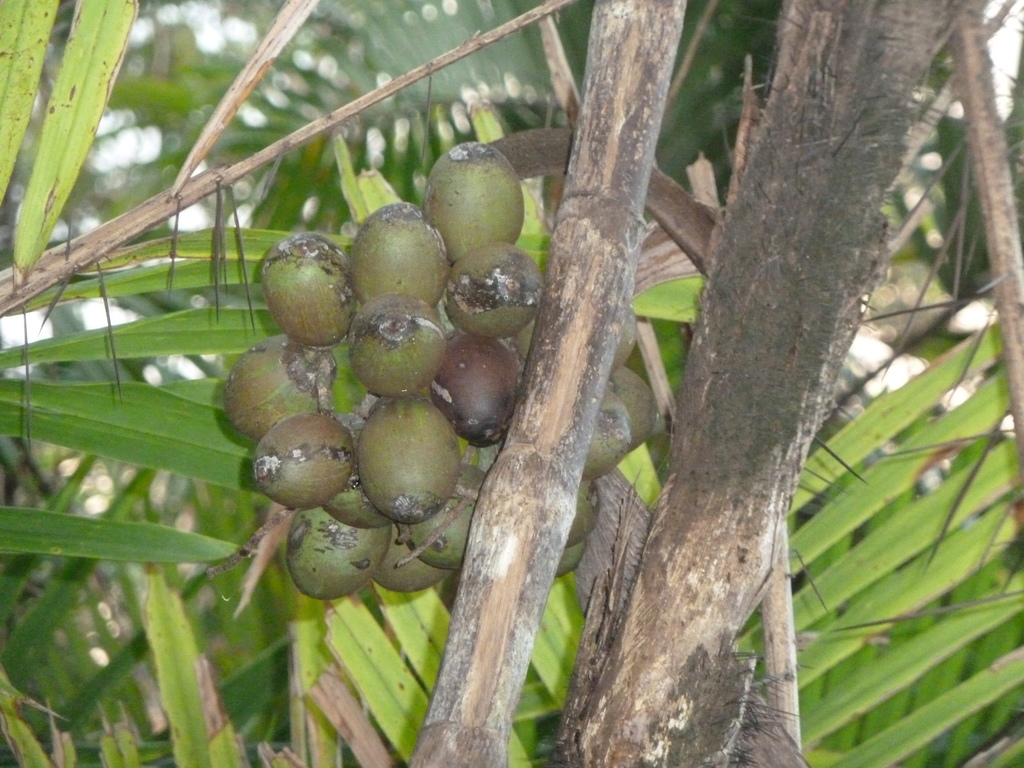
Bactris maraja
Bactris maraja is a species of flowering plant in the family Arecaceae. It is native to South America, and was described in 1826.
Bactris maraja is a shrub or understorey palm, with compound leaves and edible fruits. The International Union for Conservation of Nature lists the species as of Least Concern.
From the article Bactris maraja on Wikipedia (CC BY-SA), quoted section by section
Description
Bactris maraja is a shrub or tree. It is an understory palm. The stems are in clusters of up to fifteen. The stems are 1–7 metres (3.3–23.0 ft) tall, and 1–4 centimetres (0.39–1.57 in) wide. The leaves are compound, and have seventeen to thirty pinnae on each side. The leaf spines are flattened, 5–10 centimetres (2.0–3.9 in) long, and yellowish, turning black at the base and apex. The leaf stems are 13–76 centimetres (5.1–29.9 in) long. The flower stems are 11–18 centimetres (4.3–7.1 in) long. The male flowers are around 3.55 millimetres (0.140 in) long. The female flowers are 3–4 millimetres (0.12–0.16 in) long. The petals are 3–5 millimetres (0.12–0.20 in) long, and form a tubular corolla. The sepals are 0.5–1.5 millimetres (0.020–0.059 in) long. The calyx is a 2.5–4 millimetres (0.098–0.157 in) tube. Bactris maraja flowers in January and February.
The fruits are smooth, round, purple to black, and up to 1.7 centimetres (0.67 in) in diameter. The mesocarp is juicy. Bactris maraja fruits from March to December.
Range & habitat
Bactris maraja is native to the wet tropical biome of South America. It is present in Bolivia, northern and west-central Brazil, Colombia, Costa Rica, Ecuador, French Guiana, Guyana, Panama, Peru, Suriname, and Venezuela. It is found at elevations of 0–1,000 metres (0–3,281 ft). The species grows in various types of forests. It usually grows on non-inundated soils, but can also be found in waterlogged soil near streams.
Wikipedia: “Distribution”
At the table
The fruits are used for human food. The species is also used for animal food, medicine, and fuel.
Wikipedia: “Uses”
Where it lives
Recorded sightings
—
geo-referenced records in GBIF, from museums, herbaria and field observers.
Drag the globe to turn it. Dots are where records exist, not a range map; darker means more records.
In the stacks
Searching the stacks…
Every page naming Bactris maraja in the Biodiversity Heritage Library →
This page is assembled live from iNaturalist, GBIF, Wikipedia, the Source Library and the Internet Archive. It is not yet part of the hand-edited codex. iNaturalist taxon 364400.