- Plants
- ›Vascular Plants
- ›flowering plants
- ›monocots
- ›Aroids, Water Plantains, Seagrass, and allies
- ›Arum Family
- ›Aroideae
- ›Arisareae
- ›Arisarum
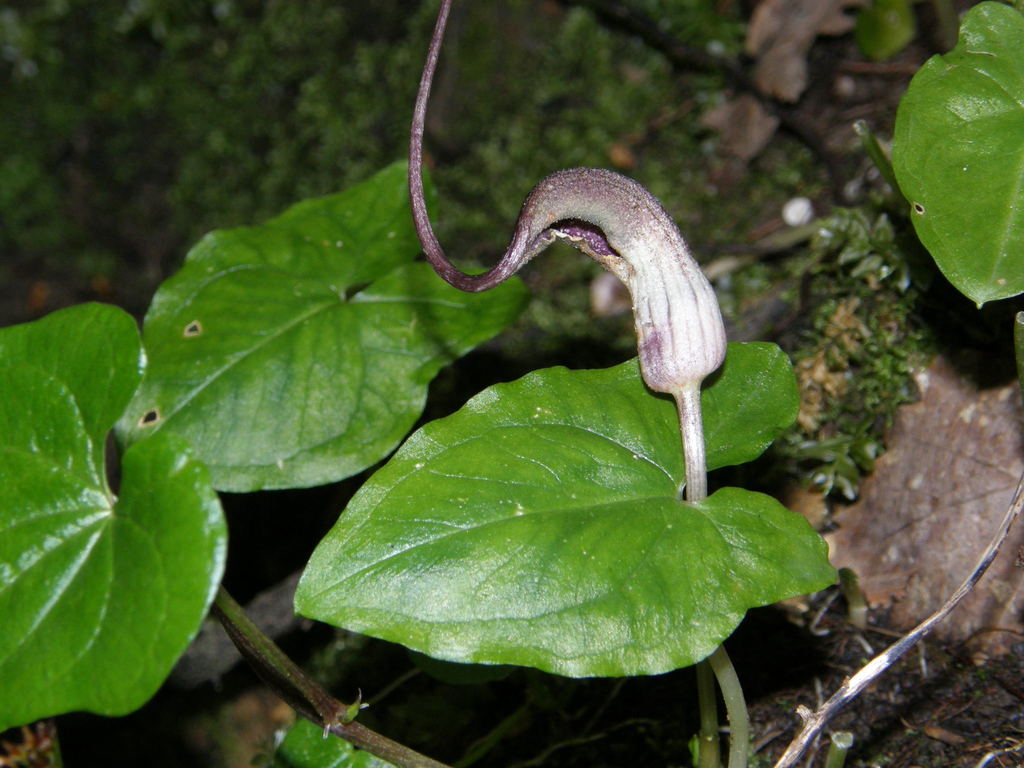
Mousetail plant
Arisarum proboscideum
Arisarum proboscideum, also known as the mouse plant or mouse-tail plant, is a flowering plant in the family Araceae.
From the article Arisarum proboscideum on Wikipedia (CC BY-SA), quoted section by section
Description
Arisarum proboscideum is a herbaceous perennial plant. This species has a short and slender rhizome. Leaves are green and range from 6 – 15 cm long. The leaves are either sagittate, obtuse or mucronate in leaf structure. A. proboscideum possesses a spathe up to 10 cm long and an inflorescent spadix. Plants are monoecious, with usually one to three female flowers and up to sixteen male. Larger inflorescences also contain disproportionally more male flowers than female flowers. Pollination is performed by insects such as fungus gnats, which are lured into the spathe through a small opening. Once the insect is inside they are trapped and must struggle to escape. The struggling insect transfers pollen from male to female flowers.
Range & habitat
This species is native Europe, where it can be found in western Spain and both central and southern Italy. Arisarum proboscideum has been introduced outside of its natural range into the United Kingdom, New Zealand and North America.
Wikipedia: “Distribution”
What it does
Arisarum proboscideum is a host plant of the phytopathogenic fungus Melanustilospora arisari. It causes black, round spotting of up to 1 cm in size.
Wikipedia: “Parasite ecology”
How it is grown
It can be cultivated outdoors in shaded areas, and it is not suitable for warm greenhouses exposed to the summer sun, as the rhizomes are intolerant of desiccation. They require sufficient moisture. Planting and re-planting is advised to take place in springtime.
== References ==
Wikipedia: “Horticulture”
Where it lives
Recorded sightings
—
geo-referenced records in GBIF, from museums, herbaria and field observers.
Drag the globe to turn it. Dots are where records exist, not a range map; darker means more records.
In the stacks
Searching the stacks…
Every page naming Arisarum proboscideum in the Biodiversity Heritage Library →
This page is assembled live from iNaturalist, GBIF, Wikipedia, the Source Library and the Internet Archive. It is not yet part of the hand-edited codex. iNaturalist taxon 366206.