- Plants
- ›Vascular Plants
- ›flowering plants
- ›Dicots
- ›Gentians, Dogbanes, Madders, and Allies
- ›madder family
- ›Cinchonoideae
- ›Guettardeae
- ›Guettarda
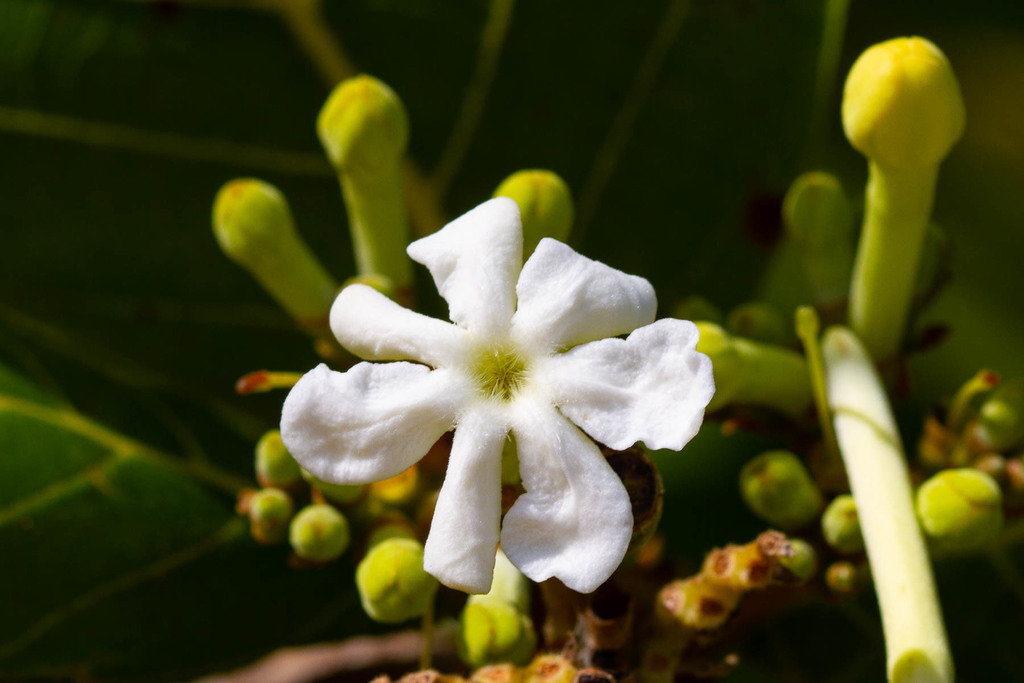
Beach Gardenia
Guettarda speciosa
Guettarda speciosa, with common names sea randia, or zebra wood, is a species of shrub in the family Rubiaceae found in coastal habitats in tropical areas around the Pacific Ocean, including the coastline of central and northern Queensland and Northern Territory in Australia, and Pacific Islands, including Micronesia, French Polynesia and Fiji, Malaysia and Indonesia, Maldives and the east coast of Africa. It reaches 6 m in height, has fragrant white flowers, and large green prominently-veined leaves. It grows in sand above the high tide mark.
From the article Guettarda speciosa on Wikipedia (CC BY-SA), quoted section by section
Description
It is a perennial shrub or small tree 2–6 m (7–20 ft) tall by 1–3 m (3.5–10 ft) wide with smooth creamy grey bark. The large oval-shaped leaves are 15–23 cm (6–9 in) long by 10–18 cm (4–7 in) wide. Dark green and smooth above with prominent paler veins, they are finely hairy underneath. Flowering is from October to May, the fragrant white flowers are 2.5–3 cm (1–1+1⁄4 in) long with 4–9 lobes. These are followed by sweet-smelling globular hard fruit, measuring 2.5 cm–2.8 cm × 2.2 cm–2.5 cm (0.98 in–1.10 in × 0.87 in–0.98 in), which mature September to March.
Range & habitat
Guettarda speciosa is found in coastal habitats in tropical areas around the Pacific Ocean, including the coastline of central and northern Queensland and Northern Territory in Australia, and Pacific Islands, including Micronesia, French Polynesia and Fiji, Malaysia and Indonesia, Maldives and the east coast of Africa. As its name suggests, the beach gardenia grows on beaches and sandy places above the high tide level.
Wikipedia: “Distribution and habitat”
What it does
The timing of the flowers' opening at night suggests they are pollinated by moths. On Christmas Island, the Christmas white-eye (Zosterops natalis) visits the flowers, while the Christmas Island red crab (Gecarcoidea natalis) eat the fallen fruit. The Mariana Fruit Bat (Pteropus mariannus) feeds on the fruit and flowers, acting as a vector for the dispersal of seeds.
Wikipedia: “Ecology”
How it is grown
A very useful plant for seaside planting in tropical climates, Guettarda speciosa needs a sunny aspect and well-drained soil. It has proven difficult to propagate, as this must be done by seed which may take months to germinate.
Wikipedia: “Cultivation”
In human culture
The large leaves were used in various ways by the indigenous people of northern Australia; they could hold food, and when heated, they were given to relieve headaches and aches in limbs. The stems could be used to make Macassan pipes. The flowers were used to scent coconut oil on the Cook Islands, and the wood for dwellings and canoes. Amongst the Marshallese people of Kwajalein, the plant is regarded as possessing spiritual power.
Wikipedia: “Use by indigenous cultures”
Where it lives
Recorded sightings
—
geo-referenced records in GBIF, from museums, herbaria and field observers.
Drag the globe to turn it. Dots are where records exist, not a range map; darker means more records.
In the stacks
Searching the stacks…
Every page naming Guettarda speciosa in the Biodiversity Heritage Library →
This page is assembled live from iNaturalist, GBIF, Wikipedia, the Source Library and the Internet Archive. It is not yet part of the hand-edited codex. iNaturalist taxon 366267.