- Animals
- ›Arthropods
- ›Hexapods
- ›Insects
- ›Winged and Once-winged Insects
- ›Flies
- ›Brachyceran Flies
- ›Cyclorrhaphan Flies
- ›Aschizan Flies
- ›Hover Flies
- ›Drone Flies and Allies
- ›Rat-tail Maggot Flies
- ›Eristalina
- ›Palpada
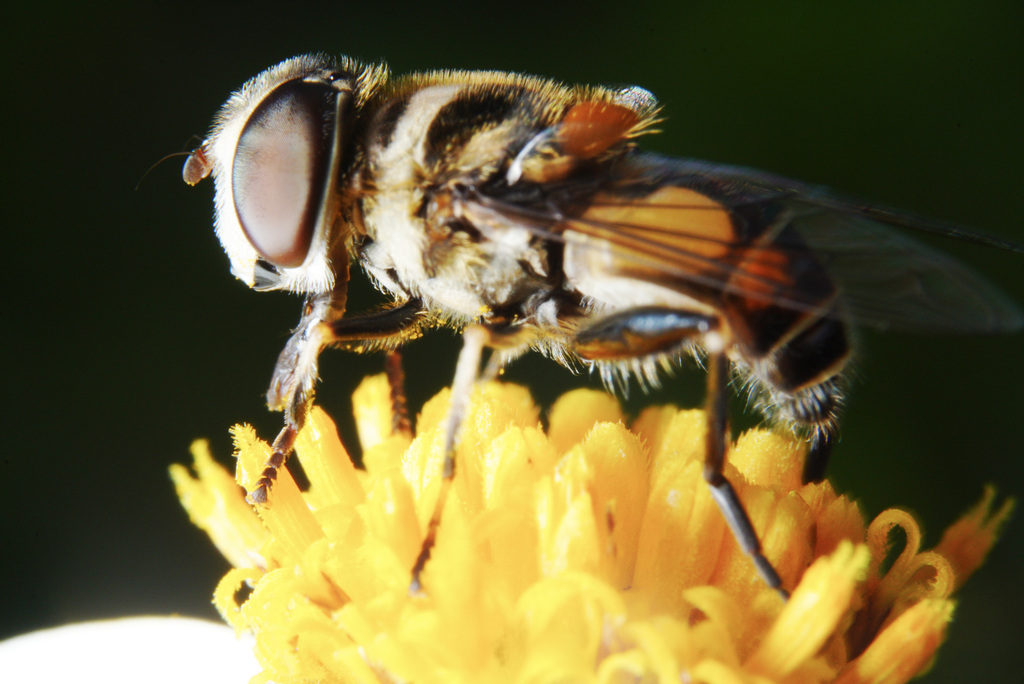
Double-banded Plushback
Palpada agrorum
Palpada agrorum, the Double-banded Plushback, is a common species of syrphid fly first officially described by Fabricius in 1787. Hoverflies get their names from the ability to remain nearly motionless while in flight. The adults are also known as flower flies for they are commonly found around and on flowers, from which they get both energy-giving nectar and protein-rich pollen. The larvae are aquatic filter feeders of the rat-tailed type.
From the article Palpada agrorum on Wikipedia (CC BY-SA), quoted section by section
Description
For terms see Morphology of Diptera. external images
Head
The face is concealed beneath white pollen and thick pure white pile that is more abundant on the frontal triangle. The facial stripe and cheeks are shining black. The eyes are pilose and Holoptic in male. Antennae are obscurely reddish or ferruginous with a bare arista.
Thorax
The scutum is black, clothed with yellowish-white pile in front, intermixed with blackish pile behind. In front of the suture is a conspicuous grayish pollinose broad band, and on each side with an oblique spot reaching from the root of the wing backward toward the scutellum. The scutellum is yellow, with a narrowly black base, and black pile female. Differs in the presence of a complete grayish band on the dorsum of the thorax in front of the scutellum The meron has fine pale hairs in front of or below spiracle.
Abdomen
First segment of abdomen black with the outer angles yellow. The second segment is light yellow, with a narrow median opaque black stripe not quite reaching the hind margin, and a little broader in front. The third segment is black with an anterior oval reddish yellow spot on each side, confluent with the yellow of the preceding segment, the hind border is yellow. …
Range & habitat
external map This species is found in North and South America with the most common occurrences in the South East United States.
Wikipedia: “Distribution”
Listen
Looking for field recordings…
Where it lives
Recorded sightings
—
geo-referenced records in GBIF, from museums, herbaria and field observers.
Drag the globe to turn it. Dots are where records exist, not a range map; darker means more records.
In the stacks
Searching the stacks…
Every page naming Palpada agrorum in the Biodiversity Heritage Library →
This page is assembled live from iNaturalist, GBIF, Wikipedia, the Source Library and the Internet Archive. It is not yet part of the hand-edited codex. iNaturalist taxon 366384.