- Plants
- ›Vascular Plants
- ›flowering plants
- ›Dicots
- ›proteas, lotuses, planes, and allies
- ›Protea family
- ›Paired Proteas
- ›Roupaleae
- ›Knightia
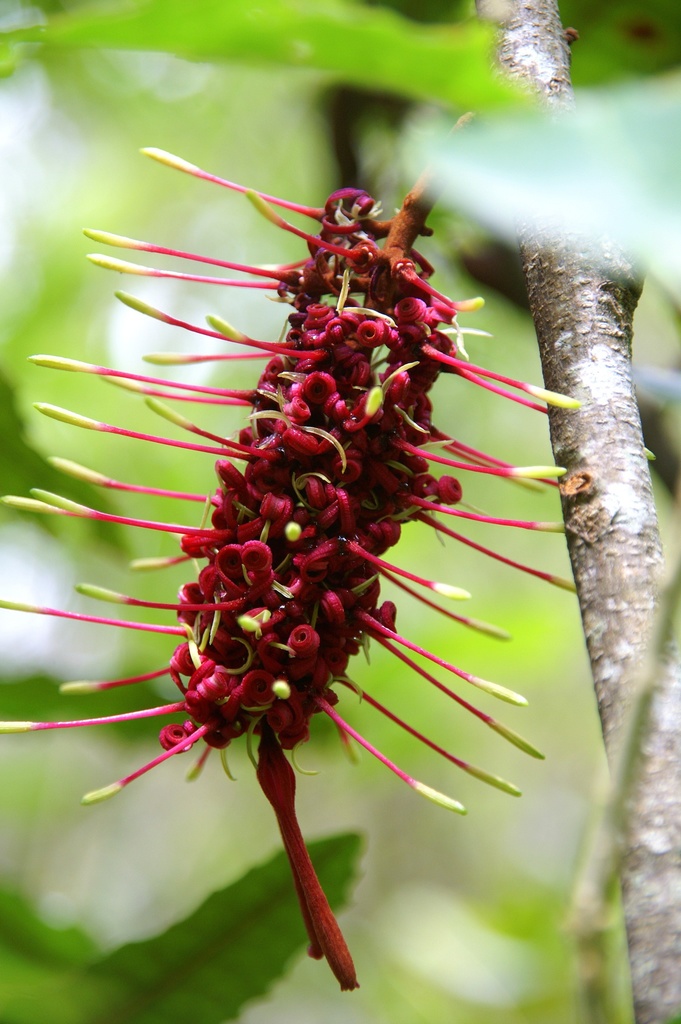
Rewarewa
Knightia excelsa
Knightia excelsa, commonly known as rewarewa (from Māori), is an evergreen tree endemic to the low elevation and valley forests of New Zealand. It is found in the North Island and at the tip of the South Island in the Marlborough Sounds (41° S) and the type species for the genus Knightia.
From the article Knightia excelsa on Wikipedia (CC BY-SA), quoted section by section
Description
Rewarewa grows to 30 metres (100 feet) tall, with a slender crown. The leaves are alternate, leathery, narrow oblong, 10–15 cm (3.9–5.9 in) long and 2.5–3.5 cm (0.98–1.38 in) wide, and without stipules. The flowers are 2–3.5 cm (0.79–1.38 in) long, bright red, and borne in racemes 10 cm (3.9 in) long. Produces dry woody follicles.
What it does
Rewarewa flower nectar is a major food source for many New Zealand native birds and is also attractive to geckos and the lesser short-tailed bat.
Wikipedia: “Ecology”
At the table
Rewarewa is a traditional resource in Māori culture. The wood was used for posts in rivers and to create palisade walls, and it has uses in traditional waka crafting, where a slow burning trunk of the wood can be placed inside a tree to more easily hollow out the centre. The nectar is also a traditional Māori food source.
Wikipedia: “Māori cultural uses”
In human culture
The etymology (word origin) of rewarewa's genus, Knightia, is named in honour of British horticulturalist Thomas Andrew Knight. The specific epithet (second part of the scientific name), excelsa, means 'elevated' or 'tall'. The Māori language name rewarewa derives from the Proto Nuclear Polynesian term *Lewa, primarily used to describe Cerbera odollam and other members of the Cerbera genus in Polynesian languages. It was called New Zealand honeysuckle by early European settlers, but the name has fallen into disuse in preference for the Māori name.
Wikipedia: “Etymology”
Where it lives
Recorded sightings
—
geo-referenced records in GBIF, from museums, herbaria and field observers.
Drag the globe to turn it. Dots are where records exist, not a range map; darker means more records.
In the stacks
Searching the stacks…
Every page naming Knightia excelsa in the Biodiversity Heritage Library →
This page is assembled live from iNaturalist, GBIF, Wikipedia, the Source Library and the Internet Archive. It is not yet part of the hand-edited codex. iNaturalist taxon 366632.