- Plants
- ›Vascular Plants
- ›flowering plants
- ›Dicots
- ›Gentians, Dogbanes, Madders, and Allies
- ›madder family
- ›Rubioideae
- ›Anthospermeae
- ›Coprosminae
- ›Coprosma
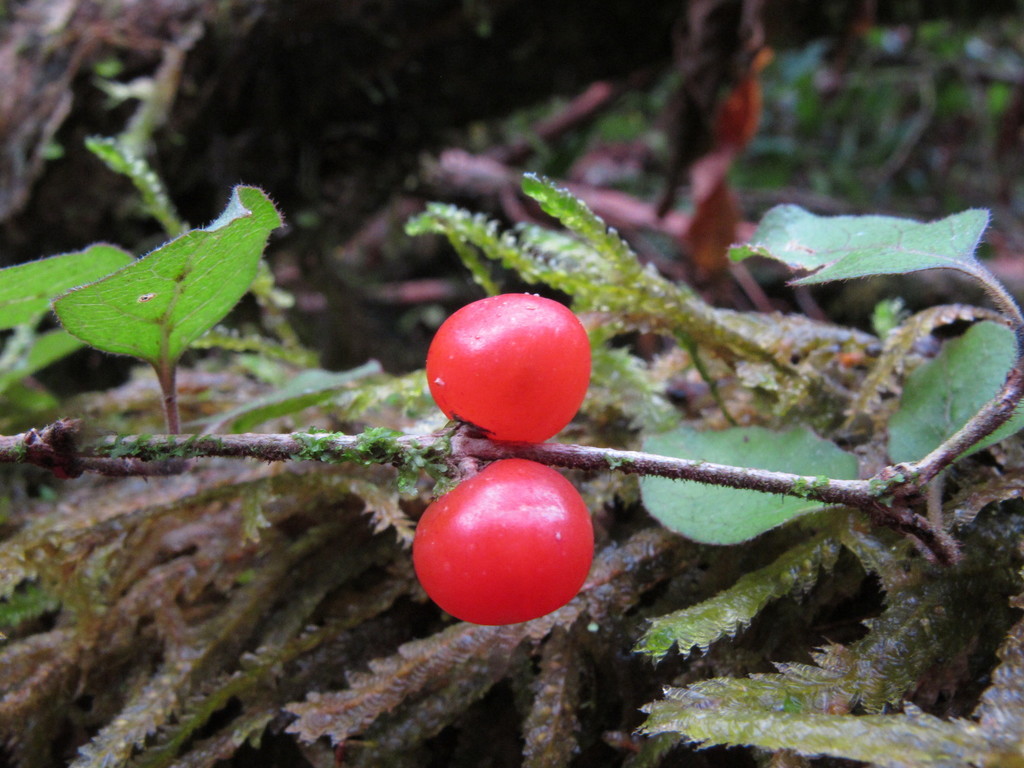
Round Leaved Coprosma
Coprosma rotundifolia
Coprosma rotundifolia, is a native forest shrub of New Zealand. It is found on the North, South and Stewart Islands, usually in forest close to a watercourse.
From the article Coprosma rotundifolia on Wikipedia (CC BY-SA), quoted section by section
Description
Coprosma rotundifolia can grow to a large bushy shrub of up to 6 metres (20 ft) tall. It has small, wide-angled divaricated branches. The branches bear small, tapered leaves 15–25 millimetres (0.59–0.98 in) to 10–20 millimetres (0.39–0.79 in) that end in a sharp tip. The leaves are opposite each other. At the base of the leaf, the stalk is subtended by a small, tooth-like stipule that is blunt and rounded at the base. The leaves are mainly pale green, often with purple blotches, and covered in short to long soft hairs, particularly on the edges of the leaf. The lamina is very thin with veins that are visible on both sides of the leaf. Domatia are present on the surface of leaves between veins, on the midrib, and near the edges on the underside of the leaf. It produces orange to red fruit. This fruit is about 4–5 millimetres (0.16–0.20 in) in diameter and grows on short branches separate from other branches supporting foliage. Flowers occur in clusters between September and November.
Range & habitat
C. rotundifolia is one of about 60 species of Coprosma found in New Zealand in the North Island from Kaitaia south, and throughout the South and Stewart Islands.
Wikipedia: “Range”
What it does
C. rotundifolia produces flowers between September and November in axillary clusters of 2–4. Female and male flowers are produced on separate trees. Male flowers do not have a calyx. The corolla is funnel-shaped, with the lobes widest at the base and ovate with a sharp tip furthest from the tube. The fruit is orange to red. Fruits are a globe-shaped drupe formed on short branches 4–5 mm in diameter. The fruit contains two seeds. These are predominantly dispersed by birds that eat the fruit. The seeds germinate in favourable conditions such as soils with higher levels of calcium carbonate, and can grow up to a small tree.
Wikipedia: “Life cycle”
In human culture
The Māori name for the small-leaved, divaricating forms of coprosma is mikimiki. The word Coprosma originates from the Greek kopros meaning "dung" and osme meaning "odour", because some Coprosma species smell like dung. The word rotundifolia originates from two Latin words: rotundus meaning "round" and folium meaning "leaf".
Wikipedia: “Etymology”
Where it lives
Recorded sightings
—
geo-referenced records in GBIF, from museums, herbaria and field observers.
Drag the globe to turn it. Dots are where records exist, not a range map; darker means more records.
In the stacks
Searching the stacks…
Every page naming Coprosma rotundifolia in the Biodiversity Heritage Library →
This page is assembled live from iNaturalist, GBIF, Wikipedia, the Source Library and the Internet Archive. It is not yet part of the hand-edited codex. iNaturalist taxon 366662.