Tree Tutu
Coriaria arborea
Coriaria arborea, commonly known as tutu and tree tutu, is a species of shrub or small tree in the family Coriariaceae. It is endemic to New Zealand. Every part of C. arborea, except the juice of the fruits, contains the toxin tutin, which is highly poisonous to humans and livestock. Poisonings can result in brain paralysis, convulsions, exhaustion, memory loss, or even death. C. arborea is a bushy shrub which can grow to a height of 7 metres (23 feet). C. arborea is able to colonise new areas of moist ground, and can be found on debris fans, glacial moraine, and stream banks.
The plant was first described in 1868 by Scottish botanist William Lauder Lindsay. There are seven New Zealand members of the Coriaria genus. C. arborea's pollination strategy is uncertain, although a 2025 source argured it is pollinated by the wind. Its seeds are dispersed by fruit-eating animals (frugivores), such as birds and lizards. A nitrogen-fixating plant, C. arborea helps enrich soil quality. The indigenous Māori were able to juice the fruits, filtering them through toetoe (Austroderia sp.) to remove the toxic seeds. C. arborea's 2023 assessment in the New Zealand Threat Classification System was "Not Threatened".
From the article Coriaria arborea on Wikipedia (CC BY-SA), quoted section by section
Description
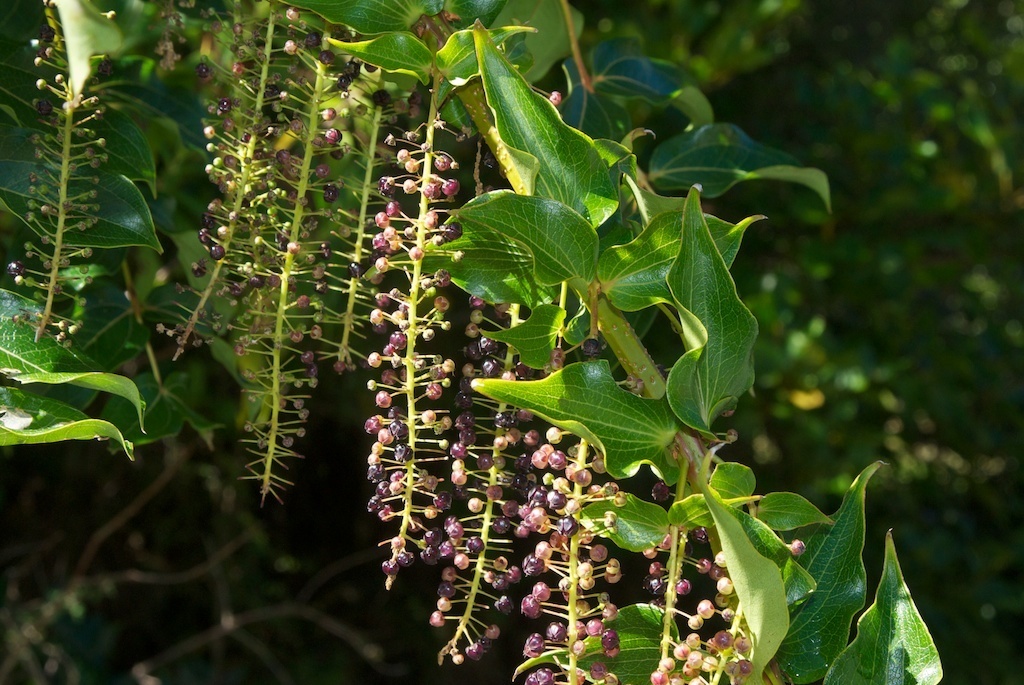
Coriaria arborea is a shrub or small tree in the family Coriariaceae. It is a bushy with spreading branches which usually grows to a height of 3–4 metres (10–10 feet), although it can grow to a height of up to 7 m (23 ft) with a cylindrical and erect trunk up to 3 m (10 ft), which has a diameter of 30 cm (10 in). The trunk and branches have greyish to dark brown coloured bark. In spring, C. arborea produces long unbranched shoots which will later develop leafy lateral branchlets (small newly grown branches). These shoots are comparable to asparagus, but they are much larger. Leaves are mostly arranged oppositely in two rows along the branchlets. They are smooth, slightly coriaceous (leather-like) texture, and are dark green in colour. The upper surface is glossy, while the underside is paler. The laminae (leaf blades) are egg-shaped with pointed tips, and the leaves have a slightly wavy margins. Flowering occurs from October to March. The flowers are arranged along hanging, unbranched inflorescences (flower clusters) which grow to up to 20–30 cm (7.9–11.8 in) long. Each individual flower is small, greenish-yellow in colour, and only about 2–3 mm in diameter. There are five sepals and petals on each flower. Fruiting occurs from November to April, the fruits ripen to a somewhat purple-black colour. They are fleshy, spherical in shape, and approximately 4 mm long. C. …
Range & habitat
New Zealand has the highest concentration of Coriaria species. C. arborea is the most common species in New Zealand. C. arborea var. arborea is found throughout the North, South, Stewart, and Chatham Islands. C. arborea var. kermadecensis is endemic to Raoul Island, which is part of the Kermadec Islands chain. C. arborea var. arborea's 2023 conservation status in the New Zealand Threat Classification System was "Not Threatened". Its 2018 asessement in the IUCN Red List was "Least Concern" and its population trend was evaluated as "Stable".
Habitat. Coriaria species typically occur on sandy soils. C. arborea, a common early successor on moist ground, can be found on alluvial terraces, cliffs, debris fans, glacial moraine, and stream banks. C. arborea can be commonly associated with inanga (Dracophyllum sp.), mountain holly (Olearia macrodonta), putaputawētā (Carpodetus serratus) and wineberry (Aristotelia serrata). C. arborea grows up to 1,000 m (3,300 ft) above sea level. C. arborea prefers moist, well-drained soils. It tolerates frost reasonably well, and is very fast-growing.
Wikipedia: “Distribution”
What it does
Coriaria arborea's seeds are dispersed by fruit-eating animals (frugivores), such as birds and lizards. A 1995 study noted the introduced blackbird (Turdus merula) and the native silvereye (Zosterops lateralis) ate the fruits of C. arborea. Other birds which are known to consume the fruits of C. arborea include the kererū (Hemiphaga novaeseelandiae) and New Zealand bellbirds (Anthornis melanura). The British botanist Thomas Potts recorded that the now possibly extinct South Island kōkako (Callaeas cinereus) fed on the fruits of Coriaria. German-born New Zealand explorer Julius von Haast recorded that the kākāpō (Strigops habroptilus), a large flightless parrot, also fed on Coriaria fruits. New Zealand Coriaria species are either andromonoecious or polygamo-monoecious, meaning they have male, female, and bisexual flowers on the same plant. The pollination strategy of Coriaria is uncertain. Burrows (1995) claimed the flowers are pollinated by birds and insects. Lloyd & Webb (1986) and Thomphson & Gornal (1995) claimed that C. arborea is wind-pollinated, although it is known that bees visit the plant to collect pollen and honeydew. …
Wikipedia: “Ecology”
At the table
Coriaria arborea has several recorded Māori names, including tutu, tāweku, tūpākihi, tāwehu, pūhou, pukou, puho, and tuturakau. C. arborea has a variety of food, medicinal and musical uses in traditional Māori culture. Despite the toxicity from most of the plant, indigenous Māori were able to juice the petals after removing the poisonous seeds by filtering them through the flower heads of toetoe (Austroderia sp.). This beverage was called waitutu and was consumed in large quantitues, which was also used as a laxative. This beverage was also fermented into a wine, which was also popular with European settlers. The leaves and young shoots were used to treat wounds and could be prepared as lotions. They were a valuable medicinal resource, with leaf infusions applied to sprains, strains, and even broken bones. The stems of larger plants were crafted into flutes, and the juice was painted on warriors' faces before battles.
Wikipedia: “Uses”
In human culture
The etymology (word origin) of C. arborea's genus name, Coriaria, derives from the Latin corium meaning 'hide', possibly originating from the use of this genus in leather tanning. The specific epithet (second part of the scientific name), arborea, comes from the Latin arbor, and means 'tree-like'. The species is commonly known as tree tutu, tutu, tree toot, or toot. The Māori language name 'tutu' has cognates (words with shared origin) found in other Eastern Polynesian languages such as Tahitian and Cook Islands Māori which use the word to describe the unrelated Colubrina asiatica, a plant that has visual similarity to Coriaria. The word 'tutu' has been used colloquially as a verb; for example, livestock may be said to have been "tutu'd", meaning poisoned by the tutu plant.
Wikipedia: “Etymology”
Where it lives
Recorded sightings
—
geo-referenced records in GBIF, from museums, herbaria and field observers.
Drag the globe to turn it. Dots are where records exist, not a range map; darker means more records.
In the stacks
Searching the stacks…
Every page naming Coriaria arborea in the Biodiversity Heritage Library →
This page is assembled live from iNaturalist, GBIF, Wikipedia, the Source Library and the Internet Archive. It is not yet part of the hand-edited codex. iNaturalist taxon 366667.