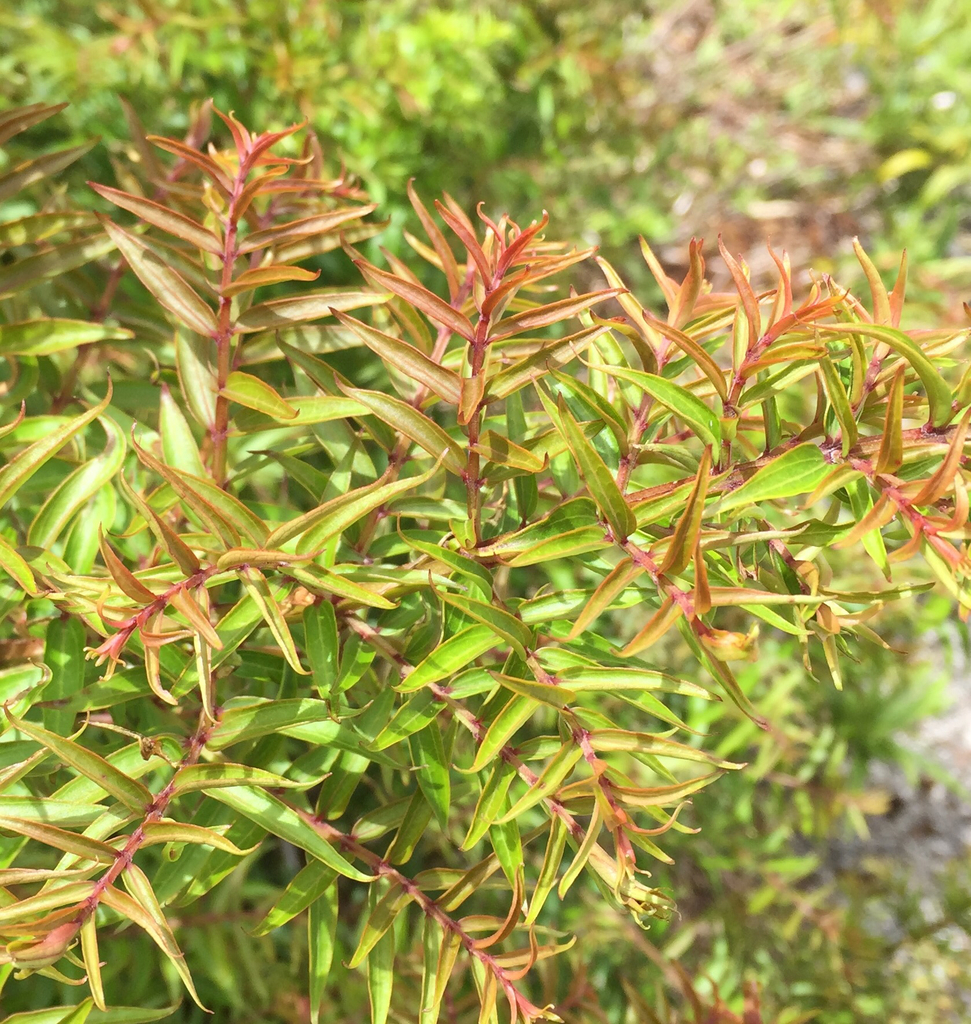
Coriaria pteridoides
Coriaria pteridoides, commonly known as tutu and small-leaved tutu, is a species of shrub in the family Coriariaceae. It is endemic to New Zealand's North Island. This species is common along streams and gravel slopes. It was first described by the New Zealand botanist Walter Oliver in 1942. C. pteridoides's range only covers Mount Taranaki, the North Island Volcanic Plateau, and the Ruahine Ranges. This species, and all Coriaria species, are poisonous, especially the seeds. C. pteridoides's 2023 assessment in the New Zealand Threat Classification System was "Not Threatened".
From the article Coriaria pteridoides on Wikipedia (CC BY-SA), quoted section by section
Description
Coriaria pteridoides is a bushy shrub in the family Coriariaceae. It usually reaches a height of 1 metre (3 feet 3 inches), and consists of many erect branches. It has long, dark-green, narrow, and pointed leaves, which are 5–25 mm long by 2–4 mm wide. The pedicels are up to 5 mm long. Fruit is reddish-black in colour. This species, and all Coriaria species, are poisonous, especially the seeds. C. pteridoides has a diploid chromosome count of 80.
Range & habitat
New Zealand has the highest concentration of Coriaria species. C. pteridoides is endemic to New Zealand's North Island. It is only found on the slopes of Mount Taranaki, the North Island Volcanic Plateau, and the Ruahine Ranges. C. pteridoides's 2023 conservation status in the New Zealand Threat Classification System was "Not Threatened".
Habitat. Coriaria pteridoides is found in mountainous environments. It can be found on gravel slopes and along streams. Daly (1967) notes that the species is found in rugged, native grasslands and shrublands, and is commonly found on pumiceous soils.
Wikipedia: “Distribution”
What it does
Coriaria pteridoides's seeds are dispersed by fruit-eating animals (frugivores). The pollination strategy of Coriaria is uncertain. Burrows (1995) claimed the flowers are pollinated by birds and insects. Thomphson & Gornal (1995) claimed that Coriaria is wind-pollinated.
Wikipedia: “Ecology”
In human culture
The etymology (word origin) of C. pteridoides's genus name, Coriaria, derives from the Latin corium meaning 'hide', possibly originating from the use of this genus in leather tanning. The specific epithet (second part of the scientific name), pteridoides, means 'fern-like', it comes from the Greek pteris, meaning fern, and -oides meaning resembling. The species is commonly known as tutu or small-leaved tutu. The Māori language name 'tutu' has cognates found in other Eastern Polynesian languages such as Tahitian and Cook Islands Māori which use the word to describe the unrelated Colubrina asiatica, a plant that has visual similarity to Coriaria. The word 'tutu' has been used colloquially as a verb.
Wikipedia: “Etymology”
Where it lives
Recorded sightings
—
geo-referenced records in GBIF, from museums, herbaria and field observers.
Drag the globe to turn it. Dots are where records exist, not a range map; darker means more records.
In the stacks
Searching the stacks…
Every page naming Coriaria pteridoides in the Biodiversity Heritage Library →
This page is assembled live from iNaturalist, GBIF, Wikipedia, the Source Library and the Internet Archive. It is not yet part of the hand-edited codex. iNaturalist taxon 366669.