- Plants
- ›Vascular Plants
- ›flowering plants
- ›Dicots
- ›sandalwoods, mistletoes, and allies
- ›showy mistletoes
- ›Psittacantheae
- ›Tupeinae
- ›Tupeia
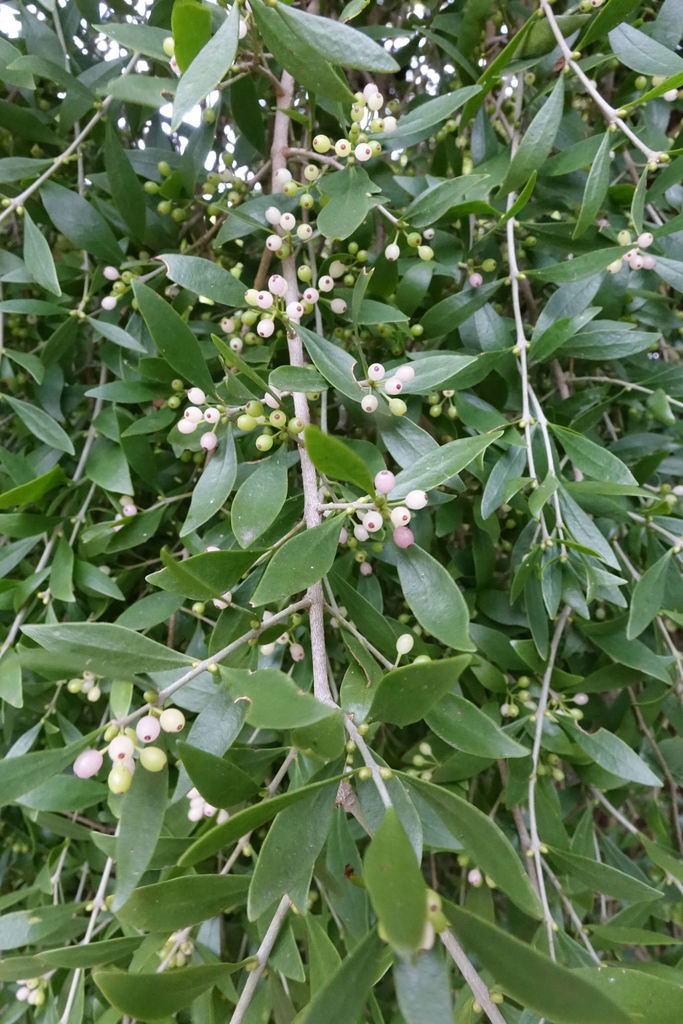
Tupeia antarctica
Tupeia is a monotypic genus of semi-parasitic shrubs (mistletoes) which occurs in both the North and South Islands of New Zealand. There is only one species in the genus: Tupeia antarctica. There are no synonyms.
From the article Tupeia on Wikipedia (CC BY-SA), quoted section by section
Description
The species, Tupeia antarctica (common names - tāpia, kohuorangi, pirinoa, piritia, white mistletoe), is a Diecious mistletoe which grows up to 1m wide. Its bark is white, and the twigs are finely hairy. The leaves are variously shaped, fleshy, bright green and from 10 to 70 mm long. The flowers are tiny and the fruit is white to pinkish.
Habitat. It is found in forest or scrub, on a wide range of hosts including tarata (Pittosporum eugenioides), karo (Pittosporum crassifolium), Coprosma species, putaputaweta (Carpodetus serratus), fivefinger (Pseudopanax arboreus), white maire (Nestegis lanceolata) and broom. According to De Lange et al., Tupeia antarctica parasitises some 48 hosts (11 exotic) with the most common host families being Fabaceae and Rubiaceae.
In human culture
The genus is named for Tupaia (c. 1725 – 1770), a Tahitian navigator and priest. The specific epithet, antarctica, derives from the Latin word, anti, meaning "against" or "opposite" and the Greek word, arktos, meaning "bear", giving an adjective, antarctica, which meant opposite the constellations of the Ursus Major and Ursus Minor, "opposing the north", or "Antarctic".
Wikipedia: “Etymology”
Where it lives
Recorded sightings
—
geo-referenced records in GBIF, from museums, herbaria and field observers.
Drag the globe to turn it. Dots are where records exist, not a range map; darker means more records.
In the stacks
Searching the stacks…
Every page naming Tupeia antarctica in the Biodiversity Heritage Library →
This page is assembled live from iNaturalist, GBIF, Wikipedia, the Source Library and the Internet Archive. It is not yet part of the hand-edited codex. iNaturalist taxon 366723.