- Plants
- ›Vascular Plants
- ›flowering plants
- ›monocots
- ›lilies, supplejacks, and allies
- ›supplejacks
- ›Ripogonum
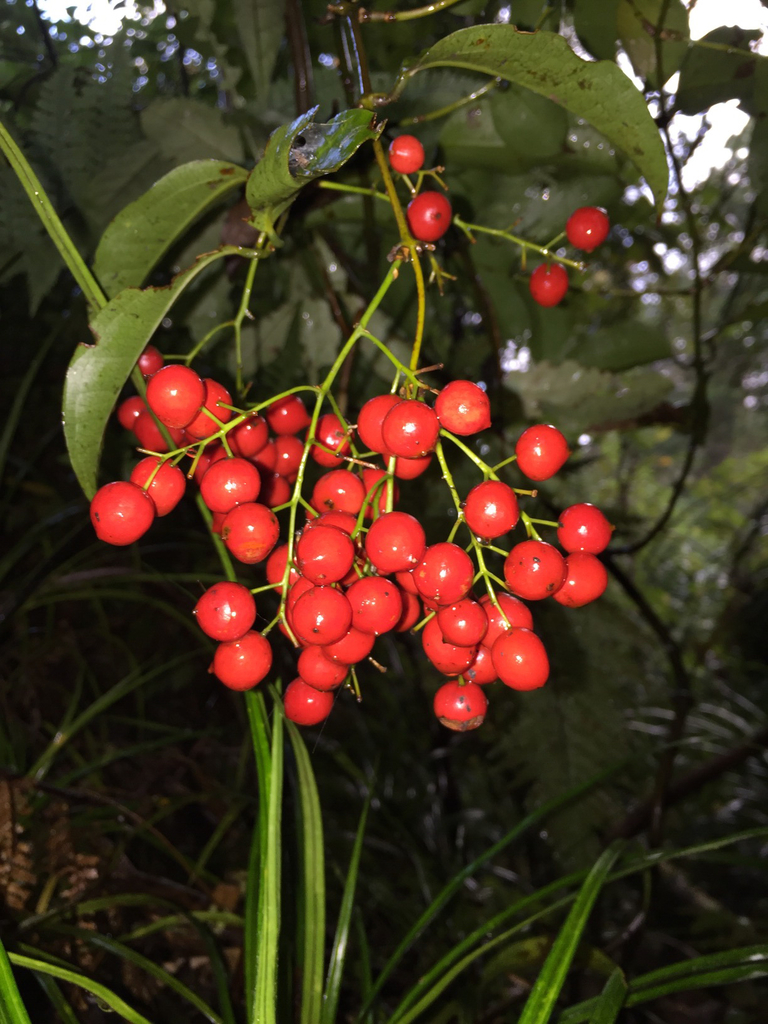
Supplejack
Ripogonum scandens
Ripogonum scandens, commonly known as supplejack and kareao, is a species of climbing forest vine in the family Ripogonaceae. It is endemic to New Zealand. Its range mainly covers the North and South Islands but it also occurs on some offshore islands. Red globe-shaped fruits, which hang from the oppositely arranged leaves, are eaten and dispersed by birds. These fruits are edible, and so are the newly formed shoots at the end of the vines.
The species was first described by Johann Reinhold Forster and Georg Forster in 1776. The genus Ripogonum (alternatively spelled Rhipogonum), was originally considered to be part of the family Smilacaceae or Liliaceae, but in 1985 was reclassified as the sole genus in the family Ripogonaceae. R. scandens was valued by Māori and European settlers, primarily for the stems that were valued for their length, strength, and flexibility. In 2023, the conservation status was assessed as "Not Threatened" in the New Zealand Threat Classification System.
From the article Ripogonum scandens on Wikipedia (CC BY-SA), quoted section by section
Description
Ripogonum scandens (supplejack) is an evergreen climbing forest vine (liane), reaching lengths of up to 18 metres (60 feet) long. The rhizomes are stout, woody, and 30–60 mm (1.2–2.4 in) in diameter. The stems can be several metres long, about 15–20 mm (0.59–0.79 in) in diameter, seldomly branched, almost black in colour, with nodes about 100–200 mm (3.9–7.9 in) apart. Leaves are mostly arranged opposite to each other, usually 55–160 × 20–60 mm long, variably green in colour, coriaceous (leather-like) in character, narrow-ovate to oblong in shape. Flowering typically occurs in December and January. The petioles are about 10–15 m (33–49 ft) long. The inflorescences (flower clusters) are 100–150 mm (3.9–5.9 in) long. Its pedicels are about 5–9 mm (0.20–0.35 in) long. Its spreading tepals are green in colour. Its filamentous stamens are about 2 mm (0.079 in) long. Its anthers are greenish to yellow in colour, linear-oblong in character, and about 3.0–5.0 × 1.0–1.5 mm long. Its ovaries are globe-shaped, about 1.5 mm (0.059 in) in diameter. Fruiting typically occurs from March onwards. Fruits are also globe-shaped, bright red in colour, 10–15 mm (0.39–0.59 in) in diameter; the pericarps are thin and fleshy. R. scandens has a diploid chromosome count of 22.
Range & habitat
Ripogonum scandens is endemic to New Zealand. Its range mainly covers the North and South Islands. It also occurs on the offshore Stewart and Chatham Islands. R. scandens generally occurs throughout the North Island. In the South Island, R. scandens's range mainly covers the western coast of the island, with several scattered distribution areas on the eastern coast of the island. Throughout Marlborough, Canterbury and Otago, the occurrence of R. scandens is sparingly found in relics of old-growth forests and is mainly found on peninsulas such as Kaikōura, Banks, and Otago. Other inland populations near Winton and Geraldine have reports of R. scandens being present. The plant is very common on Stewart Island. R. scandens's conservation status was assessed in 2023 in the New Zealand Threat Classification System as "Not Threatened".
Habitat. Ripogonum scandens is typically found in coastal to montane forests. R. scandens tends to be most common in forests that are dominated by hardwoods and podocarps. It is commonly associated with southern beech (Nothofagus) in Fiordland. R. scandens's maximum altitudinal ranges have been recorded as 900 m (3,000 ft) and 570 m (1,870 ft) in the North and South Islands, respectively. R. scandens is found on a wide range of soil types such as loam, pumice, and alluvial soils. …
Wikipedia: “Distribution”
What it does
Ripogonum scandens's fruits are dispersed by fruit-eating animals (frugivores), including numerous bird species. The kererū (Hemiphaga novaeseelandiae) and blackbirds (Turdus merula) are two bird species that consume fruits of R. scandens. The fruits are also eaten by the tūī (Prosthemadera novaeseelandiae), and are one of the main winter food sources for the North Island kōkako (Callaeas wilsoni). In addition to the fruits, kererū are also known to feed on adult leaves. R. scandens is pollinated by either insects or the wind. MacMillan (1972) noted that some flowers have underdeveloped ovaries, which allows self-pollination. Ripogonum scandens plays host to at least two species of aphids from the genus Aulacorthum. Several moths have been identified as hosts on R. scandens, including Ctenopseustis obliquana, a common species in New Zealand, the larvae eat the stems, leaves, flowers and fruits. Epalxiphora axenana's larvae feed under the cataphylls and chew the tissue and stem. Oemona hirta is also hosted on R. scandens. The fruits of R. scandens, and other parts of the plant, are eaten by cattle, deer, feral pigs, possums, and rats. A plant pathogen, Peniophora sacrata, is hosted on R. scandens. New Zealand mycologist G. H. Cunningham, recorded several fungi species of Thelephoraceae and two species of Polyporaceae that are saprophytic on dead stems of the species. …
Wikipedia: “Ecology”
In human culture
The etymology of R. scandens's genus name, Ripogonum (alternatively spelled Rhipogonum), is unclear. One possibility is that it might come from the Greek rhipos, meaning 'wickerwork', and gonu meaning 'jointed', in reference to the cane-like stems. Another possibility suggests that the genus name could mean "osier with knees". The specific epithet (second part of the scientific name), scandens, meaning 'climbing', in reference to the climbing habit of the species. The common English language name supplejack is used to describe tough, woody climbing plants, and is a name used for numerous unrelated plants. The Māori language name kareao is of uncertain etymology, but the name pirita has cognates in other Polynesian languages, typically 'pilita', which is a word used to describe the wild yam (Dioscorea pentaphylla). Ripogonum scandens was one of the first native plants to receive a common name from Europeans, known as 'supplejack', which was first coined in 1773 during Cook's second voyage to New Zealand. The etymology of the word is uncertain, but it is possible that a member of his crew named it 'supplejack', a 'jack' being a sailor. The roots of the plant had some medicinal purposes to settlers, and the plant was sometimes termed 'bush sarsaparilla'.
Wikipedia: “Etymology”
Where it lives
Recorded sightings
—
geo-referenced records in GBIF, from museums, herbaria and field observers.
Drag the globe to turn it. Dots are where records exist, not a range map; darker means more records.
In the stacks
Searching the stacks…
Every page naming Ripogonum scandens in the Biodiversity Heritage Library →
This page is assembled live from iNaturalist, GBIF, Wikipedia, the Source Library and the Internet Archive. It is not yet part of the hand-edited codex. iNaturalist taxon 366731.