On eBird ↗
Papuan Mountain-Pigeon
Live sightings near you, the range map, bar charts of when it is seen, and Macaulay Library photos and recordings.
Papuan Mountain-Pigeon
Gymnophaps albertisii
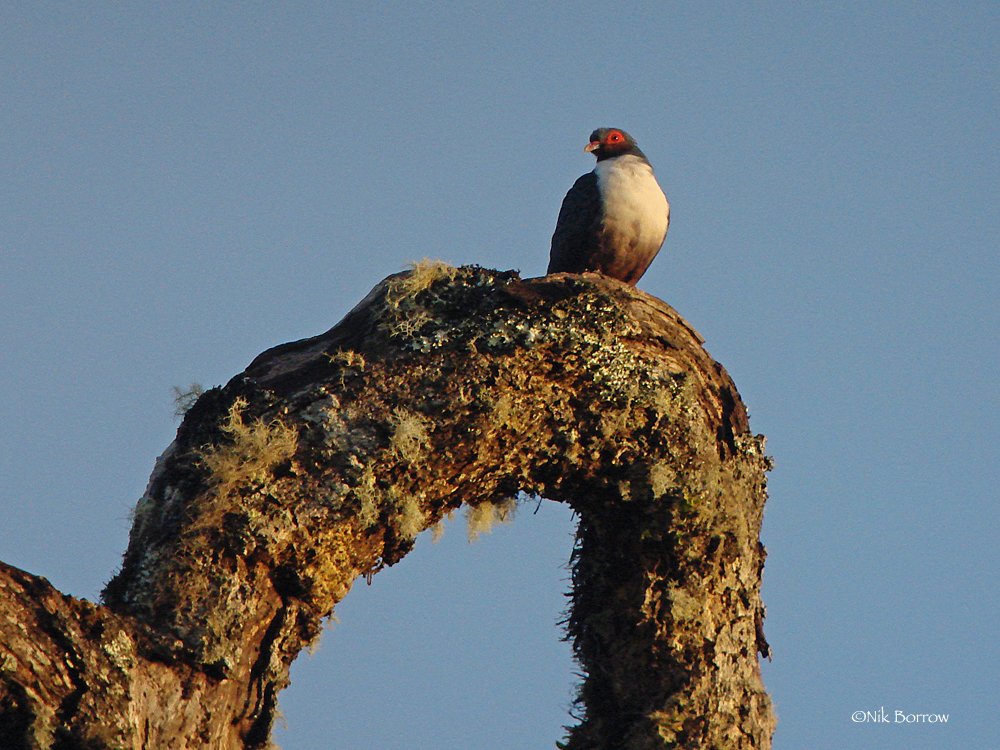
The Papuan mountain pigeon (Gymnophaps albertisii) is a species of bird in the pigeon family, Columbidae. It is found in the Bacan Islands, New Guinea, the D'Entrecasteaux Islands, and the Bismarck Archipelago, where it inhabits primary forest, montane forest, and lowlands. It is a medium-sized species of pigeon, being 33–36 cm (13–14 in) long and weighing 259 g (9.1 oz) on average. Adult males have slate-grey upperparts, chestnut-maroon throats and bellies, whitish breasts, and a pale grey terminal tail band. The lores and orbital region are bright red. Females are similar, but have grayish breasts and grey edges to the throat feathers.
The Papuan mountain pigeon is frugivorous, feeding on figs and drupes. It breeds from October to March in the Schrader Range, but may breed throughout the year across its range. It builds nests out of sticks and twigs in a tree or makes a ground nest in short dry grass, and lays a single egg. The species is very social and is usually seen in flocks of 10–40 birds, although some groups can have as many as 80 individuals. It is listed as being of least concern by the International Union for Conservation of Nature (IUCN) on the IUCN Red List due to its large range and lack of significant population decline.
From the article Papuan mountain pigeon on Wikipedia (CC BY-SA), quoted section by section
Description
The Papuan mountain pigeon is a medium-sized pigeon that is 33–36 cm (13–14 in) long and weighs 259 g (9.1 oz) on average. It has a slender appearance with a long tail and wings. Adult males of the nominate subspecies have head and upperparts slate-grey, with chestnut-maroon throats and bellies, whitish breasts, and grey undertail coverts. There is a pale grey terminal band on the tail. The lores and orbital region are bright red, while the bill is pink with a reddish base. The feet are purplish to pinkish-red. Females may have greyish breasts and grey edges to the throat feathers. Juveniles are duller, with dull brown or grey breasts, pale rufous underparts, and chestnut foreheads. Pinon's imperial pigeon looks similar to a juvenile Papuan mountain pigeon, but is larger, more heavily built, has a darker bill, and does not have the red of the orbital skin extending to the lores.
Vocalisations. The Papuan mountain pigeon is usually silent, but gives a muted, low-pitched, upslurred wooooooo m or woom during the breeding season. It also makes soft whistles.
Range & habitat
The Papuan mountain pigeon is found on New Guinea, its surrounding islands, and the Bacan Islands. It is mainly found in primary forest in hills and mountains, but occasionally visits nearby lowlands and may be common down to sea level in some areas. The nominate subspecies is mainly found at elevations of 0–3,350 m (0–10,991 ft), but exsul is found in montane forest at elevations of 900–1,500 m (3,000–4,900 ft). A dead Papuan mountain pigeon was found at an elevation of 4,450 m (14,600 ft) on the Carstensz Glacier, and is thought to have been crossing the New Guinea Highlands. The Papuan mountain pigeon is thought to be partially migratory, with large flocks in the Schrader Range descending to visit beech forests during the rainy season from October to March. It also moves to lower altitudes while foraging.
Wikipedia: “Distribution and habitat”
What it does
The Papuan mountain pigeon is a highly social species, occurring in flocks that usually contain 10–40 birds and that can sometimes have up to 80 individuals. It is also less commonly seen singly or in pairs. Individuals usually roost at high elevations, and then descend to lower elevations in flocks in the morning. While doing so, they can drop hundreds of metres in a single dive, producing a loud whooshing sound that is distinctive of Gymnophaps pigeons. While leaving the roost, flocks fly just above the treetops, but begin flying higher when crossing lowlands, sometimes flying high enough to be barely visible to the naked eye.
Diet. The Papuan mountain pigeon is frugivorous, and feeds on fruit such as figs and drupes from Planchonella, Ascarina philippinensis, and Cryptocarpa tessalata. It has also been observed feeding on the fruits of Elmerrillia tsiampaca, and may be an important seed disperser for that species. The species prefers fruit with larger seeds, with Lauraceae forming an important part of its diet, and will fly long distances during the fruiting seasons of particular plants. Foraging occurs in the canopy, and the species has been observed drinking from roadside puddles. It has also been observed eating soil.
Breeding. From July to December, as well as in April, male Papuan mountain pigeons have been observed performing display flights. …
Wikipedia: “Behaviour and ecology”
Listen
Looking for field recordings…
Where it lives
Recorded sightings
—
geo-referenced records in GBIF, from museums, herbaria and field observers.
Drag the globe to turn it. Dots are where records exist, not a range map; darker means more records.
In the stacks
Searching the stacks…
Every page naming Gymnophaps albertisii in the Biodiversity Heritage Library →
This page is assembled live from iNaturalist, GBIF, Wikipedia, the Source Library and the Internet Archive. It is not yet part of the hand-edited codex. iNaturalist taxon 3673.