On eBird ↗
Aztec Rail
Live sightings near you, the range map, bar charts of when it is seen, and Macaulay Library photos and recordings.
Aztec Rail
Rallus tenuirostris
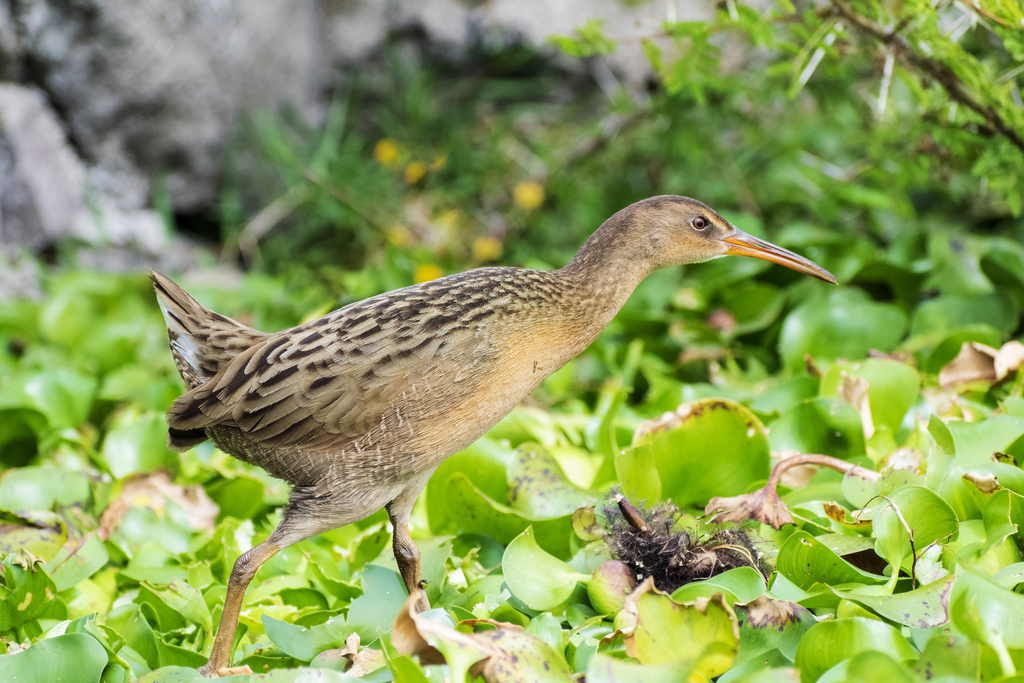
The Aztec rail or Mexican rail, (Rallus tenuirostris) is a Near Threatened species of bird in subfamily Rallinae of family Rallidae, the rails, gallinules, and coots. It is endemic to Mexico.
From the article Aztec rail on Wikipedia (CC BY-SA), quoted section by section
Description
The Aztec rail is 33 to 42 cm (13 to 17 in) long. Males weigh 271 to 331 g (9.6 to 12 oz) and females 220 to 268 g (7.8 to 9.5 oz). The sexes have similar plumage. The species has dark and light morphs. The dark morph has rich brown upperparts with blackish markings on the back. It has a pale pinkish cheek stripe and a white chin and throat. Its underparts are rufous with dull brown and white to pinkish cinnamon barring on the flanks and white undertail coverts. The light morph's underparts have a pale white center with a pinkish cinnamon wash. Juveniles have duller and darker upperparts and paler underparts than adults.
Range & habitat
The Aztec rail is found almost exclusively in central Mexico, in an area roughly defined by Nayarit, San Luis Potosí, Veracruz, and Guerrero. However, between 2013 and 2017 many records were documented in Chihuahua, mostly in the valley of the San Pedro River. The Aztec rail inhabits both seasonal and permanent highland freshwater marshes. In elevation it ranges from 800 m (2,600 ft) up to at least 2,500 m (8,200 ft).
Wikipedia: “Distribution and habitat”
What it does
The Aztec rail's principal food is crustaceans, especially crayfish, but its diet also includes molluscs, terrestrial and aquatic insects, and possibly spiders, fish, and amphibians.
Wikipedia: “Feeding”
Listen
Looking for field recordings…
Where it lives
Recorded sightings
—
geo-referenced records in GBIF, from museums, herbaria and field observers.
Drag the globe to turn it. Dots are where records exist, not a range map; darker means more records.
In the stacks
Searching the stacks…
Every page naming Rallus tenuirostris in the Biodiversity Heritage Library →
This page is assembled live from iNaturalist, GBIF, Wikipedia, the Source Library and the Internet Archive. It is not yet part of the hand-edited codex. iNaturalist taxon 367476.