- Animals
- ›Arthropods
- ›Hexapods
- ›Insects
- ›Winged and Once-winged Insects
- ›Beetles
- ›Water, Rove, Scarab, Long-horned, Leaf, and Snout Beetles
- ›Cucujiform Beetles
- ›Lady, Fungus, Scavenger, and Bark Beetles
- ›Lady Beetles
- ›Common Lady Beetles
- ›Black-spotted Lady Beetles
- ›Harmonia
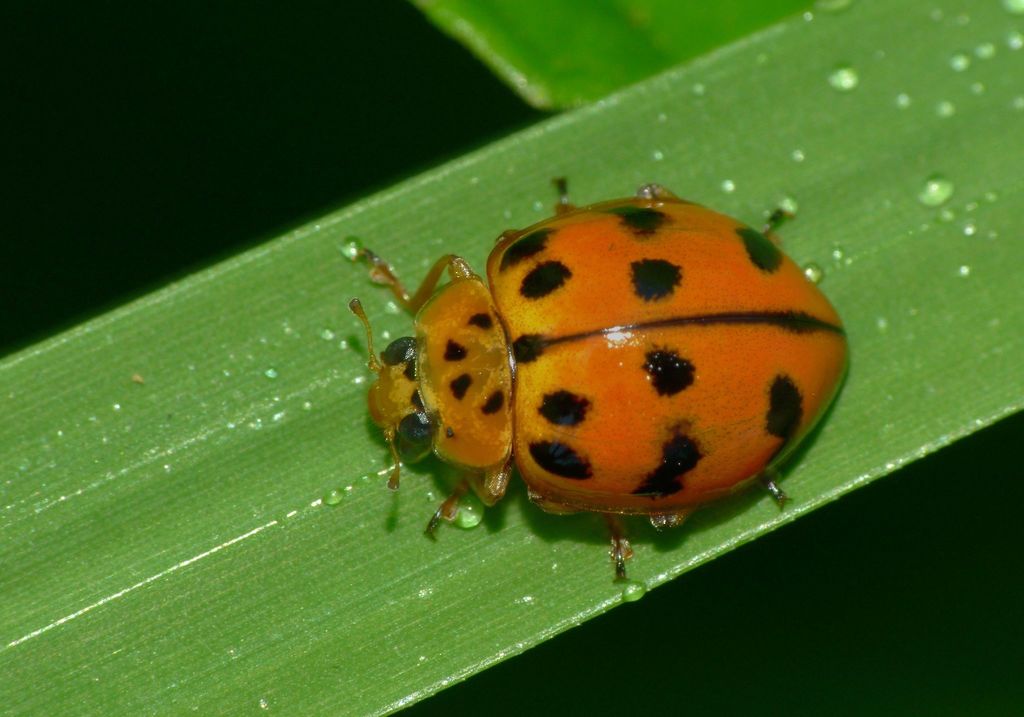
Maculate Ladybird
Harmonia octomaculata
Harmonia octomaculata (the large spotted ladybird) is a species of ladybird (the family Coccinellidae). Found in India, Pakistan, Nepal, Bangladesh, Sri Lanka, Micronesia, and Australia.
From the article Harmonia octomaculata on Wikipedia (CC BY-SA), quoted section by section
Description
It is a rare species of ladybird which is about 8 mm long. Elytra is yellowish dark orange in color with black dots. Adult female lays eggs singly or in cluster of 21 to 52 eggs on both surfaces of leaf, or sometimes on the dead aphid body. Eggs are yellowish, and oval shaped. With the development, the eggs turned to black and later become completely black before hatching. The length of eggs are about 1.25 to 1.37 mm. The incubation period varied from 3 to 4 days. After split open the eggs at the apical portion, grubs starts to wriggled out. The neonate grubs remained on egg case for some time and then moved towards prey for feeding. First instar larva is dark greyish and covered with spiny structures all over the body. Head with shiny dark head capsule. Legs are also darker in color which are comparatively longer and articulated with oval shaped body. Body length of the first instar is about 1.75 to 2.08 mm. Duration of first instar larva varies from 1 to 2 days. Second instar larva is shining black with yellowish head capsule. Later it is turned to dark brown to black in color. Body completely covered with spiny structures. Legs are black. Two orange spots can be observed on darso-lateral side of first abdominal segment. Body ventrally flat and slightly convex dorsally. Average length of second instar is about 3.90 to 4.65 mm. …
Listen
Looking for field recordings…
Where it lives
Recorded sightings
—
geo-referenced records in GBIF, from museums, herbaria and field observers.
Drag the globe to turn it. Dots are where records exist, not a range map; darker means more records.
In the stacks
Searching the stacks…
Every page naming Harmonia octomaculata in the Biodiversity Heritage Library →
This page is assembled live from iNaturalist, GBIF, Wikipedia, the Source Library and the Internet Archive. It is not yet part of the hand-edited codex. iNaturalist taxon 368264.