- Animals
- ›Arthropods
- ›Crustaceans
- ›Typical Crustaceans
- ›Malacostracans
- ›Decapods, Isopods, and allies
- ›Decapods and Krill
- ›Decapods
- ›Penaeid and sergestid shrimps
- ›Penaeoid Prawns
- ›Penaeid Prawns
- ›Penaeus
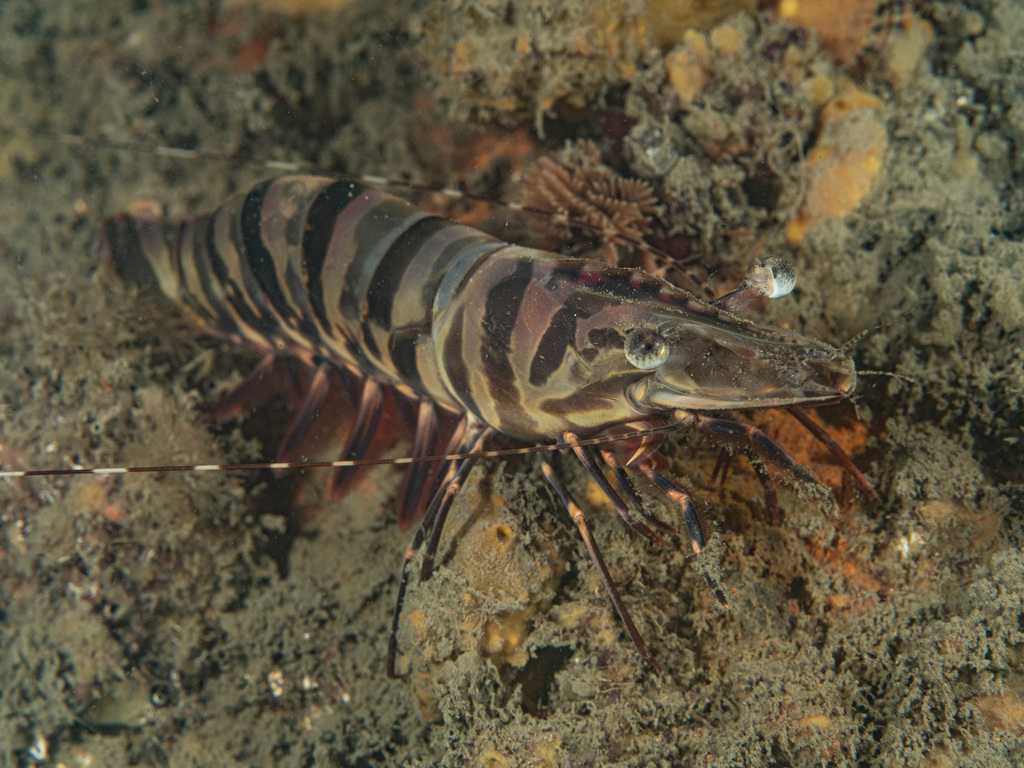
Brown Tiger Prawn
Penaeus esculentus
Penaeus esculentus (the brown tiger prawn, tiger prawn or common tiger prawn) is a species of prawn which is widely fished for consumption around Australia.
From the article Penaeus esculentus on Wikipedia (CC BY-SA), quoted section by section
Range & habitat
P. esculentus appears to be endemic to Australian waters, being found in warm waters from central New South Wales (near Sydney) to Shark Bay, Western Australia, chiefly at depths of 16–22 metres (52–72 ft). There is little population structure in the species, with only slight differentiation between regions east and west of the Pleistocene land bridge between Australia and New Guinea.
Wikipedia: “Distribution”
What it does
Juvenile P. esculentus live in seagrass beds, and reach sexual maturity at a carapace length of around 32 millimetres (1.3 in). Adults grow up to 155 millimetres (6.1 in) long, and resemble Penaeus monodon, albeit smaller and browner. They live offshore at depths of up to 200 metres (660 ft).
Wikipedia: “Ecology”
In human culture
Around 500 tonnes (490 long tons; 550 short tons) of brown tiger prawns are caught each year. Fisheries in Torres Strait are worth around A$24 million per year. It is closely related to Penaeus monodon, with which it can hybridise. It has the potential to be used in aquaculture (shrimp farming) since, although it grows less rapidly than P. monodon, it commands higher prices.
Wikipedia: “Fisheries and aquaculture”
Where it lives
Recorded sightings
—
geo-referenced records in GBIF, from museums, herbaria and field observers.
Drag the globe to turn it. Dots are where records exist, not a range map; darker means more records.
In the stacks
Searching the stacks…
Every page naming Penaeus esculentus in the Biodiversity Heritage Library →
This page is assembled live from iNaturalist, GBIF, Wikipedia, the Source Library and the Internet Archive. It is not yet part of the hand-edited codex. iNaturalist taxon 369153.