- Plants
- ›Vascular Plants
- ›flowering plants
- ›Dicots
- ›Soapberries, Cashews, Mahoganies, and Allies
- ›soapberry family
- ›Jagera
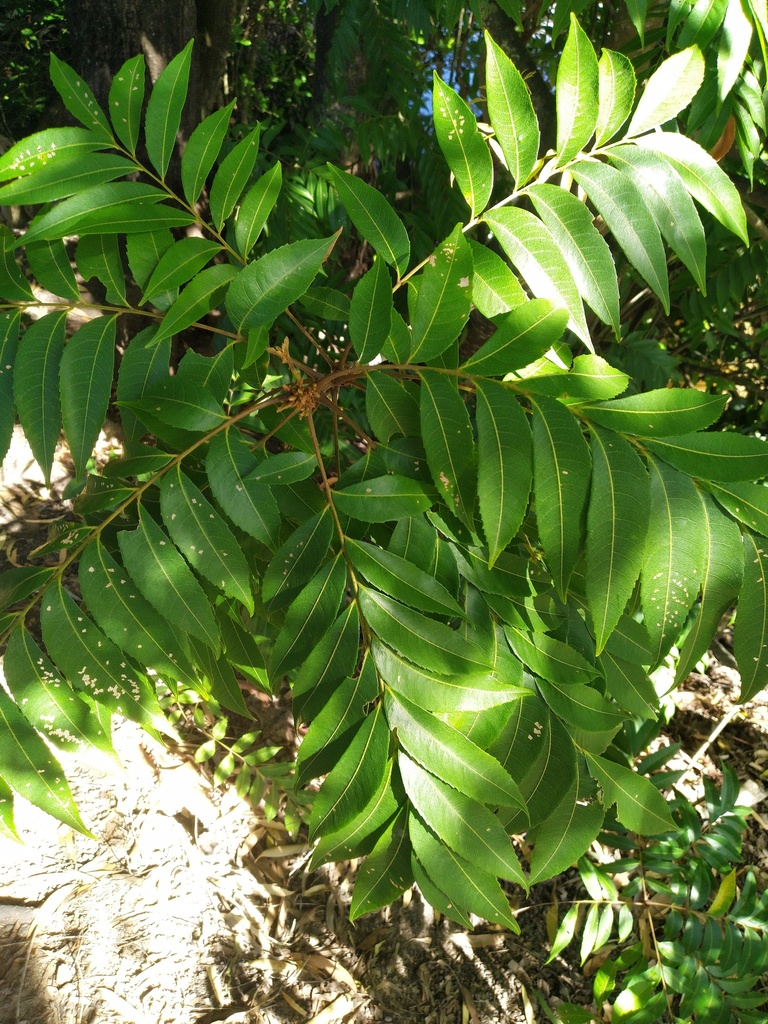
Fern Top
Jagera pseudorhus
Jagera pseudorhus, commonly named foambark, is a species of rainforest trees, in the northern half of eastern Australia and in New Guinea, constituting part of the flowering plant family Sapindaceae. Named for the saponin foam that forms on the bark after heavy rain.
From the article Jagera pseudorhus on Wikipedia (CC BY-SA), quoted section by section
Description
Jagera pseudorhus is a shrub or small tree up to about 18 m (59 ft) in height and a trunk diameter of about 30 cm (12 in). The branches and petioles (leaf stems) may be lightly or densely hairy. The leaves are arranged alternately along the branches and are pinnately divided, with four to nine pairs of leaflets. The individual leaflets are slightly curved along the midrib, with on side being slightly broader than the other. They measure between 3 and 11 cm (1.2 and 4.3 in) long and 2 and 3 cm (0.79 and 1.18 in) wide, and the margins may be either toothed or smooth. Flowers occur in panicles which appear near the tips of the branches and may be up to 25 cm (9.8 in) long and wide. Flowers are small, with petals about 2 mm (0.08 in) long. The fruit is a yellow-brown capsule about 15 mm (0.59 in) wide and long, covered in small stiff irritating hairs.
Range & habitat
In Australia, the native range is along the eastern seaboard from Myall Lakes, New South Wales, north to the tip of Cape York Peninsula, Queensland. In New Guinea they occur in the portion of the island nearest Cape York. They occur in drier rainforest types such as monsoon forest, gallery forest and beach forest, at altitudes from sea level to 850 m (2,790 ft).
Wikipedia: “Distribution and habitat”
What it does
The seeds are eaten by Lewin's honeyeaters, shrike-tits, koels and regent and satin bowerbirds.
Wikipedia: “Ecology”
At the table
Indigenous Australians use foam from crushed bark or leaves as a fish poison. It was also used as a soap in New Guinea. The timber has been used to make tool handles, and honey is harvested from the tree.
Wikipedia: “Uses”
In human culture
The genus Jagera was named after Herbert de Jager, a botanical collector for German botanist Georg Eberhard Rumphius. The species epithet pseudorhus was created by combining the prefix 'pseudo-' (false) with the genus name Rhus, as a reference to the similarity of the foliage.
Wikipedia: “Etymology”
Where it lives
Recorded sightings
—
geo-referenced records in GBIF, from museums, herbaria and field observers.
Drag the globe to turn it. Dots are where records exist, not a range map; darker means more records.
In the stacks
Searching the stacks…
Every page naming Jagera pseudorhus in the Biodiversity Heritage Library →
This page is assembled live from iNaturalist, GBIF, Wikipedia, the Source Library and the Internet Archive. It is not yet part of the hand-edited codex. iNaturalist taxon 369280.