- Plants
- ›Vascular Plants
- ›flowering plants
- ›Dicots
- ›myrtles, evening primroses, and allies
- ›myrtle family
- ›Myrtoideae
- ›Kanieae
- ›Ristantia
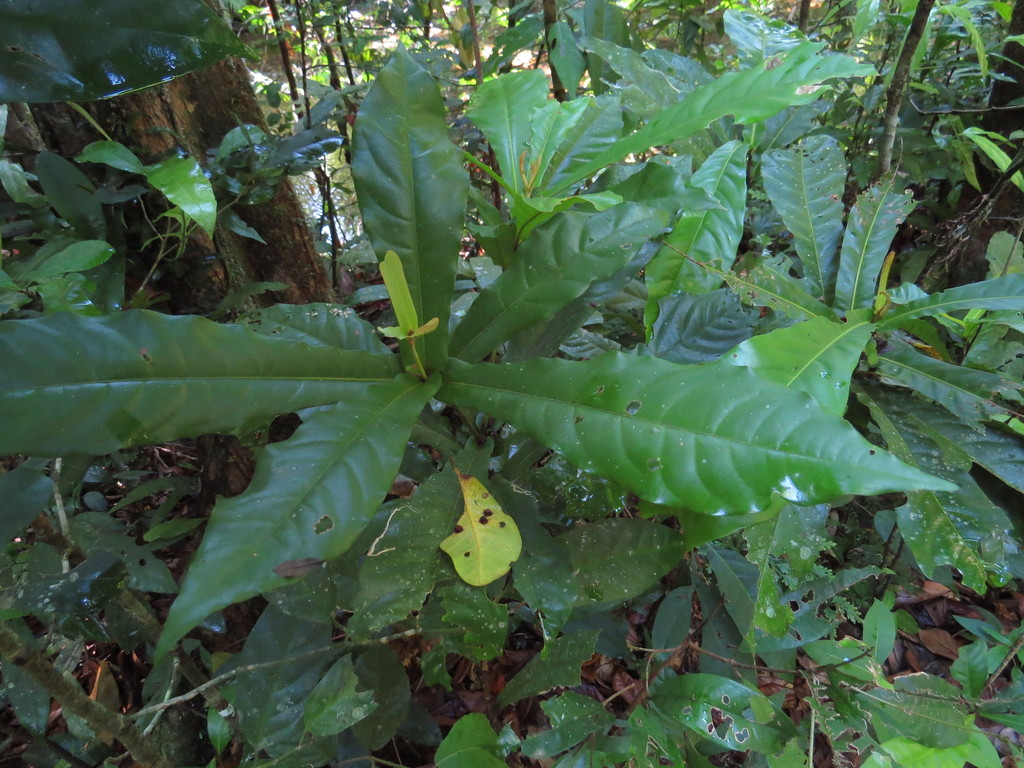
Sour Hardwood
Ristantia pachysperma
Ristantia pachysperma, commonly known as yellow penda, is a species of plant in the clove and eucalyptus family Myrtaceae. It is native to the Wet Tropics bioregion of Queensland, Australia, and is listed as critically endangered. It was first described in 1982.
From the article Ristantia pachysperma on Wikipedia (CC BY-SA), quoted section by section
Description
It is a large rainforest tree reaching up to 35 m (115 ft) in height, with brown furrowed bark and (sometimes) buttresses. The leaves are simple, arranged alternately or in whorls on the twigs, and are obovate in shape. They can grow up to 21 cm (8 in) long and are attached to the twig by a petiole (leaf stem) up to 12 mm (0.5 in) long. The inflorescences are produced from the leaf axils and are about 10 cm (4 in) long. They carry numerous quite small flowers, each with five white petals about 3 mm (0.12 in) long. Stamens number about 100 and are arranged in groups opposite the petals, each group with up to four sterile stamens and 15–20 fertile ones. The woody fruit is about 18 mm (0.7 in) diameter, with three locules or segments, and they usually contain one or two seeds per fruit.
Range & habitat
It occurs in two main populations to the north and south of Cairns, one near Cape Tribulation and another broader population from about Fishery Falls to Mourilyan. It grows in lowland rainforest at altitudes up to 100 m (330 ft), often close to swamps.
Wikipedia: “Distribution and habitat”
In human culture
The name Ristantia is an anagram of Tristania.The species epithet is derived from the Ancient Greek words păkhŭ́s, thick, and spérma, seed, as a reference to the hard woody capsules.
Wikipedia: “Etymology”
Where it lives
Recorded sightings
—
geo-referenced records in GBIF, from museums, herbaria and field observers.
Drag the globe to turn it. Dots are where records exist, not a range map; darker means more records.
In the stacks
Searching the stacks…
Every page naming Ristantia pachysperma in the Biodiversity Heritage Library →
This page is assembled live from iNaturalist, GBIF, Wikipedia, the Source Library and the Internet Archive. It is not yet part of the hand-edited codex. iNaturalist taxon 369752.