- Animals
- ›Arthropods
- ›Crustaceans
- ›Typical Crustaceans
- ›Barnacles and Copepods
- ›Copepods
- ›Neocopepoda
- ›Podoplea
- ›Siphon-mouth Copepods
- ›Sea Lice
- ›Lepeophtheirus
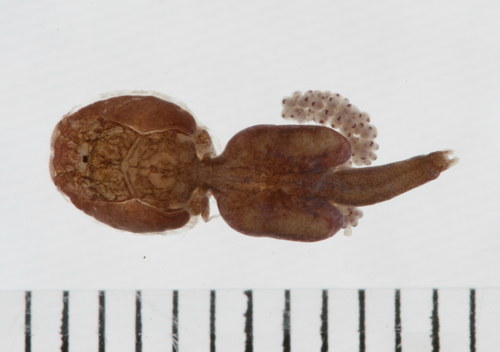
Salmon Louse
Lepeophtheirus salmonis
The salmon louse (Lepeophtheirus salmonis) is a species of copepod in the genus Lepeophtheirus. It is a sea louse, a parasite living mostly on salmon, particularly on Pacific and Atlantic salmon and sea trout, but is also sometimes found on the three-spined stickleback. It feeds on the mucus, skin and blood of the fish. Once detached, they can be blown by wind across the surface of the sea, like plankton. When they encounter a suitable marine fish host, they adhere themselves to the skin, fins, or gills of the fish, and feed on the mucus or skin. Sea lice only affect fish and are not harmful to humans.
Salmon lice are ectoparasites of salmon. In the 1980s, high levels of salmon lice were observed on pink salmon smolts. Salmon lice are found in the Pacific and Atlantic Oceans; they infect pink salmon, Atlantic salmon, and chum salmon.
From the article Salmon louse on Wikipedia (CC BY-SA), quoted section by section
Description
The thorax is broad and shield shaped. The abdomen is narrower, and in the females, filled with eggs. The females also have two long egg strings attached to the abdomen. The salmon louse uses its feet to move around on the host or to swim from one host to another.
What it does
Some research has occurred on the problems caused by this species in aquaculture, but little is known about the salmon louse's life in nature. Salmon louse infections in fish farming facilities, though, can cause epizootics in wild fish. When aquaculturalists place their post smolts into sea water, they are commonly known to be ectoparasite free, and this can last for many months. L. salmonis has a direct lifecycle (i.e. a single host) with eight life stages with ecdysis in between. These planktonic nauplii cannot swim directionally against the water current, but drift passively, and have the ability to adjust their depth in the water column. They are almost translucent in colour and are about 0.5–0.6 mm (0.020–0.024 in) long. At 5 °C (41 °F), the nauplius 1 stage lasts about 52 hours, and about 9 hours at 15 °C (59 °F). Nauplius 2 takes 170 hours and 36 hours at these temperatures, respectively. They are responsive to light and salinity. Low salinities appear to have a greater effect on the planktonic stages than on the parasitic stages. Newly hatched larvae do not survive below salinities of 15‰ and poor development to the infective copepodid occurs between 20 and 25‰. Nauplii and copepodids are positively phototactic and exhibit a daily vertical migration, rising during the day and sinking at night. The ability to find their hosts is not light dependent. …
Wikipedia: “Life cycle”
Where it lives
Recorded sightings
—
geo-referenced records in GBIF, from museums, herbaria and field observers.
Drag the globe to turn it. Dots are where records exist, not a range map; darker means more records.
In the stacks
Searching the stacks…
Every page naming Lepeophtheirus salmonis in the Biodiversity Heritage Library →
This page is assembled live from iNaturalist, GBIF, Wikipedia, the Source Library and the Internet Archive. It is not yet part of the hand-edited codex. iNaturalist taxon 369806.