- Plants
- ›Vascular Plants
- ›flowering plants
- ›Dicots
- ›carrots, ivies, and allies
- ›cheesewood family
- ›Bursaria
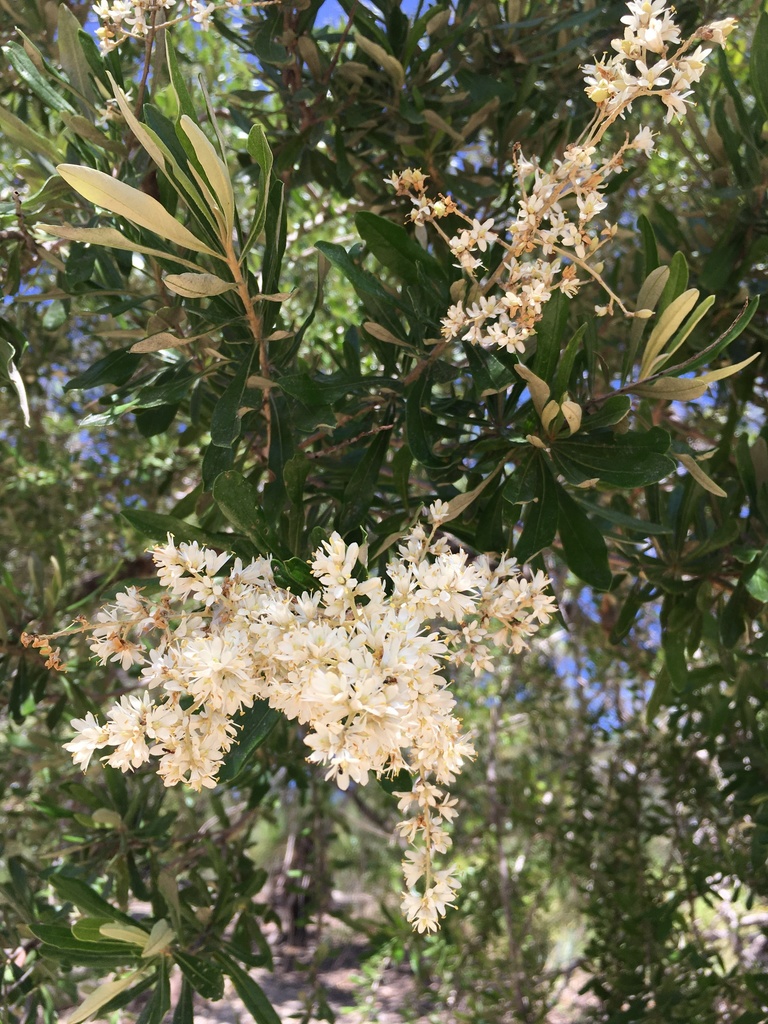
Mock Orange
Bursaria incana
Bursaria incana, commonly known as prickly pine, box thorn, native box, native olive and mock orange, is a species of flowering plant in the family Pittosporaceae and is endemic to northern Australia. It is a tall shrub or small, sparse tree with softly-hairy foliage, heart-shaped leaves with the narrower end towards the base, leafy groups of white flowers with five spreading sepals, five spreading petals, and flattened fruit.
From the article Bursaria incana on Wikipedia (CC BY-SA), quoted section by section
Description
Bursaria incana is a tall shrub or sparse tree that typically grows to a height of 3–7 m (9.8–23.0 ft), its foliage mostly softly-hairy and the young branchlets spiny. Its adult leaves are heart-shaped to lance-shaped or egg-shaped with the narrower end towards the base, 60–90 mm (2.4–3.5 in) long, 6–16 mm (0.24–0.63 in) wide on a petiole less than 2 mm (0.079 in) long. The flowers are arranged in leafy groups, each flower on a pedicel less than 2 mm (0.079 in) long. The five sepals are 1–2 mm (0.039–0.079 in) long and free from each other, the five petals white, spreading from the base, 6.0–7.5 mm (0.24–0.30 in) long. The five stamens are free from each other and the pistil is densely covered with matted hairs. Flowering occurs in mid-summer, coinciding with the start of the dry season and the fruit is a flattened brown capsule 8–10 mm (0.31–0.39 in) long.
Range & habitat
This bursaria occurs throughout most of Queensland apart from near the coast and the arid inland, and in isolated populations in the northern part of the Northern Territory. It usually grows in open, grassy woodland and open forest.
== References ==
Wikipedia: “Distribution and habitat”
Where it lives
Recorded sightings
—
geo-referenced records in GBIF, from museums, herbaria and field observers.
Drag the globe to turn it. Dots are where records exist, not a range map; darker means more records.
In the old herbals & bestiaries

In the stacks
Searching the stacks…
Every page naming Bursaria incana in the Biodiversity Heritage Library →
This page is assembled live from iNaturalist, GBIF, Wikipedia, the Source Library and the Internet Archive. It is not yet part of the hand-edited codex. iNaturalist taxon 369894.