- Plants
- ›Vascular Plants
- ›flowering plants
- ›Dicots
- ›Woodsorrels, Quandongs, and Allies
- ›quandong family
- ›Elaeocarpus
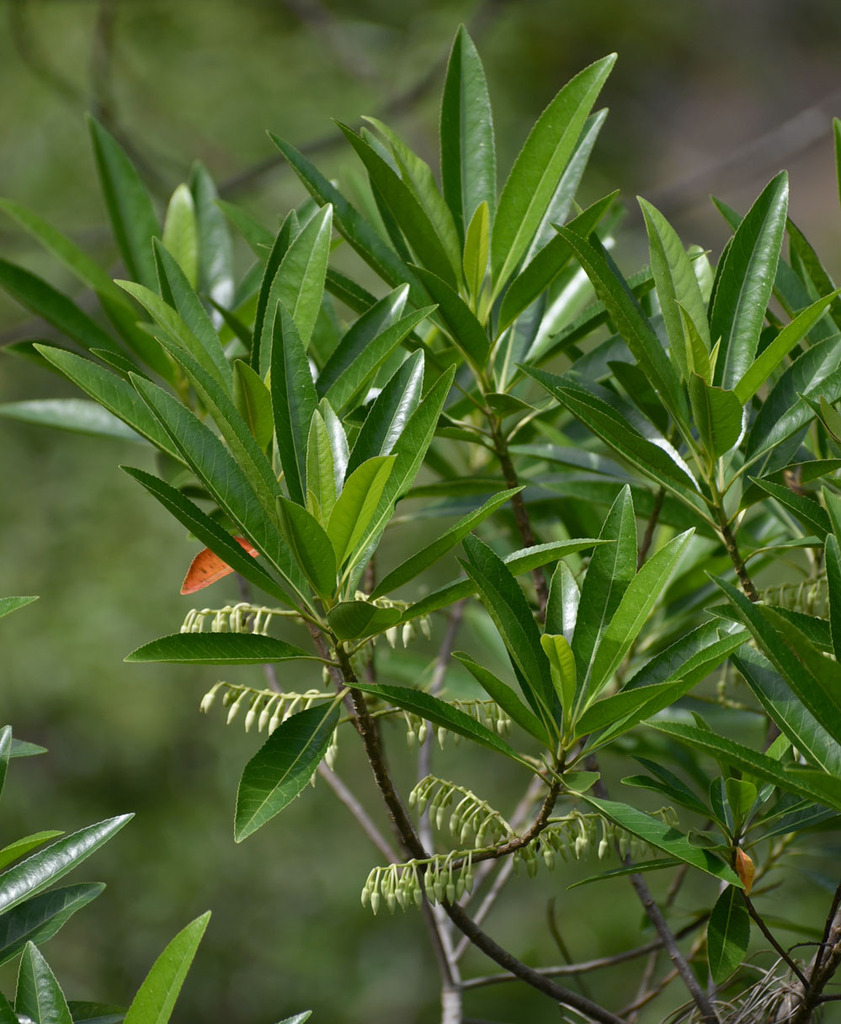
blue quandong
Elaeocarpus grandis
Elaeocarpus angustifolius is a rainforest tree in the Elaeocarpaceae family, bearing bitter edible fruit. It is commonly known as blue marble tree, and also as blue fig or blue quandong, although it is not closely related to figs. The junior synonym Elaeocarpus grandis, from a later description of the species by Ferdinand von Mueller, is also frequently found. A large tree up to 50 metres tall, usually with elaborate buttressed roots.
From the article Elaeocarpus grandis on Wikipedia (CC BY-SA), quoted section by section
Description
Elaeocarpus grandis is a large tree that may grow to a height of 35 m (115 ft). The trunk is usually straight and cylindrical with pale grey bark marked by vertical lines. Buttress roots are present even on smaller trees, becoming large and elaborate on older trees. The crown is sparse and open, the branches layered, with the leaves clustered towards the ends of the twigs. The leaves are bright green above and paler below, turning bright red before falling; it is common to see red leaves in the canopy at any time of year. The leaves are simple, i.e. without divisions or lobes, and arranged alternately on the twigs. They are oblong to elliptic and measure up to 18 cm (7.1 in) long and 4 cm (1.6 in) wide, and are regularly and shallowly toothed. They are held on a petiole up to 2 cm (0.8 in) long and have many small domatia on the underside. The blue quandong begins to flower around the seventh year, and the inflorescences are racemes up to 10 cm (3.9 in) long, produced in the leaf axils and on the branches below the leaves. They each bear 12–16 fragrant, pale green to white flowers on pedicels about 15 mm (0.6 in) long. The flowers measure about 10 mm (0.4 in) wide and 15 mm (0.6 in) long, with five petals that have thin lobes at their apices, giving them a fringed appearance. …
Range & habitat
The blue quandong grows in well developed tropical and subtropical rainforest, often along watercourses. Its range is the coastal forests from the islands of the Torres Strait, through to the Nambucca River in northeastern New South Wales. In north Queensland the altitudinal range is from sea level to 1,100 m (3,600 ft).
Wikipedia: “Distribution and habitat”
What it does
The fruit of E. grandis are eaten by a variety of birds and animals, including the southern cassowary; the wompoo, rose-crowned and superb fruit doves; the pied imperial, topknot and white-headed pigeons; the eastern tube-nosed bat and the spectacled flying fox; the musky rat-kangaroo and native rats; and Lumholtz's tree-kangaroo. The larvae of the moths Echiomima mythica and Eschatura lemurias bore into the timber of fallen trees, and were subsequently eaten by people of the Kuku Yalanji nation.
Wikipedia: “Ecology”
At the table
Indigenous Australians ate the fruit raw or buried the unripe fruit in sand for four days making it sweet and more palatable. Early settlers used the fruit for jams, pies and pickles.
Wikipedia: “Use as food”
How it is grown
The blue quandong is ideal for large gardens and parks, but its sheer size make it unsuitable for suburban home gardens or planting near drains. About 50 of these trees have been planted throughout the city of Cairns.
Wikipedia: “Cultivation”
In human culture
The genus name Elaeocarpus is derived from the Greek words ελιά (eliá) meaning "olive", and καρπός (karpós) meaning "fruit", which is a reference to the superficial similarity of the fruits of the two taxa. The species epithet grandis is the Latin word for "large", referring to the great height that this tree will grow to.
Wikipedia: “Etymology”
Where it lives
Recorded sightings
—
geo-referenced records in GBIF, from museums, herbaria and field observers.
Drag the globe to turn it. Dots are where records exist, not a range map; darker means more records.
In the stacks
Searching the stacks…
Every page naming Elaeocarpus grandis in the Biodiversity Heritage Library →
This page is assembled live from iNaturalist, GBIF, Wikipedia, the Source Library and the Internet Archive. It is not yet part of the hand-edited codex. iNaturalist taxon 369964.