- Plants
- ›Vascular Plants
- ›flowering plants
- ›Dicots
- ›Roses, Elms, Figs, and Allies
- ›Hackberry Family
- ›Celtis
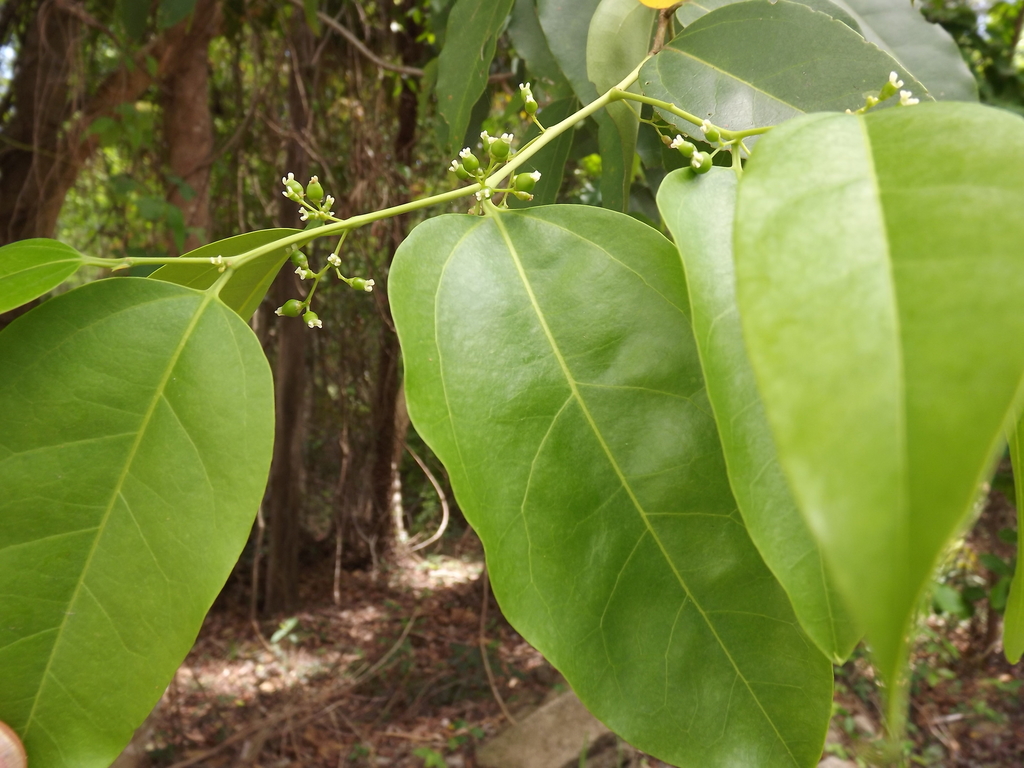
Investigator-tree
Celtis paniculata
Celtis paniculata, is a coastal rainforest tree. In Australia it occurs from Kiama (34° S) in New South Wales to the Endeavour River (15° S) in tropical Queensland. It also grows at Norfolk Island, eastern Malesia, Micronesia, and Polynesia. In Australia it is commonly known as native celtis, silky celtis, native hackberry, or investigator tree.
From the article Celtis paniculata on Wikipedia (CC BY-SA), quoted section by section
Description
The tree grows to 40 m (130 ft) tall and 90 cm (35 in) trunk width, though usually much smaller. The trunk is mostly cylindrical and somewhat buttressed at the base. The bark is thin, greyish brown and smooth, with pustular vertical lines.
Leaves. Leaves are elliptical in shape with a prominent leaf tip. Leaves are alternate and simple, smooth, not toothed, 6–10 cm (2.4–3.9 in) long with a pointed tip. The leaf stalk is somewhat channelled and flattened on the top, and 6–10 mm (0.2–0.4 in) in length. Both sides of the leaf are of a dull green shade. With a hand lens, translucent glands may be seen in the leaves. The base of the leaf is often oblique, that is of unequal length on either side of the leaf stem. Leaf venation is more evident on the underside of the leaf. An identifying feature is the intramarginal leaf vein, which starts at the leaf base and travels on either edge of the leaf, a distance of quarter to half the length of the leaf.
Flowers and fruit. Green flowers in axilliary cymes or panicles appear from December to January. The fruit is a blue to black, round to oval shaped drupe, 8–10 mm (0.3–0.4 in) long. containing a single seed which has veiny ridges. Fruit matures from July to March.
Germination and seedlings. Germination takes between 48 and 100 days. …
Range & habitat
C. paniculatta has a wide natural distribution in tropical Asia and the Pacific, including Borneo, the Moluccas, the Lesser Sunda Islands, the Caroline Islands, New Guinea, the Solomon Islands, Vanuatu, New Caledonia, and the Northern Territory and Queensland. In Australia it occurs from Kiama (34° S) in New South Wales to Cape York Peninsula, as well as on Norfolk Island. It will grow in a variety of forest types, including sandy beach forests, rainforests, monsoon forests and sclerophyll forests, and on a variety of soil types, including soils derived from basalt, granite and limestone. It is often seen in coastal areas, but in northern parts of Queensland it can be found up to an altitude of 800 m (2,600 ft).
Wikipedia: “Distribution and habitat”
What it does
Celtis paniculata is a food tree for the blue beak, common aeroplane, tailed emperor and other butterflies. Many rainforest pigeons and other birds feed on the fruit. An endangered population of the beetle Menippus darcyi feeds on Celtis paniculata. The tree produces a useful general purpose timber, with a specific gravity of 0.70.
Wikipedia: “Ecology & uses”
Where it lives
Recorded sightings
—
geo-referenced records in GBIF, from museums, herbaria and field observers.
Drag the globe to turn it. Dots are where records exist, not a range map; darker means more records.
In the stacks
Searching the stacks…
Every page naming Celtis paniculata in the Biodiversity Heritage Library →
This page is assembled live from iNaturalist, GBIF, Wikipedia, the Source Library and the Internet Archive. It is not yet part of the hand-edited codex. iNaturalist taxon 370005.