- Plants
- ›Vascular Plants
- ›flowering plants
- ›Dicots
- ›myrtles, evening primroses, and allies
- ›myrtle family
- ›Myrtoideae
- ›Myrteae
- ›Decasperminae
- ›Rhodomyrtus
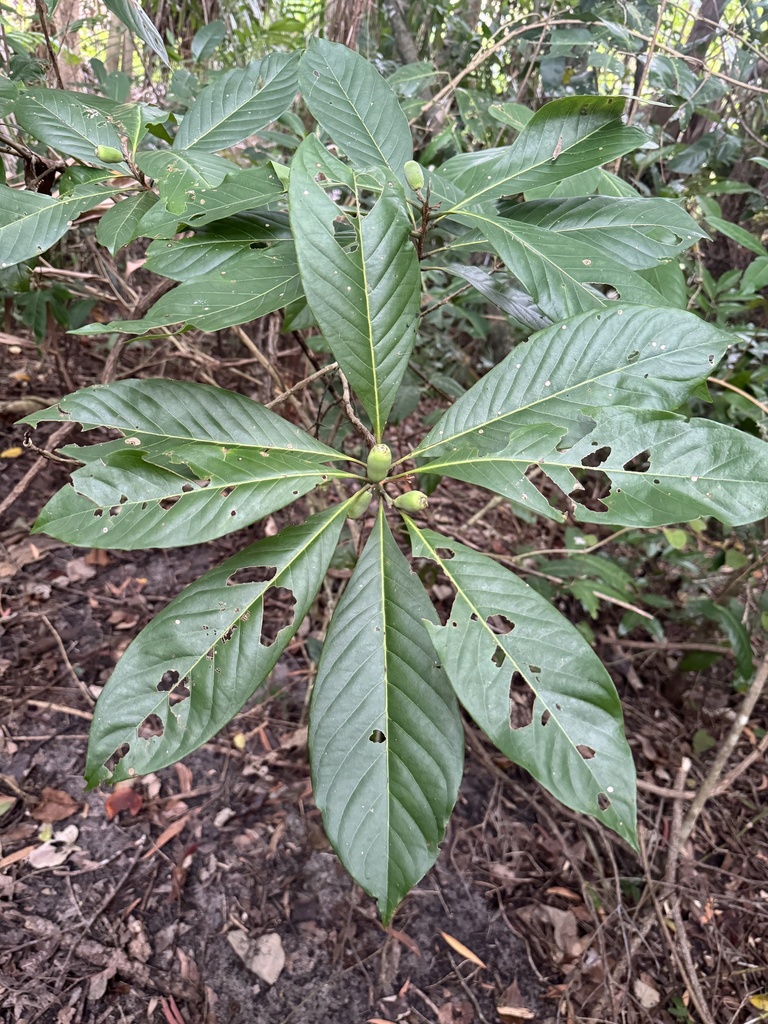
finger cherry
Rhodomyrtus macrocarpa
Rhodomyrtus macrocarpa, commonly known as finger cherry, Cooktown loquat, or wannakai, is a species of plant in the family Myrtaceae native to New Guinea, the Aru Islands, and the Australian state of Queensland. Eating the fruits is reputed to cause blindness.
From the article Rhodomyrtus macrocarpa on Wikipedia (CC BY-SA), quoted section by section
Description
Rhodomyrtus macrocarpa is a shrub or small tree growing to about 8 m (26 ft) tall with rough pale brown bark. The growing tips are covered in fine pale grey hairs. The leaves are elliptic, hairless and simple (i.e. not divided) and arranged in opposite pairs. They measure up to 25 cm (9.8 in) long by 11 cm (4.3 in) wide and are held on petioles about 10–20 mm (0.4–0.8 in) long. Flowers are produced in the upper leaf axils in clusters of 1–3; they are white or pink and about 2.5 cm (1 in) across, with numerous stamens. The fruit is a pink or red cylindrical botanical berry up to 6 cm (2.4 in) long and 2.5 cm (1 in) wide, containing from one to several flattened, pale brown seeds about 10 mm (0.4 in) diameter.
Toxicity
While it is known that the fruit of this species were eaten by Indigenous Australians without ill-effect, there has been a number of well documented incidents involving European settlers eating the fruit which resulted in them becoming permanently blind. The cases usually involved children, and the ingestion of large numbers of fruit. It has been suggested that unripe fruit or a fungal infection in the fruit may be involved, but as of November 2024 no pathogen or constituent compound of the fruit has been identified as being responsible for the loss of sight, and the cause remains a mystery.
How it is grown
The plant produces showy flowers and colourful fruit, which would normally earmark it for cultivation as an ornamental, however, this is discouraged due to the potential toxicity of the fruit.
Wikipedia: “Cultivation”
Where it lives
Recorded sightings
—
geo-referenced records in GBIF, from museums, herbaria and field observers.
Drag the globe to turn it. Dots are where records exist, not a range map; darker means more records.
In the stacks
Searching the stacks…
Every page naming Rhodomyrtus macrocarpa in the Biodiversity Heritage Library →
This page is assembled live from iNaturalist, GBIF, Wikipedia, the Source Library and the Internet Archive. It is not yet part of the hand-edited codex. iNaturalist taxon 370200.