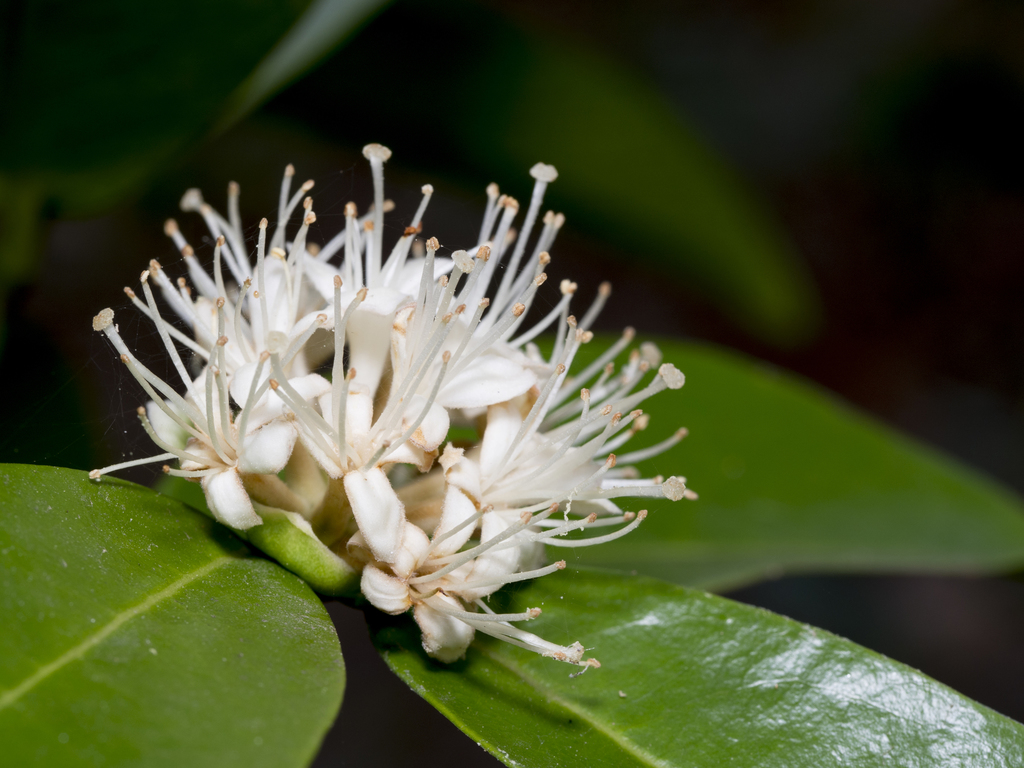
Phaleria octandra
Phaleria octandra, commonly known as dwarf Phaleria, is a species of plant in the family Thymelaeaceae, native to Indonesia, New Guinea and northern Australia. It is a rainforest shrub that was first described by Carl Linnaeus in 1767, and it has the conservation status of least concern.
From the article Phaleria octandra on Wikipedia (CC BY-SA), quoted section by section
Description
This is a shrub growing to about 2 or 3 m (6 ft 7 in or 9 ft 10 in) tall. It has elliptic leaves measuring up to 20 cm (7.9 in) long and 7 cm (2.8 in) wide, which are arranged in opposite pairs on the twigs. White scented flowers appear from November to February, followed in March and April by globular, shiny red fruit about 1.5 cm (0.59 in) long.
Range & habitat
The westerly limit of Phaleria octandra's native range is the Indonesian island of Java, then eastward through the Lesser Sunda Islands, Maluku Islands, New Guinea and the Solomon Islands, and south into the Northern Territory and Queensland in Australia. It is found as far south as Sarina, Queensland. It inhabits mature rainforest on a variety of soils. In Australia it occurs up to about 800 m (2,600 ft) in altitude.
Wikipedia: “Distribution and habitat”
How it is grown
Dwarf Phaleria is considered to be an attractive plant for cultivation, due to the dense clusters of showy flowers. It needs shade, aerated soil and plenty of moisture.
Wikipedia: “Cultivation”
Where it lives
Recorded sightings
—
geo-referenced records in GBIF, from museums, herbaria and field observers.
Drag the globe to turn it. Dots are where records exist, not a range map; darker means more records.
In the stacks
Searching the stacks…
Every page naming Phaleria octandra in the Biodiversity Heritage Library →
This page is assembled live from iNaturalist, GBIF, Wikipedia, the Source Library and the Internet Archive. It is not yet part of the hand-edited codex. iNaturalist taxon 370216.