- Plants
- ›Vascular Plants
- ›flowering plants
- ›Dicots
- ›Heathers, Balsams, Primroses, and Allies
- ›symplocos family
- ›Symplocos
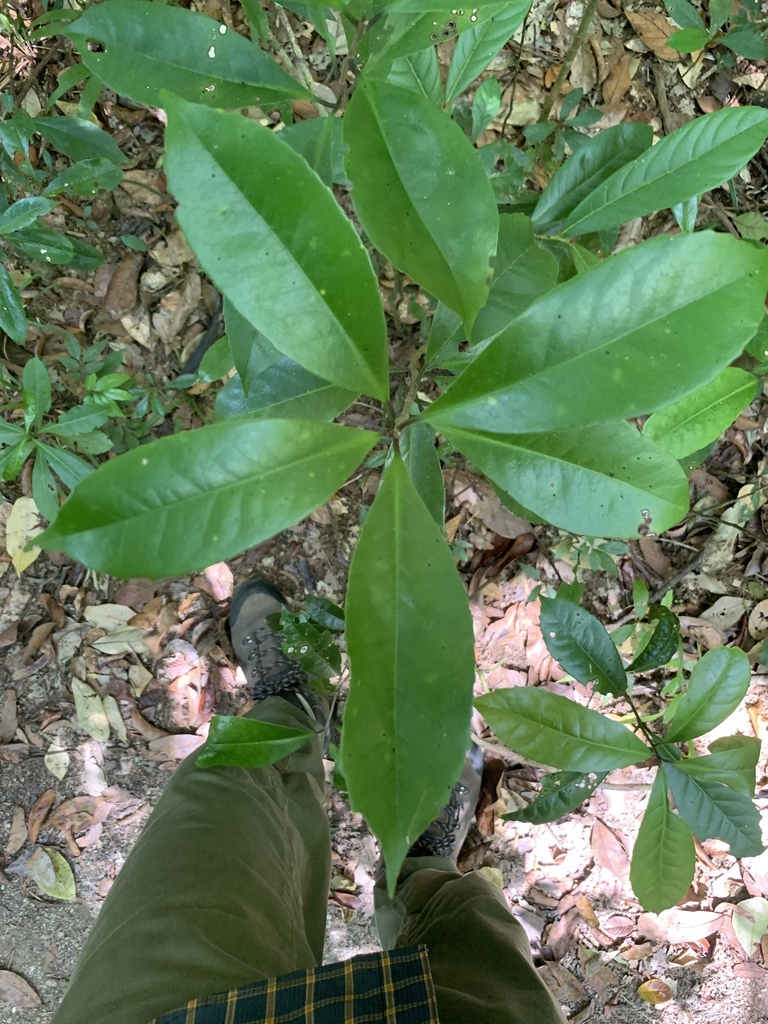
Symplocos puberula
Symplocos puberula is a plant in the family Symplocaceae found in northeastern Queensland, Australia. It is a tree up to 25 m (82 ft) tall with pubescent new growth (i.e. covered in fine soft hairs). The leaves are stiff, widest near the apex and tapered at the base (obovate), and they have a short "drip tip". They measure up to 15 cm (5.9 in) long and 6 cm (2.4 in) wide, and have 6–12 pairs of lateral veins either side of the...
From the article Symplocos puberula on Wikipedia (CC BY-SA), quoted section by section
Description
Symplocos puberula is a tree up to 25 m (82 ft) tall with pubescent new growth (i.e. covered in fine soft hairs). The leaves are stiff, widest near the apex and tapered at the base (obovate), and they have a short "drip tip". They measure up to 15 cm (5.9 in) long and 6 cm (2.4 in) wide, and have 6–12 pairs of lateral veins which curve towards the leaf tip and connect to the next vein. The leaf edges are finely toothed in the distal half of the leaf blade. The inflorescence measures up to 7 cm (2.8 in) long and takes the form of a panicle or a raceme. The white flowers are small – the sepals are about 1.5 mm (0.06 in) long and the petals about 5 mm (0.2 in) long. They have 50 to 70 stamens measuring up to 6 mm (0.24 in) long, and the style is about 4 mm (0.16 in) long. The fruit is a dark blue or black drupe with a persistent calyx at the tip. It measures about 10 mm (0.39 in) long and 6 mm (0.24 in) wide.
Range & habitat
This species can be found from the McIlwraith Range near Cooktown, south along the east coast to the area around Eungella. It inhabits well developed rainforest on metamorphic and basalt soils.
Wikipedia: “Distribution and habitat”
Where it lives
Recorded sightings
—
geo-referenced records in GBIF, from museums, herbaria and field observers.
Drag the globe to turn it. Dots are where records exist, not a range map; darker means more records.
In the stacks
Searching the stacks…
Every page naming Symplocos puberula in the Biodiversity Heritage Library →
This page is assembled live from iNaturalist, GBIF, Wikipedia, the Source Library and the Internet Archive. It is not yet part of the hand-edited codex. iNaturalist taxon 370584.