- Animals
- ›Arthropods
- ›Hexapods
- ›Insects
- ›Winged and Once-winged Insects
- ›Ants, Bees, Wasps, and Sawflies
- ›Narrow-waisted Wasps, Ants, and Bees
- ›Ants, Bees, and Stinging Wasps
- ›Vespoid Wasps
- ›Hornets, Paper Wasps, Potter Wasps, and Allies
- ›Paper Wasps
- ›Polistini
- ›Polistes
- ›Fuscopolistes
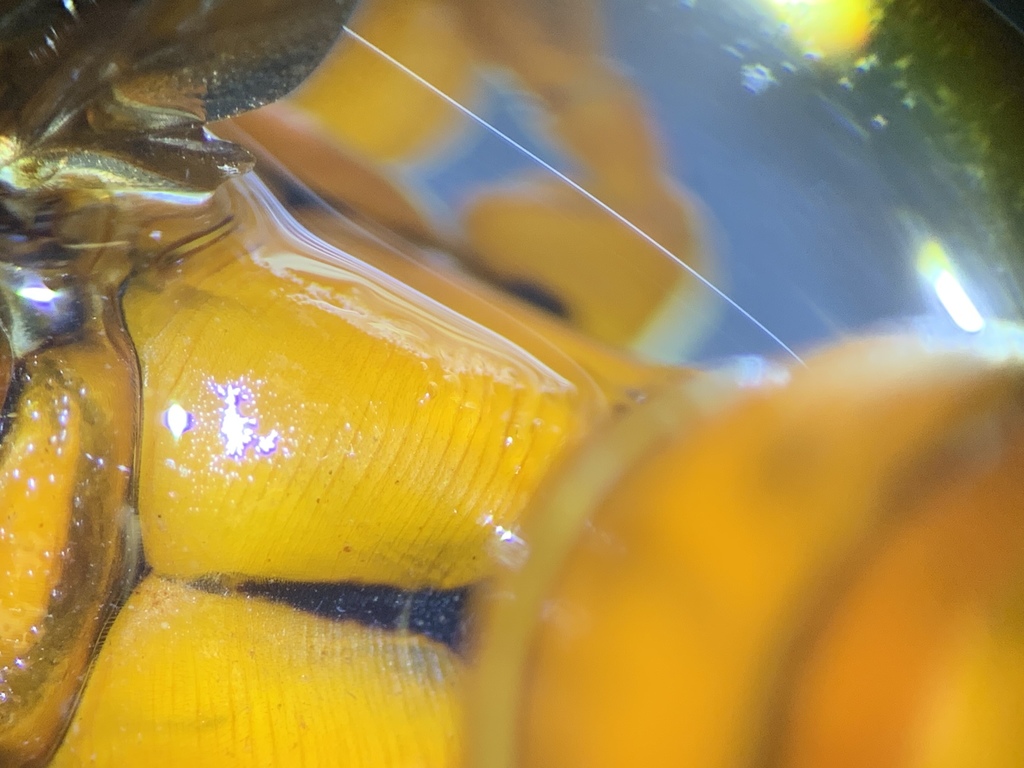
Coarse-backed Red Paper Wasp
Polistes rubiginosus
Polistes rubiginosus is one of two species of red paper wasp found in the eastern United States (the other being Polistes carolina) and is noted for the coarser ridges on its propodeum. It is a social wasp (subfamily Polistinae) in the family Vespidae. Until taxonomic revision by Matthias Buck in 2012, P. rubiginosus was long known under the name P. perplexus. It occurs northernmost from Maryland, Pennsylvania to northern Ohio, south to Georgia, and from there west to central Illinois, Kansas, Oklahoma, Texas, and Arizona.
From the article Polistes rubiginosus on Wikipedia (CC BY-SA), quoted section by section
Description
The length of the forewing is 18.0–21.5 mm in the female, 17.0–18.0 mm in the male. The body of the creature is almost entirely rusty red, broken by a number of black to dark brown markings. These markings consist of a usually well developed spot around the eyes, this rarely divided into individual spots around each eye, and often a spot in front of pronotal carina. In some cases there are yellow markings on the propodeal valves and tarsi. Polistes rubiginosus and P. carolina are the only large red-coloured wasp species in the eastern US. P. rubiginosus is, however, extremely similar to P. carolina, and can be found in the same regions; the key morphological difference being the malar area (the "cheek") seen from the side, but this works only for the female wasps. This area and the gena are covered in silvery pubescent hairs. P. rubiginosus is the only Polistes wasp in the P. fuscatus-group to have this characteristic, all other species have this area bare or almost so. Both sexes of P. rubiginosus can also be distinguished from P. carolina by the coarser transverse ridging of the propodeum.
Range & habitat
This species is endemic to the eastern United States. It has been recorded from Pennsylvania south to Georgia and west to Kansas, Oklahoma, and Texas. This currently understood distribution largely overlaps with that of P. carolina, apart from absence in Florida. Because this species is very similar to P. carolina, its historical range may have been under-reported.
Wikipedia: “Distribution”
What it does
The ecology is poorly known because of the aforementioned confusion with P. carolina. It is a eusocial insect, building nests in sheltered locations such as in hollow trees, or under wooden platforms and inside storage buildings.
Wikipedia: “Ecology”
Listen
Looking for field recordings…
Where it lives
Recorded sightings
—
geo-referenced records in GBIF, from museums, herbaria and field observers.
Drag the globe to turn it. Dots are where records exist, not a range map; darker means more records.
In the stacks
Searching the stacks…
Every page naming Polistes rubiginosus in the Biodiversity Heritage Library →
This page is assembled live from iNaturalist, GBIF, Wikipedia, the Source Library and the Internet Archive. It is not yet part of the hand-edited codex. iNaturalist taxon 370906.