- Plants
- ›Vascular Plants
- ›flowering plants
- ›Dicots
- ›pinks, cactuses, and allies
- ›knotweed family
- ›Polygonoideae
- ›Docks, Sorrels and Rhubarbs
- ›Rumex
- ›Rumex
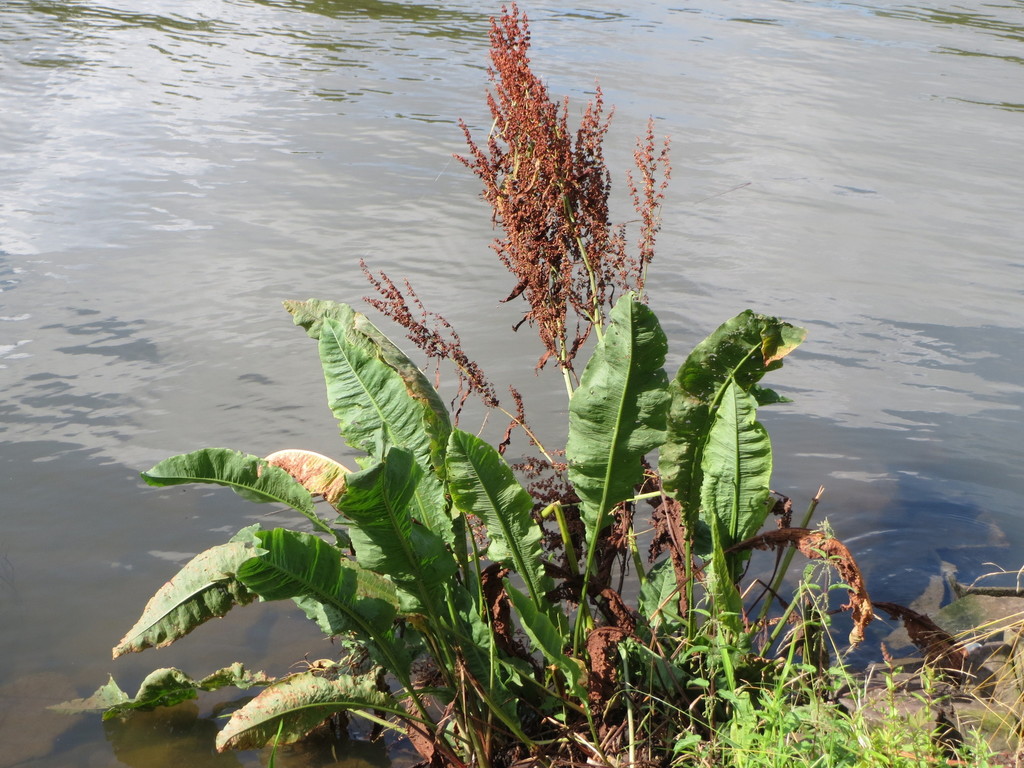
Water Dock
Rumex hydrolapathum
Rumex hydrolapathum, the great water dock, water dock, or giant water dock, is a species of perennial herbaceous plants in the genus Rumex native to fens and freshwater banks of Europe and Western Asia. It is the tallest species in the genus, with flowering stems attaining a height of up to 2 m (6 ft 7 in). It is one of the small number of decaploid organisms, containing two hundred individual chromosomes.
From the article Rumex hydrolapathum on Wikipedia (CC BY-SA), quoted section by section
Description
Great water dock is a tall perennial plant reaching a height of 2 m (6 ft 7 in). During its first year it has a rosette of long-stalked, hairless leaves with lanceolate leaf blades up to 80 cm (31 in) in length. These have smooth margins and are generally unwrinkled. These leaves are large and taper at both ends, and their lateral veins are at right angles to the midrib. In subsequent years it produces an upright flowering stem, unbranched until the base of the inflorescence. The stem is tough, grooved, green when young but turning reddish with age. Leaves growing on the stem are alternate, arching and decreasing in size higher up the stem. The inflorescence is a compound raceme. The numerous small flowers are regular, with the perianth segments in two whorls of three, the outer whorl spreading and the inner one covering the developing fruits. There are six stamens, three fused carpels and three styles. The fruit is a triangular–ovate achene, at first green then brown. This plant flowers from June to September.
Range & habitat
The great water dock is a native of Europe and western Asia. It grows beside lakes and rivers and the sea. It is usually close to the margin of the water line or growing in shallow water. Its distribution affects the distribution of the large copper butterfly. When the Norfolk fens were drained in the 19th century the loss of the great water dock led to the local extinction of the large copper.
Wikipedia: “Distribution and habitat”
Where it lives
Recorded sightings
—
geo-referenced records in GBIF, from museums, herbaria and field observers.
Drag the globe to turn it. Dots are where records exist, not a range map; darker means more records.
In the old herbals & bestiaries

In the stacks
Searching the stacks…
Every page naming Rumex hydrolapathum in the Biodiversity Heritage Library →
This page is assembled live from iNaturalist, GBIF, Wikipedia, the Source Library and the Internet Archive. It is not yet part of the hand-edited codex. iNaturalist taxon 371574.