- Plants
- ›Vascular Plants
- ›flowering plants
- ›monocots
- ›grasses, sedges, cattails, and allies
- ›grasses
- ›Pooideae
- ›Lygeeae
- ›Lygeum
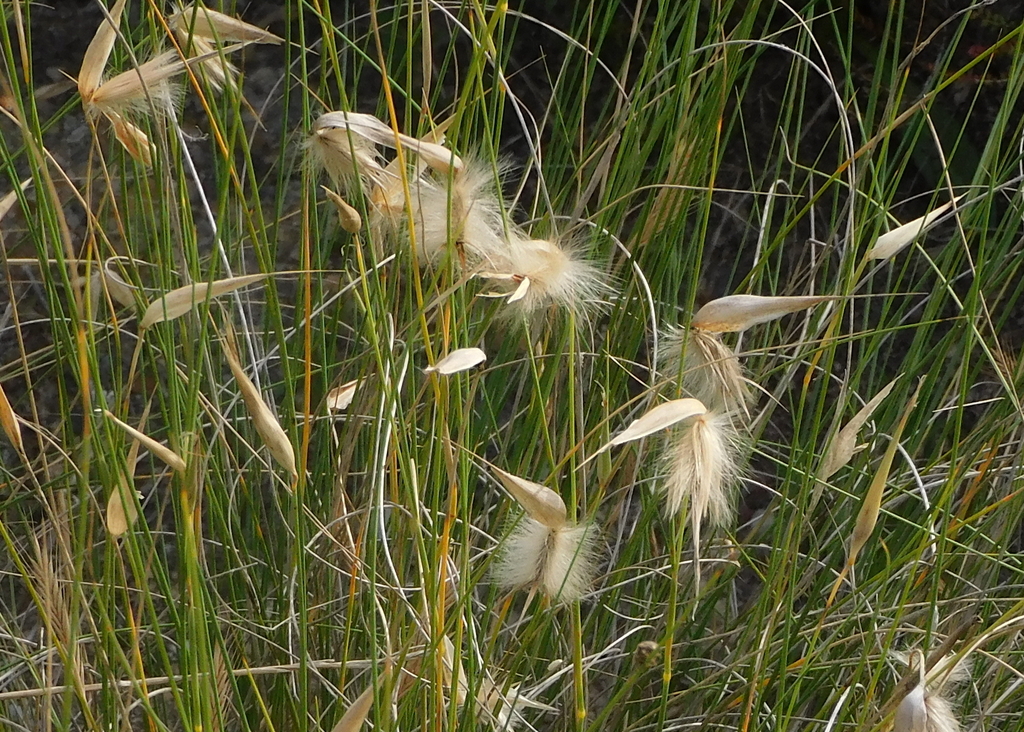
albardine
Lygeum spartum
Lygeum is a genus of Mediterranean plants in the grass family. It is placed in its own tribe Lygeeae, which is sister to Nardeae.
The only known species is Lygeum spartum, commonly called esparto grass, cord grass or albardine, which is distributed in arid areas around the Mediterranean Sea. It is similar in appearance to Macrochloa tenacissima and both species are used to produce a fibre product known as esparto or esparto grass.
From the article Lygeum on Wikipedia (CC BY-SA), quoted section by section
Description
Lygeum spartum is a rhizomatous hermaphroditic, perennial grass growing up to 75 centimetres (30 in) tall. The rhizome and the base of the stem are scaly. The leaves are threadlike but stiff and tough, measuring up to 50 centimetres (20 in) long. The inflorescence is made up of a few long-haired spikelets each up to 4.5 centimetres (1+3⁄4 in) long. They are wrapped in a lance-shaped bract called a spatheole. This sheath is 3 to 9 centimetres (1+1⁄6 to 3+7⁄12 in) long and can have a sharp point.
Range & habitat
Lygeum spartinum is native to southern Europe and North Africa, where its distribution includes Crete, Italy, Spain, Algeria, Egypt, Libya, Morocco, and Tunisia. It may have been introduced to Kashmir.
Wikipedia: “Distribution”
At the table
Lygeum spartum fibres have high tensile strength and flexibility, and is used for making ropes, sandals, baskets, mats and other durable articles. They have also used in the manufacture of high quality paper. It can also be used locally as a fodder for livestock and to stabilise sand dunes and rehabilitate salt soils, due to its tolerance of saline conditions.
== References ==
Wikipedia: “Uses”
Where it lives
Recorded sightings
—
geo-referenced records in GBIF, from museums, herbaria and field observers.
Drag the globe to turn it. Dots are where records exist, not a range map; darker means more records.
In the stacks
Searching the stacks…
Every page naming Lygeum spartum in the Biodiversity Heritage Library →
This page is assembled live from iNaturalist, GBIF, Wikipedia, the Source Library and the Internet Archive. It is not yet part of the hand-edited codex. iNaturalist taxon 371871.