- Animals
- ›Chordates
- ›Vertebrates
- ›Reptiles
- ›Turtles and Tortoises
- ›Pond and Box Turtles
- ›Deirochelyine Turtles
- ›Graptemys
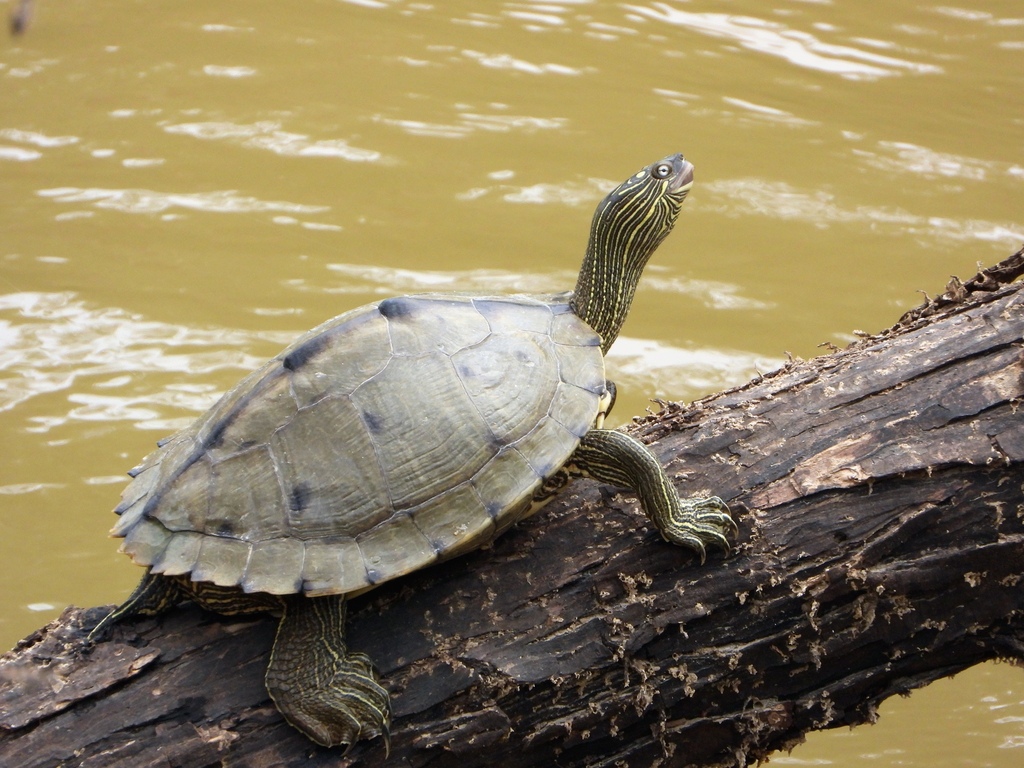
Sabine Map Turtle
Graptemys sabinensis
The Ouachita map turtle or Sabine map turtle (Graptemys ouachitensis) is a species of turtle endemic to the United States.
From the article Ouachita map turtle on Wikipedia (CC BY-SA), quoted section by section
Description
This species' carapace features a row of low vertebral spines, and is serrated on the posterior rim. The carapace is olive, dark brown, or black in coloration with light yellowish markings with dark borders. The plastron color varies from cream to yellow and is patterned with dark lines and swirls. The body color is grayish brown to blackish and is marked with yellowish stripes. On the head, it has light yellow spots: a rectangular one behind each eye, an oval under each eye, and a round one on each side of the jaw. In some specimens, the spot behind and the spot under the eye can combine to form a single thick "C" stain. The eye has a black stripe in the middle. Males are significantly smaller than females. The males can grow to be as large as 5 in (13 cm) in carapace length. The females can grow to be up to 10 in (25 cm) in carapace length.
Range & habitat
This species is endemic to the United States. It can be found in Texas, Louisiana, Mississippi, Alabama, Oklahoma, Kansas, Arkansas, Missouri, Iowa, Minnesota, Wisconsin, Indiana, Ohio, West Virginia, Illinois, Tennessee and Kentucky. G. o. sabinensis exists only in the Sabine River of Louisiana and Texas. Both G. o. ouachitensis and G. o. sabinensis are freshwater riverine turtles. The G. o. ouachitensis is rarely seen on land unless it is nesting season or it is basking.
Wikipedia: “Distribution”
What it does
Ouachita map turtles feed mainly on small aquatic animals such as shrimp, insects (such as mayflies, caddisflies, beetles, grasshoppers, fly larvae, and midge larvae), molluscs, fish, and fish carrion. They also consume algae and aquatic plants (such as pondweed, duckweed, and manna grass).
Wikipedia: “Diet”
In human culture
Hatchlings of this species have recently been found to make sounds prior to exiting the nest. These are mostly "clicking" noises, but more tonal "mewing" sounds are also sometimes present. These sounds are the first documented for any North American hatchling turtle.
Wikipedia: “Natural history”
Where it lives
Recorded sightings
—
geo-referenced records in GBIF, from museums, herbaria and field observers.
Drag the globe to turn it. Dots are where records exist, not a range map; darker means more records.
In the stacks
Searching the stacks…
Every page naming Graptemys sabinensis in the Biodiversity Heritage Library →
This page is assembled live from iNaturalist, GBIF, Wikipedia, the Source Library and the Internet Archive. It is not yet part of the hand-edited codex. iNaturalist taxon 371941.