- Plants
- ›Vascular Plants
- ›flowering plants
- ›monocots
- ›gingers, bananas, and allies
- ›Gingers
- ›Zingiberoideae
- ›Zingibereae
- ›Zingiber
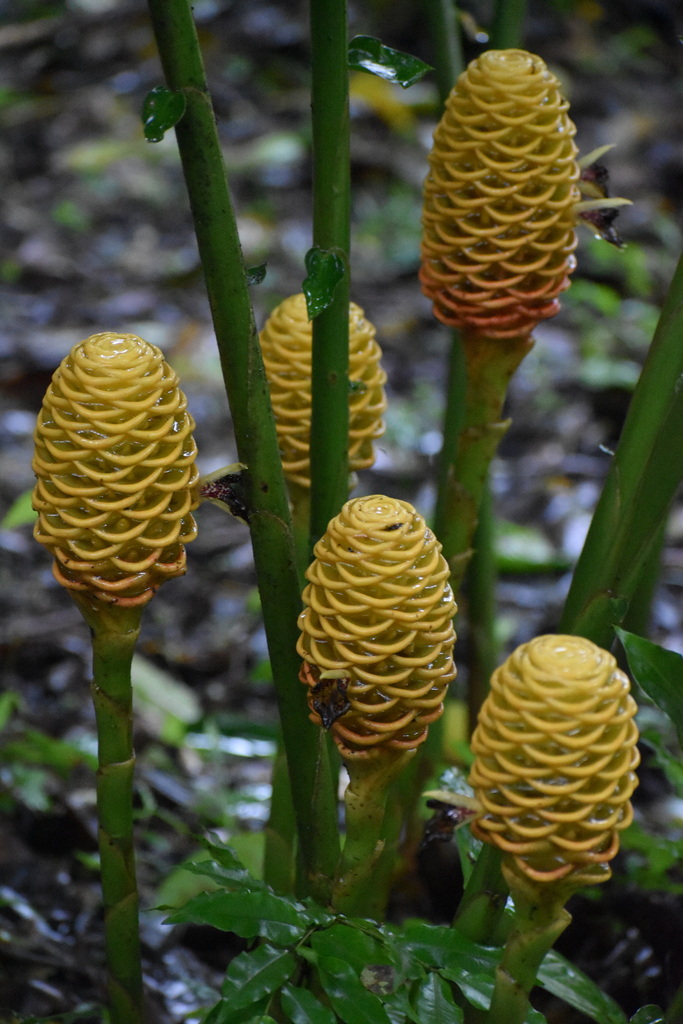
beehive ginger
Zingiber spectabile
Zingiber spectabile is a species of true ginger, native to Maritime Southeast Asia. It is primarily grown in the West as an ornamental plant, although it has been used in South-East Asia as a medicinal herb.
From the article Zingiber spectabile on Wikipedia (CC BY-SA), quoted section by section
Description
In common with most plants in genus Zingiber, the leaves of the plant are long and mostly oblong shaped, tapering to a single point at their tip. Under ideal circumstances, the plant can reach a height of 4.5 metres (15 ft), or even more. The plant's inflorescence is set atop a spike and can measure up to 30 centimetres (12 in) in height. The bracts attached to the structure can differ in colour, from white, to yellow, orange, or even red, often darkening as the bracts mature and develop. The flowers themselves are small, with purple petals and yellow spots, and a fragile, papery texture.
At the table
In Indonesia, the plant has been used in traditional medicine to treat inflammation of the eyes. It is prepared for use by pounding the leaves of the plant into a thick paste, and then topically applying it to the required part of the body. It has also been recorded being used to treat burns, as a treatment for headaches and back pain, and as an agent for food preservation. Academic research has found that the plant has antimicrobial properties, and significant concentrations of the Zerumbone synthase enzyme, which may be effective in treating colon cancer.
== References ==
Wikipedia: “Uses”
Where it lives
Recorded sightings
—
geo-referenced records in GBIF, from museums, herbaria and field observers.
Drag the globe to turn it. Dots are where records exist, not a range map; darker means more records.
In the stacks
Searching the stacks…
Every page naming Zingiber spectabile in the Biodiversity Heritage Library →
This page is assembled live from iNaturalist, GBIF, Wikipedia, the Source Library and the Internet Archive. It is not yet part of the hand-edited codex. iNaturalist taxon 372652.