- Fungi Including Lichens
- ›Basidiomycete Fungi
- ›Higher Basidiomycetes
- ›Mushrooms, Bracket Fungi, Puffballs, and Allies
- ›Agaricomycetidae
- ›boletes and allies
- ›boletes
- ›Suillelloideae
- ›Butyriboletus
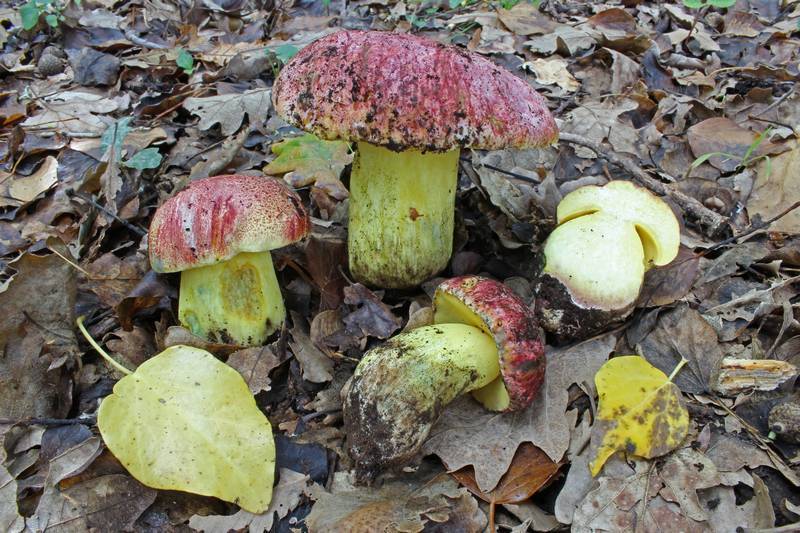
Royal Bolete
Butyriboletus regius
Butyriboletus regius (formerly Boletus regius), commonly known as the royal bolete or red-capped butter bolete, is a basidiomycete fungus of the genus Boletus found in China, Europe, and North America. B. regius has a pink cap, yellow flesh, and a reticulate pattern on the stem. Harry D. Thiers described a similar mushroom from California as B. regius, although it has yet to be shown to be the same species. B. regius in Europe does not stain when exposed to...
From the article Butyriboletus regius on Wikipedia (CC BY-SA), quoted section by section
Description
The caps are convex or flat, reaching a diameter of 6–20 cm (2+1⁄4–7+3⁄4 in) wide. The cap surface is pink to red, occasionally with hints of yellow or brown, more so around the margin. Initially velvety to slightly tomentose (hairy) when young, these minute hairs tend to slough off with age, and the cap develops wrinkles and pits. The cap flesh is yellow, usually slowly and erratically bruising blue in North American specimens. In Europe, it does not stain when exposed to air or stains weakly. The pores on the underside of the cap are angular and measure about 1–2 per millimetre. The color of the pore surface is bright yellow to start, but eventually darkens somewhat, and will stain blue with damage. The depth of the tubes comprising the pores extends to 0.8–2.5 cm (1⁄4–1 in). The stem measures 5–14 cm (2–5+1⁄2 in) long and 2.5–6 cm (1–2+1⁄4 in) thick, typically with a thick, bulbous base. It is solid (i.e., not hollow), and a bright yellow color, often with reddish tones, particularly near the base of the stem. The stem surface can be covered with fine yellow reticulations either throughout its length, or just on the upper portion. The spore print is olive-brown. …
Range & habitat
Butyriboletus regius is an ectomycorrhizal species with a broad host range, associating with oak and conifers, especially fir. The fruit bodies grow singly, scattered, or grouped together. In North America, they usually appear from August to November, although they also appear between May and June. The North American distribution includes the Pacific Northwest states of California, Oregon, and Washington, where its frequency of occurrence ranges from "rare to locally abundant". It is rare in Europe, appearing on the Regional Red List of several countries and being considered endangered in the Czech Republic. The species has also been recorded from China.
Wikipedia: “Habitat and distribution”
At the table
Both European and California species are considered choice edibles, but the latter can be maggot-infested.
Wikipedia: “Uses”
Where it lives
Recorded sightings
—
geo-referenced records in GBIF, from museums, herbaria and field observers.
Drag the globe to turn it. Dots are where records exist, not a range map; darker means more records.
In the stacks
Searching the stacks…
Every page naming Butyriboletus regius in the Biodiversity Heritage Library →
This page is assembled live from iNaturalist, GBIF, Wikipedia, the Source Library and the Internet Archive. It is not yet part of the hand-edited codex. iNaturalist taxon 372725.