- Plants
- ›Vascular Plants
- ›flowering plants
- ›Dicots
- ›Mints, Plantains, Olives, and Allies
- ›mazus family
- ›Mazus
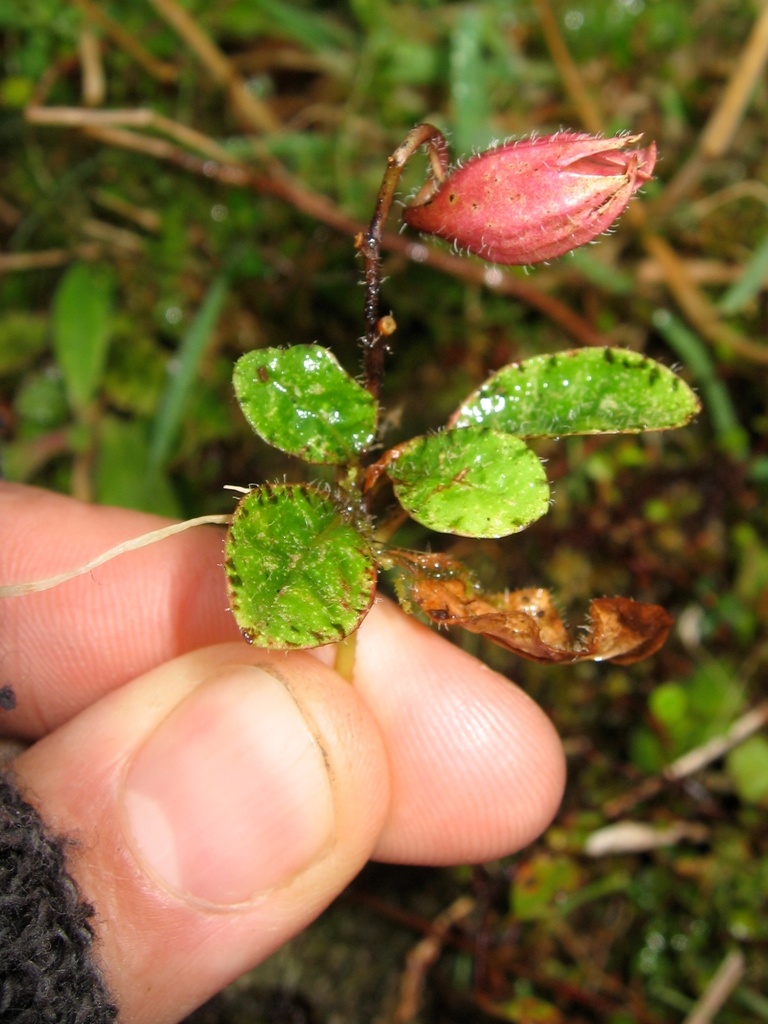
Swamp Musk
Mazus radicans
Mazus radicans is a low-growing perennial plant endemic to New Zealand. It is generally found in damp habitats in sub-alpine regions of New Zealand. The leaves are up to 5cm long, simple and variably hairy to glabrous. Flowers are borne from one to three on a peduncle close to the ground. Each flower has an upper lip which is deeply divided and a lower lip clearly divided into three lobes. The flower is white overall with...
From the article Mazus radicans on Wikipedia (CC BY-SA), quoted section by section
Description
M. radicans is a small, creeping wetland herb which is native to New Zealand. It has prostrate main branches rooting at nodes. The lateral branches are short and leafy with distinctive internodes on leaf-bearing or subterranean and horizontal branches. Leaves are a brownish colour. The petiole is 3–70 mm (0.12–2.76 in) long and has membranous wings lined on each side. Leaves are obovate or elliptic or more broadly, about 5–35 mm (0.20–1.38 in) by 4–15 mm (0.16–0.59 in). The base of leaves is gradually small and blade margin is slightly undulate to serrate and broad-acute to rounded at apex. Margins have soft hairs. Inflorescences are usually on a terminal of the short lateral branches, with 15–130 mm (0.59–5.12 in) long flowers. Pedicels usually lack bracts and fall off early. Bracteoles are the same size and shape, which alternate along pedicels about 3–35 mm (0.12–1.38 in). The lower bracteole buds occasionally, and are 2.5–7 mm (0.098–0.276 in) long and a little hairy. Its calyx is about 3–7.5 mm (0.12–0.30 in) long with purple flowers. Externally, it is white with purple flesh; the internal flesh is deep purple. It has a white and yellow lip. The lower lip has rounded lobes, that are glabrous apart from the palate. The length of the tube is twice that of the calyx. The upper lip is about 4–8.5 mm (0.16–0.33 in) long and has capsule fruit that does not fall off. …
Range & habitat
It is a common wetland weed on the South Island. It can be seen in damp places such as wild wetland and swamp. As an endemic species in North Island, it appears in Awanui near Kaitaia, Hautai Beach and Waipapa Stream near East Cape. It survives in higher regions in New Zealand up to 100–1100 m above sea level. It occurs in alpine regions up to 1,200 m (3,900 ft) from Mt Egmont\Taranaki and the Huiarau Ranges southwards to Fiordland.
Wikipedia: “New Zealand range”
What it does
M. radicans is a perennial or annual herb. It usually has a flower from November to March in New Zealand. The flowering time is in summer. In autumn, fruits mature, but do not fall off the plant. Fresh seeds are easy to germinate and the best environment for its reproduction is permanently moist or badly drained earth under the shade, which is a good ground shelter. The flowers are pollinated by bees.
== References ==
Wikipedia: “Life cycle”
Where it lives
Recorded sightings
—
geo-referenced records in GBIF, from museums, herbaria and field observers.
Drag the globe to turn it. Dots are where records exist, not a range map; darker means more records.
In the stacks
Searching the stacks…
Every page naming Mazus radicans in the Biodiversity Heritage Library →
This page is assembled live from iNaturalist, GBIF, Wikipedia, the Source Library and the Internet Archive. It is not yet part of the hand-edited codex. iNaturalist taxon 381108.